Search All Site Content
Total Index: 6911 publications.
Subscribe to our Mailing List!
Sign up for our mailing list to keep up to date on all the latest developments.
The Peninsula
U.S.-South Korea Relations in 2026: Key Issues to Watch
Published February 2, 2026
The U.S.-South Korea relationship underwent profound changes in 2025 due to a myriad of factors, including new leadership, protectionist trade policies, and continued volatility on the Korean Peninsula and across the Indo-Pacific. As both countries grapple with new realities in the bilateral relationship, Seoul faces the challenge of strengthening alliance credibility while expanding strategic autonomy in a more contested regional environment. President Lee Jae Myung’s ambitious domestic reform agenda and pragmatic foreign policy orientation collide with shifts in U.S. domestic priorities and the Donald Trump administration’s expectations for greater allied responsibility under the 2026 National Defense Strategy.
Below, KEI experts compiled and analyzed the key issues to watch in 2026. We examine the Lee administration’s domestic policy agenda and its impact on economic competitiveness, the mechanics of alliance modernization and burden-sharing, prospects for U.S.-North Korea engagement, South Korea’s push to achieve developed-market status, the evolving U.S.-South Korea trade and investment relationship under the shadow of tariff uncertainty, and South Korea’s ambitions for AI leadership in the new year.
The Lee Jae Myung Administration’s Domestic Reform Priorities
In a meeting with senior secretaries and advisors in November 2025, South Korean President Lee outlined his domestic reform agenda, emphasizing the regulatory, finance, public, pension, education, and labor sectors. President Lee highlighted the need to pursue structural reform as the primary means for facilitating a sustained economic growth rate and avoiding the “low-growth trap” affecting other leading economies. With the ruling party holding a majority in the National Assembly and a steady approval rating of around 60 percent, Lee possesses both the support and bandwidth to pursue his reform agenda. Both conservatives and progressives have expressed confidence that the Lee administration can produce tangible results in the outlined areas, underscoring the need for the government to maintain political stability and public support as it implements its reforms.
However, the pursuit of institutional reform has plagued past administrations in South Korea, particularly when the motivations for reform are seen as political rather than in the national interest. In addition, the speed and nature of reform are often called into question, and personal scandals within the government deplete the political capital and momentum needed to pass necessary legislation. The Moon Jae-in administration’s pursuit of prosecution reform as a top domestic priority was challenged throughout President Moon’s five-year tenure, facing strong opposition from the conservative party and polarized public opinion over involved personnel. The previous Yoon Suk Yeol administration’s pursuit of labor reform faced backlash from key union groups and the public, leading to numerous union strikes against the government’s proposed policies and the eventual loss of momentum and public confidence surrounding certain policy agendas. To avoid a similar fate of reform policies becoming a lightning rod for public criticism or political backlash, it is critical for the Lee administration to enact its desired structural reform in a manner that ensures both public buy-in and tight internal coordination across the bureaucracy.
In anticipation of the inevitable challenges that come with institutional reform, President Lee stated, “Just as transformation requires discomfort, our society cannot move in a better direction or correct irrationalities without some degree of conflict and resistance. Only by enduring that struggle does real change occur.” Whether the Lee administration can strike the right balance between consensus and transformation and address public concerns in a transparent manner will determine the South Korean government’s success in addressing deep-rooted inefficiencies across critical sectors and pushing forward tangible resolutions.
The Lee Jae Myung Administration’s Pragmatic Foreign Policy
Under the Lee administration, foreign policy rhetoric is increasingly framed around prioritizing national interest, pragmatic diplomacy, and enhancing strategic autonomy rather than rigid bloc politics. The Ministry of Foreign Affairs has repeatedly described its guiding principle as “pragmatic diplomacy” that protects South Korean interests, alongside a push for “everyday, business-focused diplomacy.” Many in Seoul view 2026 as a year to widen the country’s maneuverability in a more volatile regional order without signaling a departure from the U.S.-South Korea alliance.
With regard to the United States, pragmatism will mean doubling down on deterrence and advanced defense capabilities while navigating tougher conversations on burden-sharing and alliance modernization. The United States is signaling a shift toward a more limited U.S. role in deterring North Korea, with South Korea expected to shoulder greater defense responsibilities. This trend is paired with deeper cooperation on specific capabilities such as nuclear-powered submarines, as well as renewed debate over OPCON transfer and command arrangements. Together, these shifts point to an alliance in transition, with South Korea assuming greater responsibility for deterrence and the United States adopting a more flexible strategic posture in the Indo-Pacific.
On China and Japan, expect compartmentalization: maintaining the U.S. alliance as the backbone of South Korean national security while resisting pressure to choose sides in U.S.-China competition and steadily rebuilding practical cooperation with Japan. Lee’s approach toward China emphasizes “maximum flexibility,” seeking to stabilize ties with China through strategic autonomy and selective cooperation even as security coordination with the United States continues. At the same time, the Lee administration is likely to institutionalize a “new normal” of cooperation with Japan to reduce political vulnerability while expanding practical coordination. These efforts have been supported by active summit diplomacy aimed at keeping Seoul’s regional options open.
North Korea is where pragmatism faces its hardest test. Lee’s instinct appears to be crisis prevention paired with calibrated engagement, yet Pyongyang remains hostile, largely ignoring outreach while leaning further into its “two hostile states” narrative and coercive signaling. The January drone incidents underscored how quickly tensions can escalate, with Lee warning that unauthorized flights into North Korean airspace could amount to war-provoking behavior.
Taken together, 2026 is likely to be defined by careful diplomatic balancing, as Seoul strengthens its alliances while expanding strategic flexibility in a more contested regional environment. Pragmatism, rather than ideological alignment, will remain the guiding logic shaping South Korea’s foreign policy choices.
The 2026 U.S. National Defense Strategy and Expectations on South Korea
The 2026 U.S. National Defense Strategy envisions a U.S. strategy that is less focused on coalition-building, development, and prosperity in the Indo-Pacific as part of a values-driven U.S.-China competition, and more focused on deterring Chinese aggression through peace through strength.
To achieve this objective, the National Defense Strategy imposes a rigorous, sparing prioritization of China-centered deterrence by denial while requesting that allies take greater responsibility for their own defense. For South Korea, the most significant aspect of this revised strategy is that the United States expects South Korea to do more to defend itself against external threats, including North Korea and China. Under this framework, South Korea will continue to enhance its own autonomy in the defense sphere while minimizing the potential for conflict within the U.S.-South Korea alliance. At the same time, South Korea has an increasingly important role to play in the strengthening of the U.S. defense industrial base as a critical partner and technology provider.
Prior to the release of the strategy, the main bureaucratic vehicle for pursuing a revamped U.S.-South Korea strategy was “alliance modernization.” As part of this conversation, South Korea provided reassurances to the United States regarding its willingness to raise defense spending, take a greater role in deterring North Korea, and provide support for the maintenance of peace across the Taiwan Straits. In the course of the development of the National Defense Strategy, South Korea came to be referred to as a “model ally,” suggesting that the U.S.-South Korea alliance had already evolved to encompass a regional deterrence framework, rather than being solely focused on deterrence on the Korean Peninsula.
The 2026 National Defense Strategy prioritizes hemispheric defense and China-based deterrence but says less about Indo-Pacific strategy than previous national defense strategies, including those pursued in the first Trump administration. As a result, South Korea’s 2022 Indo-Pacific strategic framework will receive less attention, and South Korea will therefore be free to pursue its own defense and security relationships with Southeast Asia with less consideration for U.S. framing and priorities. However, the task of coordinating respective defense and security priorities toward China will remain important for “alliance modernization,” even as the Lee administration attempts to further stabilize South Korea-China relations in 2026.
U.S.-North Korea Relations in the New Year
Despite U.S. President Donald Trump’s repeated calls for a summit with North Korean leader Kim Jong Un in 2025, U.S.-North Korea relations entered the new year with a continued standoff between the two countries. In early January, North Korea strongly criticized the U.S. military operation in Venezuela, calling it “the rogue and brutal nature of the U.S.” and “the most serious form of encroachment on sovereignty and [a] wanton violation of the UN Charter and international laws.” During U.S. Under Secretary of Defense for Policy Elbridge Colby’s travel from South Korea to Japan in late January, North Korea test-fired two ballistic missiles toward the East Sea, vowing to increase its nuclear deterrent.
Yet speculation persists about a possible reengagement between Trump and Kim in 2026. Media and pundits suggest that spring could be the most likely window for a bilateral summit, as Trump is scheduled to visit Beijing in April. In this scenario, Trump could stop by South Korea to meet Kim at the demilitarized zone (DMZ). Alternatively, a Trump-Kim summit could take place after the China trip to avoid overshadowing the summit between Trump and Chinese leader Xi Jinping. If past precedents hold any predictive value, one possible indicator that the Trump-Kim summit is underway would be a Xi-Kim summit meeting in May or later, recalling that Kim met with Xi before meeting Trump in both 2018 and 2019.
While there is considerable unpredictability regarding both Trump and Kim, the prospect of a near-term breakthrough in the current U.S.-North Korea deadlock appears increasingly bleak. With the Ukraine peace talks at a standstill over the status of occupied Ukrainian territories, the North Korea-Russia strategic partnership will continue to make Kim see little need to engage in dialogue with the United States. More significantly, a series of U.S. military operations in Iran and Venezuela—for example, a military attack on Iranian nuclear facilities in 2025, the arrest of Venezuelan President Nicolas Maduro, and the dispatch of a “massive armada” to Iran in January 2026—has undoubtedly heightened Kim’s fears regarding regime survival and hardened his grip on his nuclear deterrent, motivating him to reject U.S. overtures for dialogue.
What deserves attention going forward is how North Korea will perceive the growing ambiguity surrounding the Trump administration’s denuclearization policy and the U.S. push for burden-sharing and strategic flexibility of U.S. Forces Korea (USFK) on the peninsula amid a shift in U.S. focus to the mainland and the Western Hemisphere. If Kim sees the confluence of these developments as a waning U.S. security commitment to South Korea or a decoupling of its security from that of South Korea, there is a danger that North Korea will recalibrate its strategic calculus. Kim could decide to seize a U.S.-North Korea dialogue as an opportunity to drive a wedge between the United States and South Korea and create a rupture in the alliance. A strong, clear U.S. nuclear deterrence commitment to South Korea is critical at this moment to preempt North Korea’s miscalculation and adventurism.
South Korea’s Stock Market and Regulatory Efforts
President Lee has vowed to resolve the “Korea Discount”—the relative undervaluation of the South Korean stock market compared to its peers in the Indo-Pacific. The bulk of this work lies in enacting and stewarding reforms in corporate governance and market accessibility. A range of measures is required to help push forward South Korea’s accession to MSCI’s developed market status. Such a distinction would mark a major breakthrough in addressing the Korea Discount.
MSCI’s most recent Market Classification Review acknowledged South Korea’s recent stock market reforms, such as improved foreign investor access, increased availability of investment instruments, and relief of the country-wide short-selling ban. Nevertheless, the report dictated that the country would spend at least another year on its emerging market list while it assessed South Korea’s overall market stability amid its broad deployment of regulatory changes. The country already fulfilled the requirements for economic development and size and liquidity for developed market classification status—market accessibility is the third and final factor standing in the way of full reclassification. Market accessibility requires greater ease of access for foreign investors, greater availability of investment instruments, and particularly fewer constraints on foreign exchange trading for the won.
Reforms to the South Korean financial system need to be in place for the duration of a monitoring period for reclassification, after which MSCI would move the country to a developed market “watch list” on an interim basis. Some existing reforms are likely to weigh in favor of this. The debut of an alternative trading system (ATS) through the Nextrade exchange in March 2025, for instance, helped better align trading hours with international markets, expand the availability of investment instruments, and spur the Korea Exchange to make similar reforms.
The Lee administration appears resolute in making the final changes to improve market accessibility to get into the MSCI Developed Markets list—a major psychological feature of the Korea Discount sobriquet. In an attempt to improve foreign investors’ access, President Lee announced plans to establish twenty-four-hour trading for the won, beginning in July 2026. The Lee administration has also been proactive in amending provisions to the Commercial Act to add shareholder protections aimed at improving South Korea’s overall corporate governance structure. And most recently, on January 9, the Ministry of Economy and Finance published a targeted policy document to execute on the administration’s comprehensive plans to achieve developed-market status, including greater foreign trading access for the won. The MSCI will review these reforms in June 2026, during which South Korea could be placed on the official watchlist for developed market status, allowing full inclusion in June 2027.
Ongoing regulatory efforts to improve corporate governance and anticipation surrounding the Lee administration’s expected market changes, alongside South Korean tech companies’ roles in supporting the global AI transition, have already pushed the KOSPI index to a 5,000-point record, with even larger valuations projected through the end of the year. The intense performance of the South Korean stock market, combined with the high likelihood of achieving developed-market status, could make 2026 the year investors begin to shed the country’s association with the Korea Discount. Few indicators would more clearly capture the pace of South Korea’s economic ascent.
Tariffs and the U.S.-South Korea Trade Relationship
For decades, the United States and South Korea had assumed that free trade would guarantee South Korea’s stable access to the U.S. market. South Korean companies establishing production in the United States also assumed steady access to imported components and skilled labor from South Korea. These assumptions are starting to weaken. Global value chains (GVCs) are getting costlier and riskier due to tariffs, shifting the main economic dynamic of the relationship from one focused on trade to one centered around corporate investment decision-making. Accordingly, to understand the U.S.-South Korea economic relationship today, it is important to look beyond trade data and track where firms are choosing to produce and invest.
In 2025, the Trump administration repositioned the persistent U.S. trade deficit as a structural economic and security challenge under its “America First Trade Policy” and introduced reciprocal tariffs under the International Emergency Economic Powers Act (IEEPA) to address that challenge. Following negotiations between the United States and South Korea, the trade deal set a 15 percent tariff floor on the majority of South Korean-origin goods, except for Section 232 goods such as steel (which is subject to its own 50 percent tariff).
In 2026, South Korean exporters will continue to carry tariff costs, but the scope of trade diversion may be more limited under a relatively consistent tariff environment. For example, as a result of South Korea’s investment fund negotiations, the South Korean automotive industry will compete on a more level playing field with other top auto exporters, such as Japan. As the uncertainty in 2025 highlighted, expanding domestic production in the United States secures a more stable basis for market access. Manufacturing further upstream in the value chain can reduce exposure to policy volatility and provide predictable access to inputs for the significant manufacturing investments that South Korean companies have already made in the United States. In this context, investments become a strategic tool for securing market access by minimizing vulnerability to policy uncertainty and strengthening access to key inputs.
Recent moves by South Korean firms, such as Hanwha Ocean and Korea Zinc, illustrate exactly how this shift is playing out as they build projects in the United States. Their investments are not simply about expanding sales; instead, they focus on building production bases and supply chains within U.S. borders. These moves also align with U.S. national priorities, with Hanwha Ocean tied to the defense industrial base and Korea Zinc tied to critical minerals.
The upcoming U.S. Supreme Court decision related to IEEPA may affect how U.S. universal and reciprocal tariffs are implemented. Even so, the broader policy objective of using trade measures to encourage production and investment in the United States is unlikely to change, as alternative policy tools remain at the president’s disposal. Trade conditions are therefore likely to remain relatively set. For investment, however, the memorandum of understanding (MOU) between the United States and South Korea accompanying the trade deal effectively lowers the cost of capital for South Korean firms investing in the seven strategic industries inside the United States. As a result, rather than trade, the more important shifts in the U.S.-South Korea relationship will come from where investment decisions are made, with the biggest moves likely to come from the defense industry, energy, critical minerals, and AI.
Impact of U.S. Domestic Politics on South Korean Investments
The U.S.-South Korea partnership enters the year ahead with industrial interdependence deeper than ever—and governance risk newly priced into South Korean investment decisions. The immigration raid against the Hyundai metaplant in Georgia late last year revealed a structural tension between Washington’s push for reindustrialization and an immigration enforcement posture that can disrupt allied industrial projects overnight. Short-term damage control restored stability on the surface, but the absence of a durable visa and workforce immigration policy in the new year leaves South Korean firms navigating a U.S. operating environment where political volatility remains a material business risk.
South Korean investment in the United States continues, driven by supply-chain diversification away from China, a tariff floor under evolving trade arrangements, and sustained demand for advanced manufacturing. Hyundai’s decision to expand rather than retreat underscores that U.S. market access still justifies long-term integration. But firms will tighten compliance procedures, rethink travel, and build redundancy into project timelines. Congressional paralysis on visa reform and ongoing hardline enforcement mean workforce mobility remains the critical chokepoint in the partnership’s industrial agenda.
The coming year will determine whether Washington can reconcile immigration enforcement with its industrial strategy before credibility costs accumulate. If coordination improves, the Hyundai raid will fade into a stress test that accelerated institutional adaptation. If not, South Korean firms may begin recalibrating future investment away from maximum U.S. exposure, slowing U.S. reindustrialization momentum. In this phase of the alliance, success will be measured less by summit communiqués than by whether factories open on schedule, visas are issued predictably, and South Korean technical expertise continues flowing into U.S. production lines.
The Future of South Korea’s AI Policy
South Korea has become the first country to enact comprehensive AI sector regulation, with the AI Basic Act coming into effect on January 22, 2026. The speed with which the government has moved to adopt such legislation stems from South Korea’s ambition to become a first mover in emerging technologies, from joining the United States and China in the “AI G3” to becoming the global leader in physical AI by 2030. Some South Korean businesses, however, have raised concerns that the government has moved too quickly, leaving them with little time to prepare and curtailing their ability to innovate.
Ahead of the enactment of the AI Basic Act, the Presidential Council on National Artificial Intelligence Strategy released its AI Action Plan in December 2025. Consisting of ninety-eight tasks to be accomplished before the end of the Lee administration’s term in 2030, the plan calls for significant investment in the build-out of data centers and other key infrastructure, innovation in physical AI—AI models designed for use in robots and autonomous vehicles—and AI talent development projects.
Regulatory reforms serve as the basis of this ramp-up of South Korea’s AI economy, and the government has touted the AI Basic Act as a regulation guided by an “innovation-first” principle, allowing companies to develop AI systems without government approval in a bid to speed up innovation. Exceptions are in place for “high-impact” AI systems used in sensitive fields, such as healthcare, and following a one-year grace period, firms will have to establish methods of risk assessment and monitoring and ensure transparency by watermarking all AI-generated content or face significant fines.
AI safety has been a top priority in the Lee administration’s AI strategy. Last September, President Lee chaired a UN Security Council debate on AI and international security in which he urged the international community to develop “inclusive and human-centric AI” and “compete for national interest while cooperating for the benefit of humankind at the same time.”
Some South Korean companies believe the government has not successfully struck a balance between safety and innovation. Startups in particular are raising concerns that the law’s definition of “high-impact” AI is too vague and encourages them to be risk-averse with their AI development to avoid hefty penalties. Lee has expressed his sympathy for such concerns, and the Ministry of Science and ICT announced the development of a guidance platform and support center for companies to be released during the grace period, though business leaders also fear the timeline for enforcement of the law is too rushed. Clarifying regulatory definitions around AI is also critical to safeguard the influx of AI investment from major U.S. firms and support ongoing joint initiatives with U.S. companies from Amazon Web Services to Intel. Whether the AI Basic Act will serve as the foundation for a thriving AI ecosystem and propel South Korea’s status as a global AI leader and norm-setter will draw considerable attention in 2026.
Authors (in order of authored section): Jennifer Ahn, Program Manager; Yujin Son, Communications Intern; Scott Snyder, President & CEO; Ellen Kim, Director of Academic Affairs; Tom Ramage, Economic Policy Analyst; Soobeen Park, Economic Research Intern; Arius Derr, Director of Communications; and Sebastian Garcia, Program Officer. The views expressed are the authors’ alone.
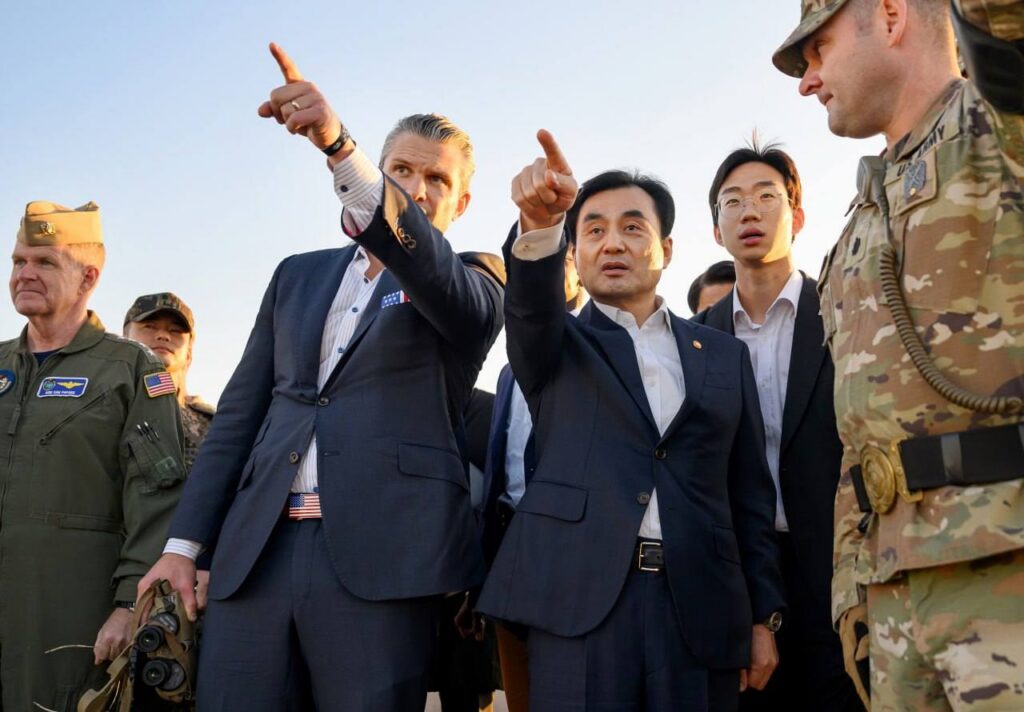
Feature image from the South Korean Defense Ministry.
KEI is registered under the FARA as an agent of the Korea Institute for International Economic Policy, a public corporation established by the government of the Republic of Korea. Additional information is available at the Department of Justice, Washington, D.C.