
Search All Site Content
Total Index: 6943 publications.
Subscribe to our Mailing List!
Sign up for our mailing list to keep up to date on all the latest developments.
The Peninsula
America’s Nuclear Red Line: Trust in Alliances, Not Proliferation
Published November 7, 2025
Author: Yujin Son
Category: Indo-Pacific, U.S. Foreign Policy, US-Korea alliance

On many foreign policy questions, American voters are sharply divided. But on nuclear weapons, a bipartisan consensus still holds. New polling by the Korea Economic Institute of America (KEI) and YouGov shows broad public opposition to letting allies such as South Korea develop nuclear weapons, even as risks from North Korea, Russia, and other countries mount. In short, U.S. voters demonstrate a durable belief that extended deterrence and U.S. alliances remain the most effective tools for safeguarding international security.
The survey shows only 20 percent of Americans support South Korea developing its own nuclear weapons. Other long-standing U.S. allies fare only slightly better, with just 24 percent supporting nuclear development for Australia and Japan. In every case, opposition to allied nuclear proliferation far outweighs support. The data shows that most Americans support alliances, not additional bombs.
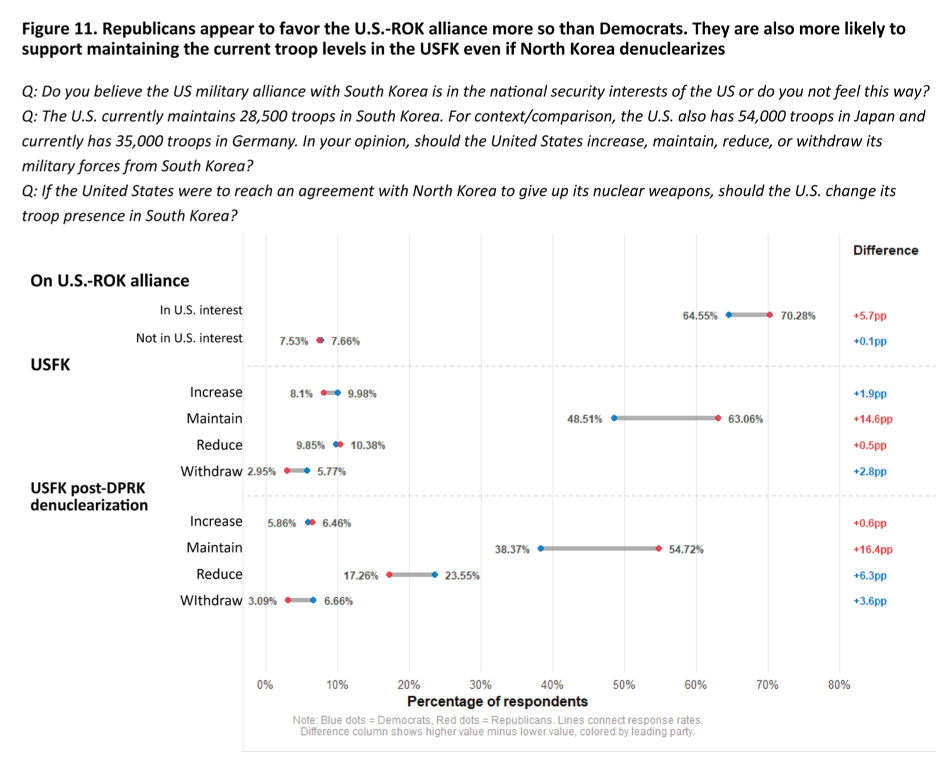
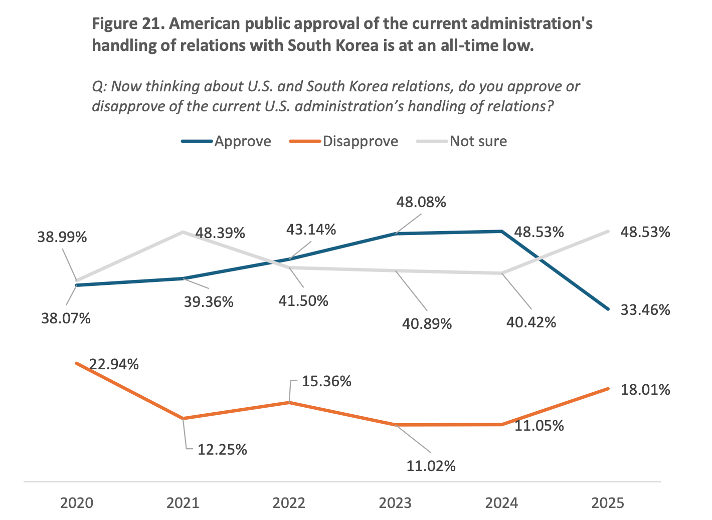
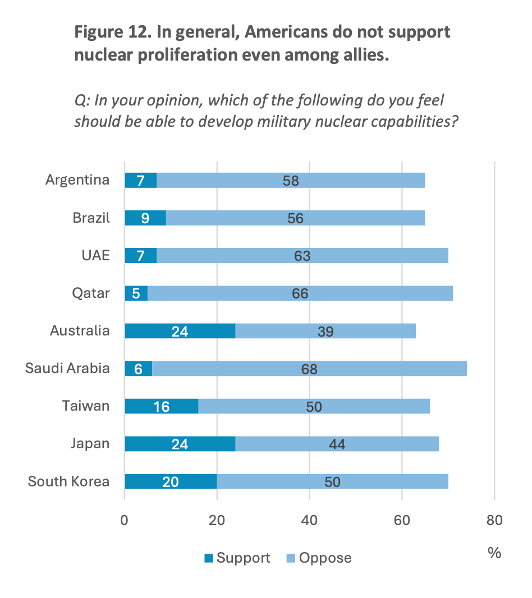 Aversion to nuclear proliferation does not stem from a lack of trust in U.S. partners. On the contrary, 66 percent of Americans hold a favorable view of South Korea. Nearly 63 percent believe the U.S.-South Korea alliance advances U.S. national security interests, and about 60 percent support maintaining or increasing current U.S. troop levels on the Korean Peninsula. Even if North Korea were to denuclearize, 46 percent still favor keeping U.S. forces there. Self-identified Republicans in the survey were even more supportive of the alliance than self-identified Democrats (70 percent in favor versus 65), even though Republicans less supportive of other alliances overall. U.S. voters do not see the alliance as a narrow hedge against North Korea, but as a broader linchpin of Indo-Pacific stability. According to the survey, the alliance itself is the security guarantee—and permitting allies to nuclearize would erode that foundation.
A Divided View Across the Pacific
This contrasts sharply with opinion in South Korea, where public support for a domestic nuclear program has surpassed 70 percent in several polls. South Koreans cite the growing North Korean military threat and doubts about the reliability of the U.S. nuclear umbrella. In contrast, Americans see proliferation, even among allies, as inherently destabilizing and unnecessary when U.S. security commitments remain in place.
This divergence reveals what could be described as a “trust gap.” While South Koreans fear abandonment, Americans fear escalation. One side sees nuclear weapons as insurance; the other sees them as destabilizing the existing order.
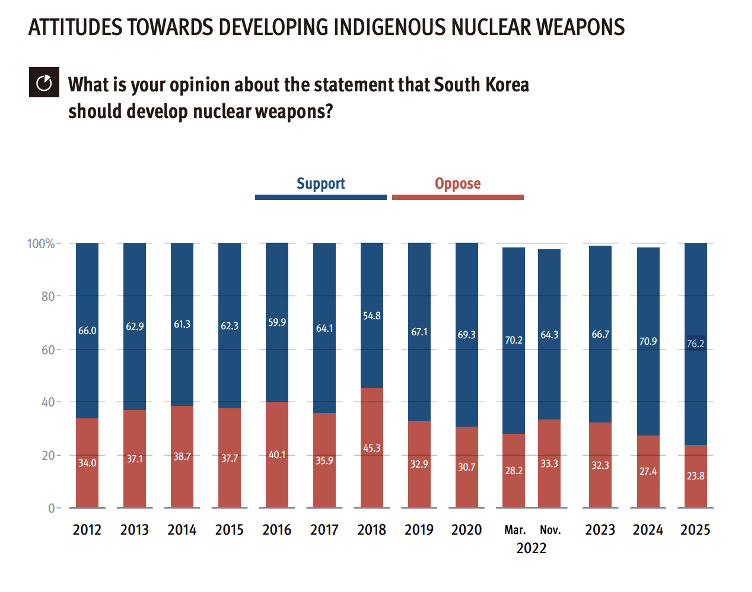
Source: Asan Poll from South Koreans and Their Neighbors 2025
Bipartisan Agreement on Restraint
Nuclear issues stand out as a rare point of bipartisan consensus across the United States. Republicans are more likely than Democrats to favor reforming or reducing U.S. alliances, but both parties share skepticism toward global proliferation. In the 2025 survey, 54 percent of Republicans supported reforming or ending some alliances (compared to 36 percent of Democrats), but majorities in both parties opposed allowing South Korea to develop nuclear weapons. Americans may debate trade, tariffs, and troop deployments, but they agree that more nuclear weapons make the world less secure.
Yujin Son is Communications Intern at KEI. All views presented are the author’s alone.
Feature image from the U.S. Air Force.
KEI is registered under the FARA as an agent of the Korea Institute for International Economic Policy, a public corporation established by the government of the Republic of Korea. Additional information is available at the Department of Justice, Washington, D.C.