
South Korean Firms Are Powering U.S. Energy Storage
Storing electricity is just as critical as the ability to generate it, making battery energy storage systems (BESS) an essential component of power systems.
The rapid expansion of AI data centers and advanced manufacturing is driving up electricity consumption in the United States. Early this year, the U.S. Energy Information Administration (EIA) projected electricity demand growth of 1 percent in 2026 and 3 percent in 2027. This would be the strongest four-year period of electricity demand growth in the United States since 2000. It also projects that, for the first time this year, electricity consumption in the commercial and transportation sectors, which include data centers, will surpass residential consumption.
This demand for electricity makes grid reliability and peak demand management increasingly important. Power systems must continuously balance electricity supply and demand in real time, particularly during periods of high electricity consumption. Simply increasing electricity generation is not sufficient to meet this challenge, as electricity produced during periods of low demand must be available when demand peaks.
Therefore, the ability to store electricity is just as critical as the ability to generate it, making battery energy storage systems (BESS) an essential component of power systems. BESS can stabilize the grid and reduce strain during periods of peak demand by storing electricity when supply is abundant and discharging when demand rises. As demand from AI infrastructure and advanced manufacturing continues to grow, expanding energy storage capacity will become more significant for maintaining grid reliability and supporting economic growth.
Battery Storage Manufacturing Supply Chain
Unlike batteries used in electric vehicles (EVs), most battery energy storage systems use lithium iron phosphate (LFP) graphite batteries—a market sector currently dominated by Chinese firms, as illustrated in Figure 2. In 2025, China accounted for 63.5 percent of U.S. imports of non-EV lithium-ion batteries, compared with 11.4 percent from Korea and 9.7 percent from Japan. According to the International Energy Agency (IEA), China accounts for approximately 80 percent of global lithium-ion battery manufacturing capacity and about 97 percent of global anode material production capacity.
Expanding Investment, Reducing Dependence
Against this backdrop, the United States has introduced a range of policy measures and industrial initiatives aimed at strengthening BESS supply chains across the entire value chain—from critical mineral processing and battery component manufacturing to system assembly and deployment. These efforts seek to reduce dependence on imported battery technologies and materials while enhancing national energy security and supply chain resilience.
Until recently, the Inflation Reduction Act (IRA) was the primary driver of this strategy by providing significant financial incentives for domestic battery manufacturing and energy storage deployment. Section 48E offers investment tax credits for qualifying standalone BESS projects, reducing upfront capital costs and improving project economics. Section 45X provides production tax credits for domestically manufactured battery components and processed critical minerals, incentivizing firms to expand U.S.-based manufacturing capacity. Together, these provisions stimulated substantial investment in domestic battery production and energy storage infrastructure. Although the 2025 “One Big Beautiful Bill Act” removes many of the IRA’s tax provisions, the original 2030 phase-out for the 48E and 45X tax credits survived.
In parallel, Washington’s implementation of the Prohibited Foreign Entity (PFE) rules has further reshaped sourcing and manufacturing strategies for companies serving the U.S. market. Designed to reduce reliance on battery materials, components, and processing linked to entities of concern, the PFE requirements directly affect eligibility for IRA tax incentives. As a result, companies seeking to benefit from these incentives are increasingly expected not only to manufacture within the United States but also to diversify their supply chains away from China and other prohibited foreign entities. Consequently, compliance with domestic content and supply-chain security requirements has become an increasingly important consideration in investment and procurement decisions across the U.S. BESS industry.
These policy and industrial initiatives have accelerated the development of a domestic BESS manufacturing ecosystem in the United States. According to the American Clean Power Association, domestic battery module manufacturing capacity meets current U.S. demand, while domestic battery cell manufacturing capacity is projected to reach demand levels by the end of 2026.
Despite this progress, significant supply chain challenges remain. Many companies that are expanding battery manufacturing in the United States continue to depend on established global supply chains for battery materials and intermediate products. In particular, according to the IEA, a substantial share of global refining and processing capacity for critical battery materials remains concentrated in China. Reducing this dependence will require developing alternative sources of raw materials, intermediate products, and processing capacity.
However, qualifying new suppliers, securing reliable sources of critical minerals, and constructing new refining and processing facilities are time-intensive processes that require significant capital investment and regulatory approvals. These challenges are especially pronounced in upstream segments of the BESS supply chain, such as graphite processing and other critical mineral refining, where domestic capacity remains limited and is likely to require a longer timeframe to establish.
Korean Companies and BESS Manufacturing
As the United States advances the development of a domestic BESS supply chain, Korean companies have adapted to the evolving policy and market environment and have emerged as important contributors to this transition.
LG Energy Solution has indicated that the IRA’s tax incentives have created additional opportunities for suppliers with U.S.-based production capacity, while the implementation of PFE rules has strengthened the competitive position of battery manufacturers with established production and sourcing networks outside China. Other Korean battery manufacturers, including SK On and Samsung SDI, have likewise expanded investments in U.S. energy storage systems, battery manufacturing, and battery materials production.
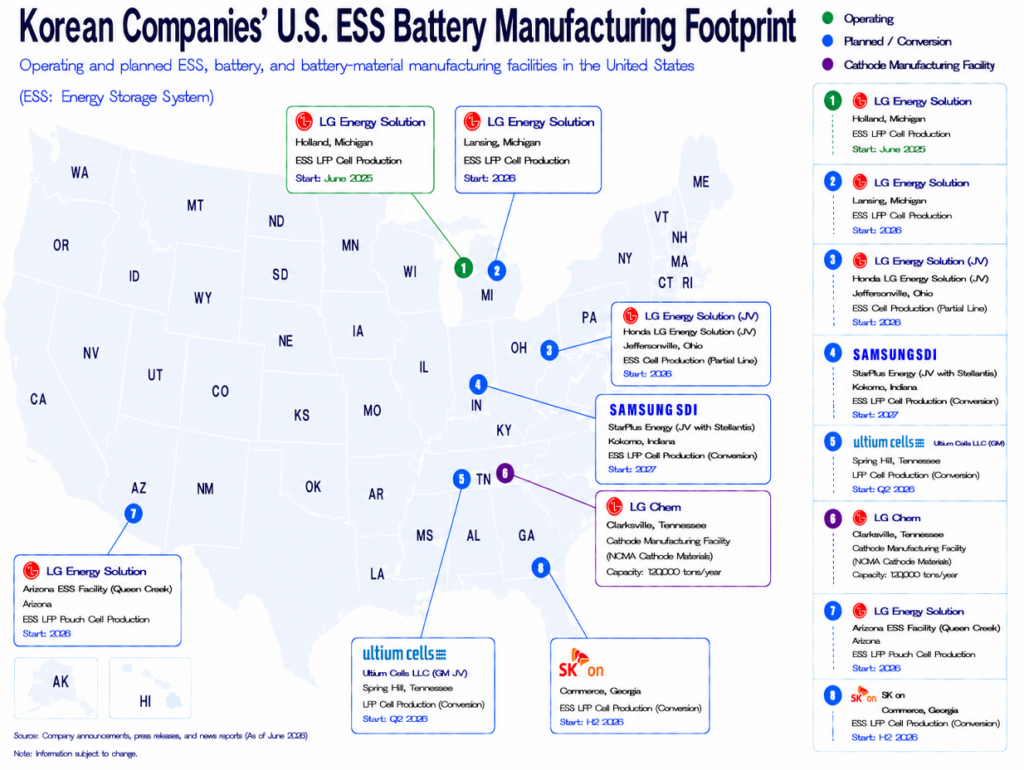
Figure 3 illustrates the broad participation of Korean firms across the U.S. battery and BESS supply chains. Several companies have announced plans to repurpose existing EV battery manufacturing facilities for BESS production. Converting existing manufacturing assets enables companies to expand domestic BESS manufacturing capacity more rapidly and cost-effectively than constructing new facilities. In addition, LG Chem is investing in cathode manufacturing in Clarksville, Tennessee, demonstrating that Korean investment extends beyond battery cell production into midstream battery materials.
Nevertheless, important constraints remain. Although Korean firms are expanding manufacturing capacity in the United States, many of their operations continue to rely on upstream supply chains for critical minerals and battery materials that are heavily concentrated in China. As a result, achieving a fully localized and resilient U.S. BESS supply chain will require continued diversification of upstream material sourcing and further investment in domestic refining and processing capacity, particularly as eligibility for the Section 48E investment tax credits is increasingly conditioned on compliance with the Foreign Entity of Concern restrictions governing ownership structures and the sourcing of certain components and materials.
Figure 3. Korean Battery Companies’ U.S. Manufacturing Footprint
Not Just Where, But How
Domestic BESS manufacturing is now moving in a positive direction to strengthen its supply-chain resiliency and security. However, diversifying supply chains and reducing reliance on imports across the entire value chain, from upstream materials to downstream manufacturing facilities, will require time and careful planning. U.S. industrial policies and incentives should consider business realities, including market conditions, investment risks, and operational challenges associated with onshoring production. To develop effective and sustainable policies, Congress and the Donald Trump administration should continue to engage with industry stakeholders and incorporate their perspectives into the policymaking process.
Soobeen Park was Research Intern at KEI (2025-2026). Hyun Jung “Jessie” Je is Senior Fellow and Director for External Engagement at the Korea Economic Institute (KEI). The views expressed are the authors’ alone.
This material is distributed by KEI on behalf of the Korea Institute for International Economic Policy. Additional information is available at the Department of Justice, Washington, DC.