
South Korea Should Be an Economic Model for Besieged Cuba
Cuba’s recent outreach to South Korea suggests that the island country views Korea as a potential model for state planning and export-driven economics under autocratic conditions.
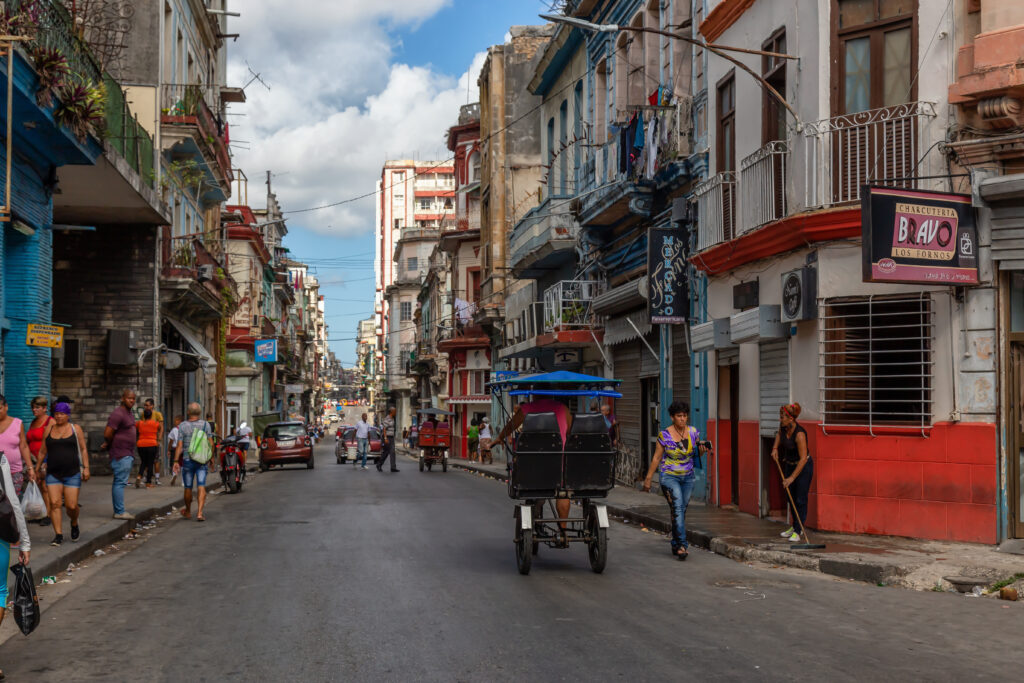
As the United States continues to tighten sanctions against Cuba, the country is looking externally for examples of state-driven economic development to apply back home. Cuba’s recent outreach to South Korea suggests that the island country views Korea as a potential model for state planning and export-driven economics under autocratic conditions. To ensure Cuba does not deepen its economic dependence on revisionist anti-U.S. countries such as Russia and Venezuela, the United States should encourage its allies and partners to support the Cuban economy by carving out exceptions in its sanctions regime for allied assistance and private-sector investments.
In June of this year, the Cuban Embassy in Seoul hosted a seminar on “Business Opportunities in Cuba.” Cuban officials touted the potential bonanza awaiting Korean companies across investment sectors ranging from healthcare and agriculture to tourism. Yet the seminar seemed less like a celebration of opportunity than a sign of desperation by a sanctions-ridden, cash-strapped Cuban government. More importantly, there was an elephant in the room: the recently tightened U.S. sanctions on the communist-ruled island. “The political and economic pressure on Cuba is growing as the United States continues to impose new economic sanctions,” Cuban Ambassador to Korea Claudio Monzón Baez said. “But this does not mean Cuba has no opportunities. Cuba remains a land of opportunity and possibility.”
While the Cuban regime enacts historic economic reforms under U.S. economic pressure and threats of military action, it is also notable that Cuban officials are increasingly looking abroad for examples of state-driven economic development. Recently, Cuba’s ambassador to Hanoi praised Vietnam’s economic development and its hybrid communist-capitalist model. “Vietnam’s socio-economic achievements in recent years have inspired the Cuban people and expressed hope that the two countries would continue sharing experience, particularly lessons from Vietnam’s 40 years of Doi Moi (renewal) process,” Cuban Ambassador Rogelio Polanco Fuentes said during a May 2026 meeting with Vietnam’s prime minister.
But Cuba’s recent establishment of diplomatic relations with South Korea and its ongoing efforts to court Korean investors suggest that Havana sees the country as a potential economic archetype. Korea’s economic development during the 1970s and 1980s was remarkable. Supported by significant state planning and exports, multinational conglomerates such as Hyundai and Samsung drove rapid industrial growth. Relevant to the Cuban situation, the Korean government under Park Chung Hee was no beacon of liberal democracy, although economic development gradually allowed a flourishing of a democratization movement. The “Miracle on the Han River” cannot be perfectly replicated in Cuba, but its broader lessons of state planning and export-driven economics under autocratic conditions are clear: inefficient economies are not always doomed to permanent ineptitude.
Cuba’s robust biotechnology sector and organic farming practices are some of the most promising pathways for Korean investment. Nonetheless, Korean interest in the Cuban market will remain low for the foreseeable future. This is due to increased U.S. scrutiny of events on the island. The United States has moved an unprecedented number of intelligence assets near Cuba. As such, Korean companies will be wary of attracting American ire and risking their much more lucrative business opportunities in the United States. Given Secretary of State Marco Rubio’s permanent fixation with Cuba, this is a rational and pragmatic approach by Korean businesses.
By imposing harsh sanctions and an oil blockade on Cuba, Washington risks plunging the island into further chaos and instability. Food and medicine scarcity are now a fact of everyday life in Cuba. Inflation and high oil costs make travel extremely costly on the island. A crisis similar to the situation in Haiti, with armed gangs roaming the streets, could soon be on the horizon.
While Korea’s history vastly differs from that of Cuba, it is worth remembering that U.S. officials once lambasted Korea for incompetence and authoritarianism. For example, in 1961, Assistant Director of U.S. Operations Mission to Korea Hugh Farly lamented in a letter to Deputy National Security Advisor Walter Rostow that the Korean society was “shot through with graft, corruption, and fraud.” He worried that the Korean government’s incompetence naturally led to growing public interest in communist politics. Given Korea’s remarkable transition from an aid recipient to an OECD aid donor, Cuba is correct to look to Seoul for economic guidance and assistance.
Rectifying the economic maladies in Cuba will not be as simple as dogmatically applying a foreign model, whether it be Korean or Vietnamese. Nonetheless, the U.S. government should consider offering lifelines to Cuba from allied nations. Rather than allowing Cuba to fall back into Chinese or Russian spheres of influence, the United States should encourage assistance from allies, such as Korea, to support Cuba. This would be a win-win situation for Washington. Cuba would no longer depend on external support from revisionist anti-U.S. powers, such as Russia or Venezuela. Including exceptions in the current sanctions regime for Korean businesses would give Cuba’s private sector a chance to grow and, more importantly, learn from a successful, liberal foreign nation.
Benjamin R. Young is Nonresident Fellow at the Korea Economic Institute of America (KEI) and Assistant Professor of Intelligence Studies at Fayetteville State University. The views expressed here are the author’s alone.
This material is distributed by KEI on behalf of the Korea Institute for International Economic Policy. Additional information is available at the Department of Justice, Washington, DC.