
Hard Choices for Seoul After Strait of Hormuz Attack
An attack on the HMM Namu is squeezing Seoul between U.S. alliance pressure, oil dependence, and exposure to China.
By Sia Choi
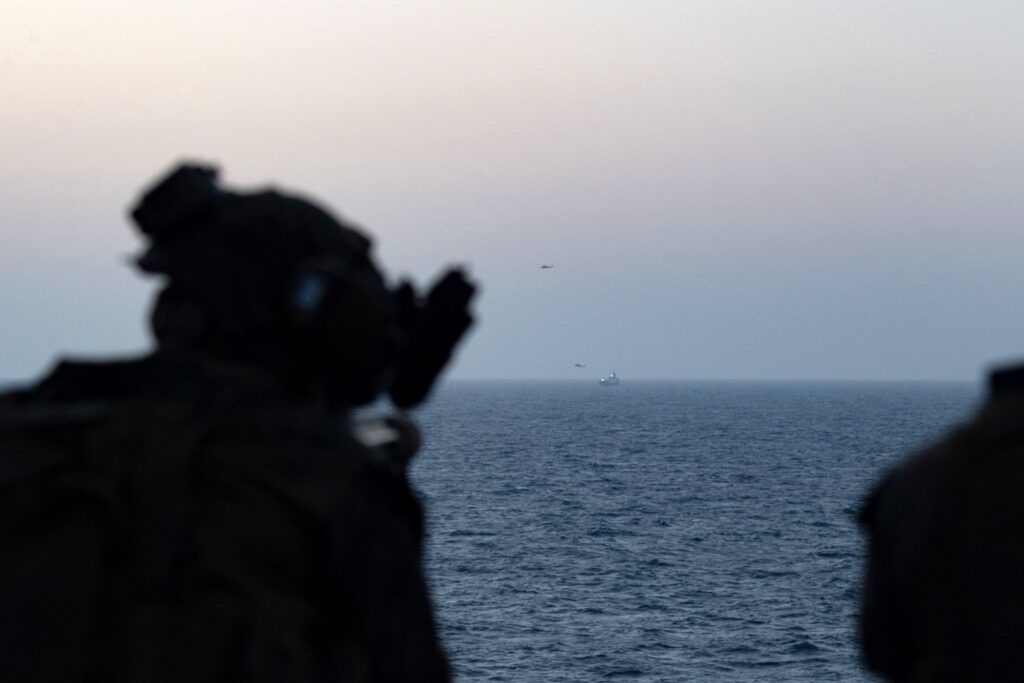
A fire and explosion on a South Korean-operated tanker in the Strait of Hormuz on May 4 underscored the extent to which the ongoing war in Iran has exposed the fragility of South Korea’s energy security, U.S.-South Korea alliance management, and Indo-Pacific priorities. Roughly 20 percent of global petroleum moves through the Strait of Hormuz, along with 70 percent of South Korea’s crude oil. Within hours of the explosion, President Donald Trump pressed the country to join a U.S.-led maritime security mission in the Strait of Hormuz, forcing the Lee Jae Myung administration to make a choice it has thus far avoided making.
The two-dozen crew members escaped the Panama-flagged HMM Namu unharmed. While the Iranian Embassy in South Korea denied responsibility or involvement, a South Korean government investigation confirmed unidentified airborne objects as the source of the attack, causing a fire in the vessel’s engine room. The South Korean presidential office stated that the ship was complying with all maritime rules and that any attack on commercial cargo ships cannot be justified.
Meanwhile, the apparent Namu attack underscores South Korea’s longstanding balancing act between its security alliance with the United States, dependence on Middle Eastern energy imports, and strong economic ties with China. Trump has called on allies to enhance maritime security, cooperate on sanctions against Iran, and participate in supply chain restructuring. Such enhanced cooperation, however, could be sensitive for the alliance, as it could expose South Korea to military risks, economic burdens, and worsening relations with countries such as China and Iran.
South Korea should strengthen maritime security cooperation with the United States and partners while adopting flexible alliance strategies, such as minimizing, leveraging, or balancing responses to U.S. security requests with efforts to diversify energy, logistics, and diplomatic ties across the Indo-Pacific and the Middle East. The South Korean government has worked with the private sector to reduce its energy dependence on the Middle East, partnering with Australia and North African countries, including Algeria and Libya, to secure a stable crude oil supply.
The Namu incident could also influence domestic debates over South Korea’s future role in regional and global maritime security crises. Seoul is unlikely to engage in direct military operations in the Middle East due to high diplomatic, legal, and security constraints. However, it may face growing pressure from the Trump administration to contribute more to safeguarding key sea lines of communication and assume higher costs stemming from the relocation of U.S. military assets off the peninsula.
Added to the ongoing conflict in the Middle East, the Namu incident is likely to heighten existing strategic concerns in South Korea. Given the importance of the Strait of Hormuz to global energy flows and South Korea’s heavy reliance on Middle Eastern oil imports, the incident may further expose the country to regional instability and disruptions in maritime trade. The strait is a vital chokepoint for worldwide energy trade, accounting for 20 percent of global petroleum flows. Over 60 percent of South Korea’s crude oil and 50 percent of its naphtha, a key petrochemical feedstock, were transported through the strait in 2025. Further, the semiconductor and display industries rely on Qatar for 64 percent of helium imports, amplifying concerns about supply chain shortages.
Looming at present is a cost-push inflation cycle in which rising oil and liquefied natural gas prices weaken the already pressured won and increase production, transportation, and energy costs. The longer the instability in the strait persists, the higher shipping insurance premiums and freight costs will rise, further imperiling South Korea’s foreign exchange rate. In this sense, the Iran war could trigger a macroeconomic shock in South Korea, slowing growth and destabilizing the overall economy.
In the short term, South Korea now appears more likely to lean into non-combat roles such as maritime surveillance, intelligence sharing, logistical support, participation in multinational naval coordination, and protection of commercial shipping routes, while also strengthening cooperation on energy security, strategic reserves, and supply chain resilience as part of a broader economic security strategy.
Seoul should pursue a calibrated approach, balancing alliance commitments with domestic political constraints and the need to avoid escalation in the Middle East. Yet the longer instability persists in the Middle East, the harder it will be for Seoul to sustain the balance between alliance obligations, energy dependence, and economic exposure to China that has long defined its regional posture.
Sia Choi is Communications Intern at KEI. The views expressed are the author’s alone.
This material is distributed by KEI on behalf of the Korea Institute for International Economic Policy. Additional information is available at the Department of Justice, Washington, DC.