
By Robert King
China Courts a More Confident North Korea
Xi Jinping's North Korea visit aimed to pull Kim back toward Beijing, but it exposed a more confident leader now playing China and Russia off each other.
Listen to this article
0:00 / 0:00
Chinese President Xi Jinping visited North Korea this month to try to pull the Kim Jong Un regime back toward Beijing at a moment when Pyongyang has been leaning conspicuously toward Moscow. The visit also showed how much the relationship has changed. The formerly cautious and inexperienced Kim, who once sought Xi’s advice before meeting with U.S. President Donald Trump, is now a confident leader managing both Beijing and Moscow to his own advantage. That is an unwelcome reminder for Washington and Seoul, whose policy toward North Korea still assumes that pressure works and that others can be enlisted to apply it.
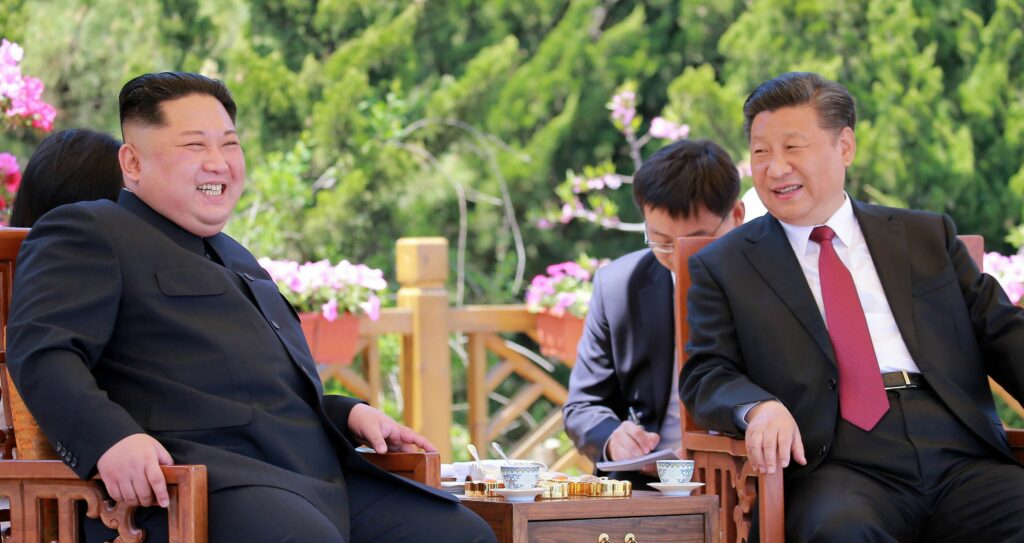
Although Kim and Xi became leaders of their respective countries around the same time, their first in-person meeting did not occur until March 2018, over five years after both had come to power. It is clear that Kim sought advice from Xi because the North Korean leader had very limited experience dealing directly with senior government officials of major countries, particularly those that were considered hostile. In fact, Kim’s first meeting with a foreign leader outside of North Korea since becoming supreme leader was the March 2018 meeting with Xi in Beijing. That meeting took place ten days after Trump announced that he would meet with Kim in Singapore. The first meeting was followed by a series of meetings between Kim and Xi, which were closely related to the high-level summits involving the United States and South Korea.
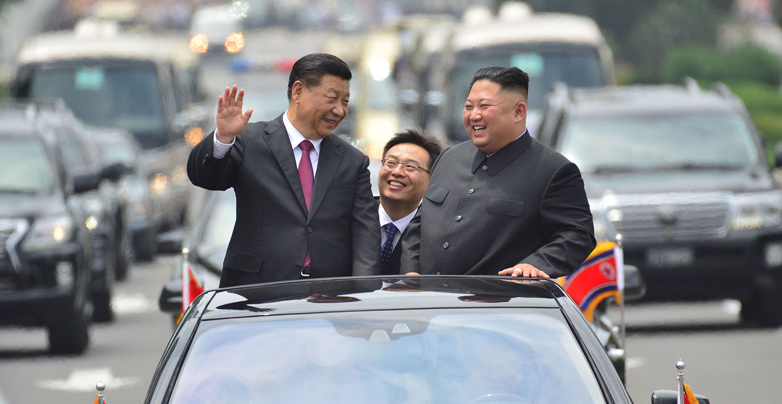
Following the earlier pattern, Kim again traveled to Beijing to consult with Xi in January 2019, a month before the Hanoi summit with Trump. Five months after that failed meeting and just days after Trump met with Kim for about an hour at the inter-Korean border, Xi met Kim yet again during a two-day visit to Pyongyang. This was the first state visit by Xi to North Korea and the first such visit by a Chinese leader in fourteen years. The pomp and ceremony were effusive and widely reported in both countries.
Kim in Beijing, Xi in Pyongyang
The first five summits between Kim and Xi in 2018 and 2019 seemingly involved the former seeking advice on how to deal with the United States and what to say to Trump. Kim had little prior governing experience when he assumed power in North Korea, whereas Xi was over thirty years older and had held several leading party and government positions before becoming the leader of China.
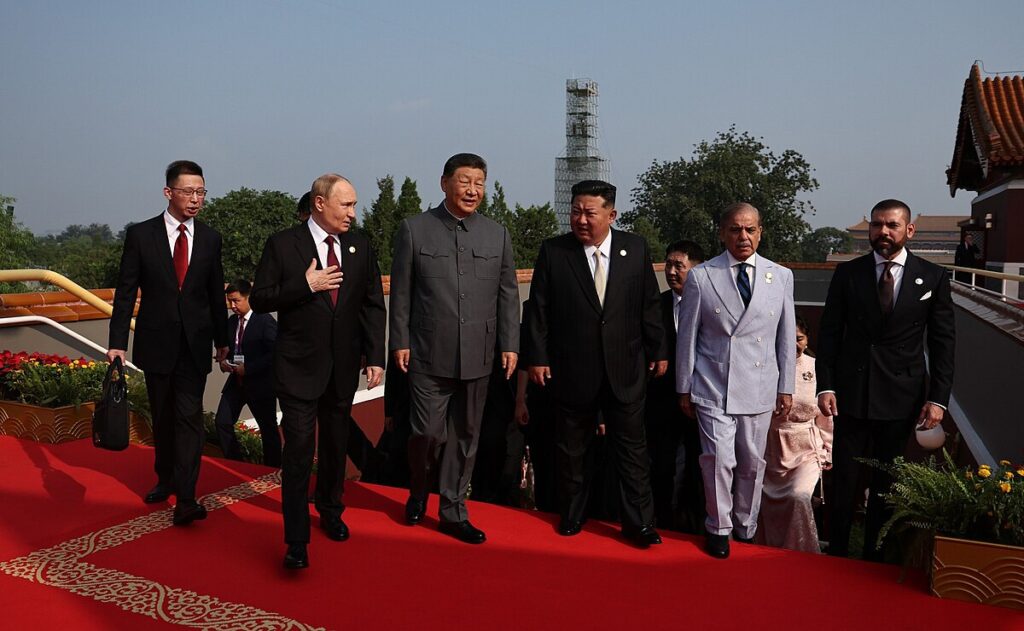
But the last two Kim-Xi meetings in September 2025 and June 2026 have a different feel. Kim seemed much more self-confident in the last two meetings, while Xi seemed more wary of the direction of Kim’s international actions. Kim traveled to Beijing in September 2025 for festivities marking the eightieth anniversary of the end of World War II. U.S. media paid special attention to Kim and Russian President Vladimir Putin’s attendance at the ceremony, as the Chinese protocol list of foreign guests for the event placed Putin first and Kim second. Xi, Kim, and Putin were together on several occasions during the anniversary festivities in Beijing; most conspicuously, the three were together on the reviewing stand for the massive parade.
Since the beginning of Russia’s war against Ukraine in February 2022, there has been a subtle but clear shift in the relationship between Russia and North Korea. Russia expected to quickly seize significant areas of Ukraine (possibly all of the country), but stiff Ukrainian resistance has prevented Russia from achieving most of its goals. As a result, Russia has come to depend heavily on North Korean military equipment and, more recently, the direct involvement and support of North Korean troops to seize and hold territory in Ukraine.
Russia’s urgent need for North Korean aid to bolster its faltering invasion appears to have boosted Kim’s confidence, with ramifications for ties with China and for inter-Korean politics. Xi’s June 2026 state visit to Pyongyang was the latest occasion for the Chinese leader to bolster ties with North Korea at a time when Russia has been showing particular gratitude to Kim for his help.
China has a much stronger interest in and closer historical ties with North Korea than Russia does. North Korea shares borders with both China and Russia, but the difference in the length of their shared borders is significant. China and North Korea share a border of 840 miles, which, for comparison, is greater than the distance from New York City to Chicago. Russia and North Korea, on the other hand, share a land border of just over 10 miles.
The Chinese-North Korean border is economically important to both countries. The Chinese port city of Dandong has a population of about two million, and the North Korean port city of Sinuiju is located on the opposite bank of the Yalu River, with a recently completed bridge to facilitate traffic and commerce. Some 40 percent of North Korea’s exports go to or through the port of Dandong. The short border with Russia is a backwater in sharp contrast. The nearest Russian port or city of any size to the North Korean border is Vladivostok, with a population of 300,000, located some ninety miles from the border.
Further, China has almost two million ethnic Koreans who live in and are citizens of China, and they are an important presence in China’s northeast. In the aftermath of World War II, Chinese “volunteers” played a particularly important role in supporting North Korea during the Korean War. At that same time, military forces of the United States and a number of UN member countries made significant contributions in supporting South Korea and preventing it from being overrun by North Korean and Chinese troops. North Korean workers are employed legally in northeast China through mutual agreement and to mutual benefit. The Chinese economy has flourished while North Korea’s economy has struggled, and Chinese economic links have been particularly important in bolstering North Korea.
A Balancing Act
Kim Jong Un appears to be carefully balancing his relationship between his two allies, but it is also clear that Beijing is concerned that Pyongyang may be leaning a bit too far toward Moscow. But it also appears that Kim understands the differences between Beijing and Moscow.
Immediately after returning from the festivities with Xi and Putin in Beijing, Kim sent a congratulatory message to Putin on June 12, Russia’s national holiday marking the adoption of the Declaration of State Sovereignty of the Russian Soviet Federative Socialist Republic in 1990, creating the current Russian Federation. In his message to Putin, Kim pledged North Korea’s unwavering support for Russia and said that the friendship of the two countries is “further strengthened into sincere and devoted relations of comradely trust and alliance, opening a new chapter of history.” The message was prominently published on the front page of North Korea’s official party newspaper. It seems clear that his effusive language was intended to show Moscow that Xi’s high-level visit had not diminished Kim’s appreciation for Putin’s gratitude for North Korean aid in the Ukraine war.
Days after Xi’s recent visit to North Korea, Kim sent a “congratulatory message and flower basket“ for Xi’s seventy-third birthday, wishing him “good health and greater success in leading the cause of socialist construction in China.” The gesture was unusual. Kim had previously marked only Xi’s milestone birthdays—the sixtieth, sixty-fifth, and seventieth, the last in 2023—and the timing drew questions at a South Korean Ministry of Unification briefing, where an official said sending flowers on a non-milestone birthday “is presumed to reflect the close relations between North Korea and China.”
Conclusion
China’s willingness to court Kim reflects its own interests as much as his. A stable North Korea on China’s border serves as a buffer, sustains the struggling economy of China’s northeast, and keeps the country from being shut out of any settlement on the Korean Peninsula. For decades, that calculation worked in China’s favor because North Korea had nowhere else to turn. Russia has changed that by offering Kim military technology, hard currency, and other goodies outside the sanctions regime. The material balance has not moved—China still accounts for nearly all of the North’s official trade—but what has moved is Kim’s leverage and, with it, the limits of what either patron can ask of him. The same confidence that lets Kim play Beijing against Moscow has only hardened his posture toward Washington and Seoul, as he now feels less vulnerable.
Robert King is a Non-Resident Distinguished Fellow at the Korea Economic Institute of America (KEI). The views expressed here are the author’s alone.
This material is distributed by KEI on behalf of the Korea Institute for International Economic Policy. Additional information is available at the Department of Justice, Washington, DC.