
By Robert King
Russia Needs North Korea More Than It Wants to Admit
Russia is paying steadily rising costs to keep North Korea on its side because North Korea has become indispensable to the war in Ukraine.
Listen to this article
0:00 / 0:00
Russia’s dependence on North Korea’s military suggests significant problems in its war efforts in Ukraine. Russia’s GDP is ten times that of Ukraine. Its per capita income is three times higher. And yet the recent flurry of North Korea-Russia visits, the fraternal declarations, and the fanfare around the first anniversary of expelling Ukrainian forces from Kursk all point to a regime that is publicly grateful to North Korea because it has to be. The louder Russia thanks North Korea, the more it reveals about the war in Ukraine.
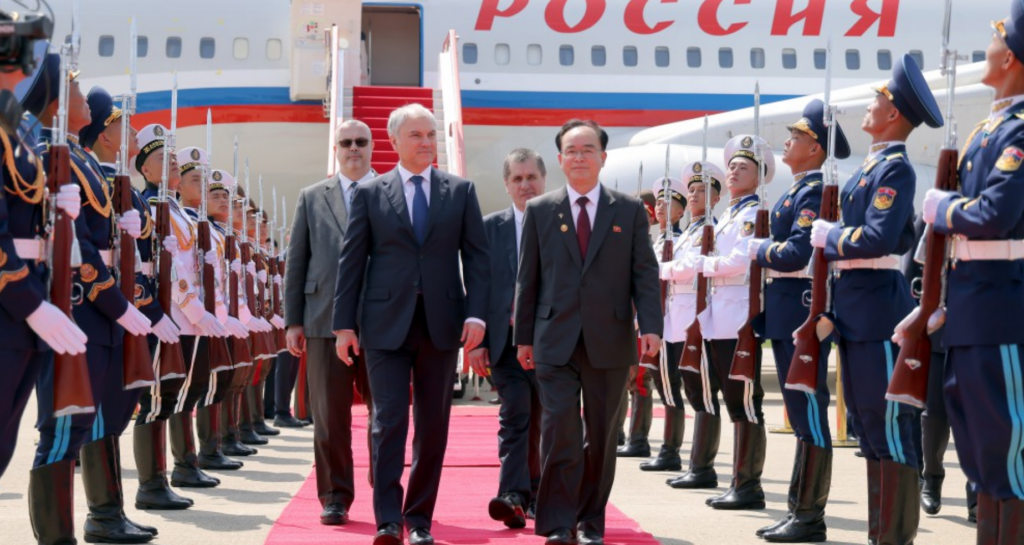
The most significant gratitude shown to North Korea was the visit of Russian Defense Minister Andrey Belousov who visited Pyongyang early this week. During his visit he met with leader Kim Jong Un and he participated in a ceremony inaugurating a memorial to North Korean troops who died in Ukraine aiding the Russian military forces, which also included the participation of Russia’s president of the Duma (parliament), Vyacheslav Volodin.
During his visit to Moscow, Defense Minister Beousov also held negotiations on a new defense cooperation agreement between Moscow and Pyongyang for the period 2027-2031. The two allies previously negotiated a mutual defense agreement in 2024. Following his visit to Pyongyang this week, Defense Minister Belousov said, “We agreed with the DPRK Defense Ministry to place our military cooperation on a stable, long-term footing.” The Defense Minister’s visit highlighted a major show of Russian thanks and promises of future cooperation in defense between Moscow and Pyongyang.
During Duma President Volodin’s visit to Pyongyang, he met with Jo Yong Wang, Chairman of the Presidium of the North Korean Supreme People’s Assembly. Both heads of parliament called for expanded cooperation between Russian and Korean legislators. That same day North Korea’s Vice Foreign Minister hailed the anniversary of the 2019 summit between Kim Jong Un and Russian President Vladimir Putin in Vladivostok.
Just a week earlier, three senior Russian government ministers made a joint visit to North Korea for high-level discussions on internal security and economic cooperation. The Russian minister of internal affairs met with his North Korean counterpart in Pyongyang, where they held meetings and signed an agreement to cooperate in combating crime, including drug trafficking and human trafficking, as well as cooperation in apprehending wanted individuals.
The Russian minister of natural resources and environment, who is also the chair of the committee on trade and economic cooperation between the two countries, met with his North Korean counterpart. Also participating in the trifecta was the Russian minister of health, who met with the North Korean minister of public health to discuss health issues and areas of cooperation between the two countries.
Their visits were linked with the celebration of the one-year anniversary of Russia’s recapture of the Kursk region, which Ukraine seized in 2024 in a surprise counterattack in the ongoing Russia-Ukraine war. North Korea has provided soldiers and military equipment to Russia and received generous economic incentives and political support from Russia.
A few days before the visit of the high-level Russian delegation, the North Korean government announced the completion of the first road bridge between North Korea and Russia. An agreement for constructing the bridge was signed in June 2024 at a summit between Kim and Putin in Pyongyang. Construction began on April 30, 2025, and was completed on April 21 of this year.
The fanfare accorded to the event emphasizes the importance both sides give to their closer relationship. The ceremony featured a North Korean and Russian construction worker installing the final bolt at the bridge’s midpoint, with both countries’ flags fluttering in the background. The two countries have a short common boundary across the Tumin River—only 11 miles in length, compared to the North Korea-China border of 840 miles. A railroad bridge between North Korea and Russia opened in 1959, but it only carries rail traffic. The new road bridge, which is scheduled to open over the summer, will permit trucks and automobiles to cross directly between the two countries and will handle up to 300 vehicles and 2,850 individuals daily.
Another recent indication of the flourishing relationship between Pyongyang and Moscow is the echo of Russia’s actions by its closest ally. Other than China and Russia, few senior government officials visit North Korea. In March of this year, however, Belarusian President Alexander Lukashenko—one of Russia’s closest and most dependent allies—made his first state visit to Pyongyang, where the two leaders signed a friendship treaty. Lukashenko gave Kim a rifle “just in case enemies appear,” and Kim gave his guest a sword and a vase adorned with a glazed image of the Belarusian leader. Lukashenko has been head of Belarus for over three decades, and he is the only president that independent Belarus has had. It is possible that Russia nudged the Belarusian leader to visit Pyongyang as a reward for the country’s help in Ukraine.
North Korea’s Contributions to Russia in Ukraine
In June 2024, North Korea and North Korea signed a mutual defense treaty, and in October 2024, North Korea began sending military forces to Ukraine to support Russian troops. The initial deployment involved around 1,500 North Korean special forces, and by the end of 2024, between 11,000 and 12,000 North Korean troops were deployed in the Kursk region.
The Kursk region was Russian territory that Ukrainian troops occupied in the summer of 2024. Kursk is historically significant, as during World War II, the Battle of the Kursk Salient was the largest tank battle in history and one of the most important on the Eastern Front. The Ukrainian army taking territory near Kursk was the first time Russian territory had been occupied by a foreign country since World War II—a clear signal that Russia was having serious difficulty in Ukraine.
It was important for Russia to reclaim that territory, which made the Russians particularly appreciative of North Korea’s contribution to the counteroffensive in Kursk. After retaking the territory, North Korea also sent thousands of construction workers for demining and reconstructing the reclaimed region. A BBC report estimated that as many as 50,000 North Korean workers were deployed in Ukraine.
Russia Shows Appreciation to North Korea
It is difficult to measure the value of North Korea’s assistance to Russia in its war efforts, but Russia’s actions toward North Korea show deep appreciation. As serious talks were underway between Kim and Putin on North Korean military assistance to Russia, Russia demolished the UN sanctions regime against North Korea for its nuclear weapons program.
Since its first nuclear weapons test in 2006, North Korea has been sanctioned by the UN Security Council—with Russia’s affirmative support—in 2006, 2009, 2013, 2016, and 2017. The sanctions were focused on prohibiting trade in weapons-related material, but as North Korea continued its nuclear testing, sanctions expanded to cover financial and banking transactions, travel, and trade in any military goods.
The UN sanctions on North Korea began to unravel in March 2024, when Russia vetoed a resolution to renew and extend the mandate of the UN Panel of Experts, which monitors the enforcement of UN sanctions against North Korea. This brought UN sanctions against North Korea to an abrupt end. While individual countries continue to impose sanctions, the UN Security Council sanctions, despite their limitations, were particularly important.
It is worth noting that the Russian government was never fully committed to sanctions against North Korea. Despite voting in favor of sanctions, there were clear indications that Russia was acting behind the scenes to help North Korea’s nuclear ambitions. The veto of the UN Panel of Experts, however, was a particularly significant and highly visible action.
Conclusion
The evidence stacks in one direction. Volodin’s visit to Pyongyang, three Russian ministers signing cooperation agreements, a new road bridge across the Tumen River, a North Korea-Belarus friendship treaty, and the quiet end of the UN sanctions regime can be read on their own as serious and impactful diplomatic and economic events. The visits of Defence Minister Berlousov and Duma President Volodin and three other ministers signing cooperation agreements describe a Russia paying steadily rising costs to keep North Korea on its side because North Korea has become indispensable to the war.
Robert King is a Non-Resident Distinguished Fellow at the Korea Economic Institute of America (KEI). The views expressed are the author’s alone.
Feature image from North Korean state media service KCNA.
KEI is registered under the FARA as an agent of the Korea Institute for International Economic Policy, a public corporation established by the government of the Republic of Korea. Additional information is available at the Department of Justice, Washington, D.C.