
By Scott Snyder
How Lee Jae Myung Bought South Korea Diplomatic Space, Time, and Leverage
In his first year, the president's foreign policy bought time and leverage by accommodating Washington while steadying ties with Beijing and Tokyo.
Listen to this article
0:00 / 0:00
In his first year as president, Lee Jae Myung bought South Korea time and leverage by accommodating the United States while strengthening South Korea’s relations with its major power neighbors. This approach will require constant vigilance as well as agility, foresight, and instincts for managing potentially rapid shifts in an increasingly dangerous neighborhood and uncertain expectations from the Donald Trump administration.
President Lee’s first task was to manage the Trump administration’s efforts to rebalance global trade on its own terms and redistribute security responsibilities onto the shoulders of allies amid major shifts in the regional and global order. In response, the Lee administration sought to stabilize relations with the United States, maintain South Korea’s international competitiveness in critical economic sectors, and stabilize relationships with its neighbors, China and Japan, through self-described “pragmatic diplomacy.”
While it is premature to make a full assessment of the effectiveness of these initiatives, it is possible to conclude that South Korea has actively adapted to new geopolitical realities by preserving maneuvering space amid global developments largely adverse to the country’s national interests.
President Lee’s first demonstration of pragmatic diplomacy was stabilizing the U.S.-South Korea relationship by cultivating a positive relationship with President Trump. This meant stabilizing the bilateral trade and investment relationship in response to U.S. global trade rebalancing priorities. Given South Korea’s need to ensure that its economic and trade competitiveness was not disadvantaged by Trump-induced changes in global trade, senior officials from South Korea’s new administration maintained near-constant communication with U.S. counterparts to ensure equivalence with evolving European and Japanese trade negotiations with the United States.
Although South Korea lost hard-won advantages from prior Korea-U.S. Free Trade Agreement negotiations, the Lee administration inked an initial understanding with President Trump that, for the moment, locked in South Korea’s baseline tariff at the same level as those of Europe and Japan.
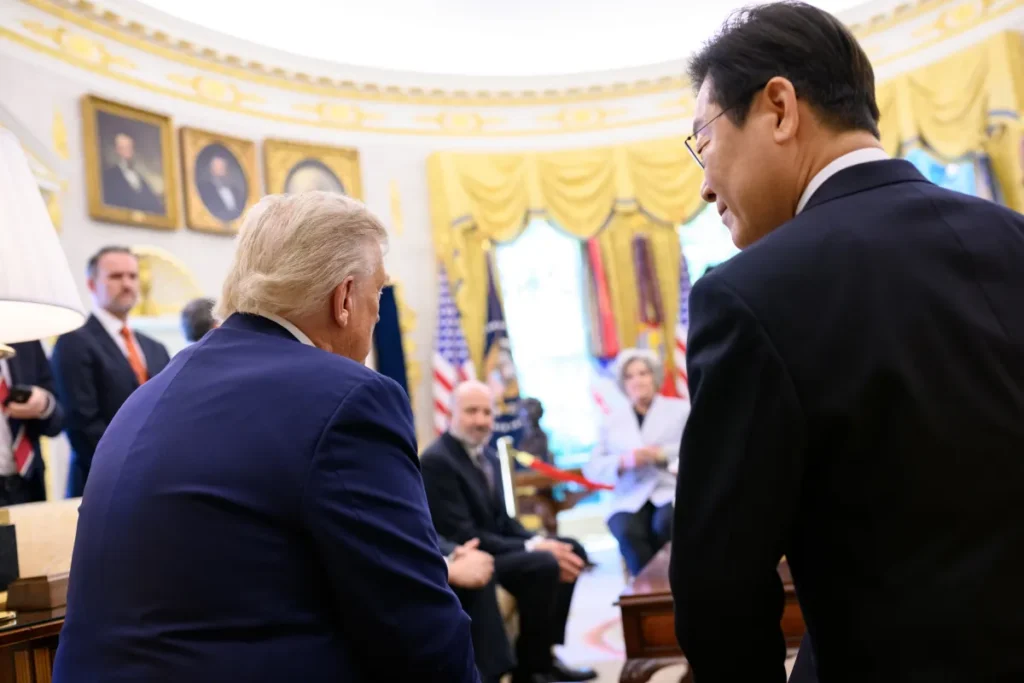
The trade and investment framework set up a critical Oval Office meeting between Presidents Trump and Lee at the end of August 2025. Despite fears that President Lee might get caught in a “Zelensky moment,” Lee seemingly developed a rapport with Trump by praising his past work on North Korea. Trump is a “peacemaker,” Lee said, and he himself was a “pacemaker” who would support the resumption of U.S.-North Korea summitry.
But critical details of the trade and investment framework remained unsettled for weeks as South Korea digested and debated U.S. requests for up to USD 350 billion of investments. While this amount compared favorably to Japan’s USD 550 billion pledge to the United States, South Korea secured new pledges that investments be commercially viable and that South Korea’s annual investment in the United States under the framework be capped at USD 20 billion per year.
The two sides concluded a detailed framework during President Trump’s second meeting with President Lee on the sidelines of the Asia-Pacific Economic Cooperation (APEC) summit in Gyeongju in October 2025. Many of Seoul’s commitments are not pure concessions, however. The USD 150 billion shipbuilding pledge, along with investments in critical minerals, energy, semiconductors, and AI, falls in sectors where South Korea sees commercial upside, positioning itself as a technology supplier with an equity stake in the U.S. market.
The second Trump-Lee summit also yielded significant progress under the rubric of “alliance modernization,” through which the Lee administration has pursued autonomous self-defense while redefining the scope and responsibilities within the alliance to deter growing threats from both China and North Korea. Specifically, the accompanying Joint Fact Sheet outlined a pathway for the United States to support “the process that will lead to the ROK’s civil uranium enrichment and spent fuel reprocessing for peaceful uses” and approval for South Korea to build “nuclear-powered attack submarines” and to work with South Korea to source enriched uranium necessary to power them.
Lee has also held reciprocal summits with Japan, meeting Prime Minister Sanae Takaichi four times in roughly six months, including respective hometown visits to Nara in January and Andong in May 2026. Given the history of friction between South Korean progressive and Japanese conservative leaders, the cadence is itself a welcome surprise. At the same time, Lee has stabilized the South Korea-China relationship from the clear tensions that arose during the Yoon Suk Yeol administration by restoring South Korea’s rhetorical support for Beijing’s “One China” policy while retaining language adopted by past South Korean and U.S. presidents endorsing the “peaceful resolution of cross-Strait issues and opposed unilateral changes to the status quo.”
A missing piece of the Lee administration’s foreign policy following one year in power is the future of South Korea-Russia relations. Russia’s war against Ukraine and its support from North Korea on the battlefield are the primary obstacles to deeper ties. Presumably, South Korea’s policy toward Russia is complicated by the reality that there is no clearly discernible pragmatic option. Yet Pyongyang’s relationship with Moscow may be the geopolitical development that generates the greatest threat to South Korea’s security by giving North Korean leader Kim Jong Un the impression that he has more room to escalate tensions on the peninsula.
On balance, the Lee administration’s most significant foreign policy accomplishment against the backdrop of an uncertain and adverse geostrategic environment is its success in buying time and building leverage. Given mounting uncertainties and rising geopolitical risks emanating from multiple sources, this approach is understandable and arguably prudent. South Korea is no longer defenseless against the machinations of surrounding major powers—a combination of pragmatism, agility, wisdom, and foresight is required to manage the challenges ahead.
Republished with permission by Korea on Point. Read the original, published June 27, 2026, by clicking here.
Scott Snyder is President and CEO of the Korea Economic Institute of America and author of South Korea at the Crossroads: Autonomy and Alliance in an Era of Rival Powers. The opinions expressed here are his own and do not reflect those of KEI.
This material is distributed by KEI on behalf of the Korea Institute for International Economic Policy. Additional information is available at the Department of Justice, Washington, DC.