Search All Site Content
Total Index: 6918 publications.
Subscribe to our Mailing List!
Sign up for our mailing list to keep up to date on all the latest developments.
The Peninsula
Korea Policy Series: Advancing U.S.-South Korea-Japan Cooperation in Natural Gas
Published December 26, 2025
Author: Seong-ik Oh
Category: Economic Security, Japan, South Korea, U.S.-Korea-Japan, US-Korea alliance
The following policy brief is part of a limited series from the Korea Economic Institute of America inspired by the latest edition of Korea Policy, Volume 3 Issue 2. You can read the author’s full paper by clicking here.
Executive Summary
Energy security cooperation among the United States, South Korea, and Japan has emerged as a central pillar of the trilateral partnership. Since the 2023 Camp David summit, the scope of U.S.-South Korea-Japan cooperation has expanded beyond traditional military arrangements to encompass economic and technological dimensions, with natural gas occupying a critical role. Natural gas serves as an essential bridge fuel, supporting energy transition goals while meeting surging electricity demand from artificial intelligence and other energy-intensive sectors.
Background
The strategic convergence is clear: the United States has emerged as the world’s top exporter of liquefied natural gas (LNG) following the shale revolution; South Korea and Japan rank among the world’s largest LNG importers, heavily reliant on energy imports to sustain their advanced industrial economies. In 2024, South Korea imported 47.7 million tons (11.4 percent of world demand) and Japan 67.7 million tons (16.5 percent) of LNG, with both countries heavily exposed to Middle Eastern oil dependence and vulnerable shipping routes in the Red Sea and the South China Sea.
Policy Recommendations
Three key areas of cooperation present tangible opportunities for trilateral partnership: (1) the Alaska LNG project; (2) joint development of natural gas resources in the South Korea-Japan continental shelf; and (3) expanded long-term LNG procurement contracts and joint investment in U.S. export terminals. Simultaneously, critical challenges—including Russia’s Power of Siberia-2 pipeline—require strategic management to ensure partnership resilience.
- Alaska LNG Project Participation
The Alaska LNG project could be a good example of energy cooperation among the three countries. While Japan’s September 2025 Letter of Intent for one million tons per annum (MTPA) from JERA and South Korea’s POSCO International strategic partnership represent a step forward, Japan and South Korea have taken a cautious approach to this issue.
- Revitalize South Korea-Japan Joint Continental Shelf Development
The collaborative development of natural gas in the East China Sea and participation from technically advanced U.S. energy companies could help South Korea and Japan meet their medium-term energy needs and bolster their energy security.
- Expand Frameworks for LNG Cooperation
Current LNG cooperation proceeds through bilateral corporate arrangements for LNG purchase and LNG terminal investment, and this can be more systematized.
- Address Power of Siberia-2 as a Strategic Challenge
Russia’s Power of Siberia-2 pipeline represents the most significant near-term competitive challenge to U.S. LNG exports to Asia. Strategic responses are required at both the bilateral and trilateral levels.
Conclusion
The United States, South Korea, and Japan possess a historically rare convergence of interests: the world’s leading natural gas exporter and two of its largest importers, bound by shared strategic values and energy security imperatives. Beyond traditional security cooperation, this trilateral energy partnership offers a foundation for mutual prosperity.
Challenges such as Power of Siberia-2’s potential completion in the mid-2030s and evolving maritime law in the East China Sea underscore the imperative for a resilient trilateral framework grounded in trust, technical capacity, and shared values. By embracing a “solutions-oriented partnership,” the three nations can transcend near-term commercial uncertainties and forge a durable energy security architecture that will benefit generations to come.
Seong-ik Oh is the Director General for Cadastral Resurvey Planning at Korea’s Ministry of Land, Infrastructure and Transport. All views are the author’s alone.
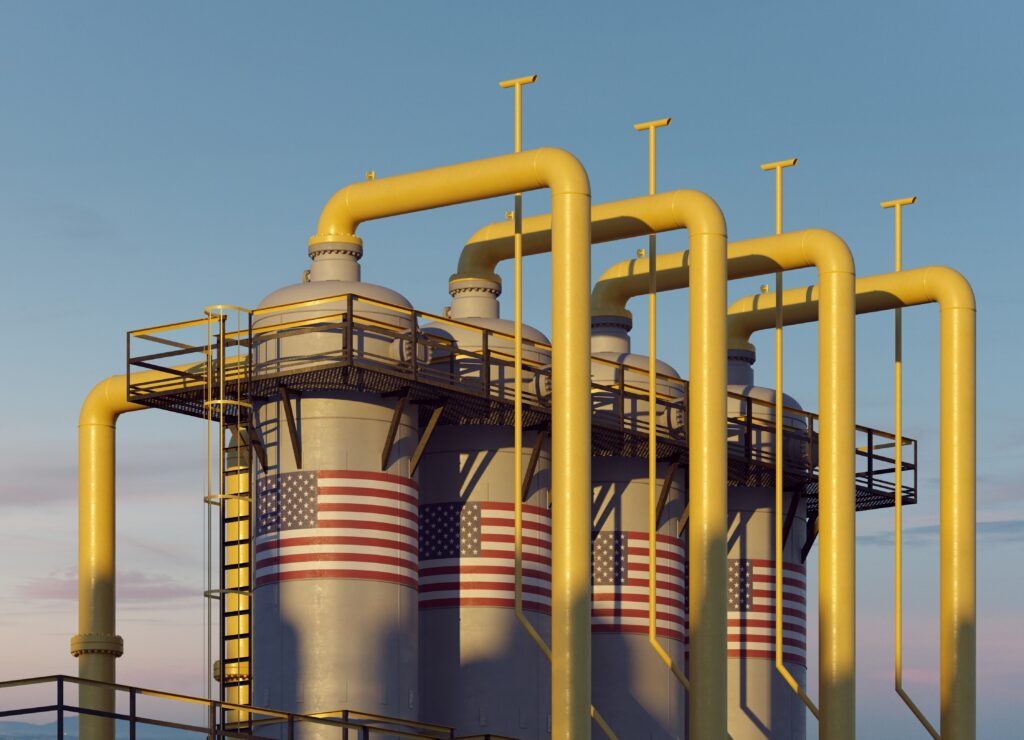
Feature image from Shutterstock.
KEI is registered under the FARA as an agent of the Korea Institute for International Economic Policy, a public corporation established by the government of the Republic of Korea. Additional information is available at the Department of Justice, Washington, D.C.