
South Korea’s Currency Problem Is Bigger Than It Looks
A won stuck above 1,500. FX reserves down to twelfth globally. A $350 billion in tariff-deal debt ahead. Shin Hyun Song must hit the ground running.
By Tony Michell
Shin Hyun Song has almost no room for error. The new Bank of Korea (BOK) governor inherits a won that has held above 1,500 to the U.S. dollar for most of the year, foreign exchange (FX) reserves that have slipped to twelfth in the world, and a U.S. tariff deal that will hang USD 350 billion of debt over the South Korean economy for decades. The fallout could push the won toward a historic 10-to-1 ratio with the yen. Early in his career, Shin argued that the most dangerous financial risks stay hidden until a threshold is crossed. He is about to find out which ones Korea missed.
In March 2023, then Minister of Economy and Finance Choi Sang-mok introduced the Improvement Measures for Foreign Exchange Market Structure, ending a long-standing ban on trading the won abroad. His case rested on three claims: the restriction hurt Korean financial institutions, offshore demand was minimal, and inclusion in the MSCI developed index required opening the currency. His solution was to open the domestic bond market to link Korean won-denominated bonds to the FTSE World Government Bond Index so that portfolio asset managers would acquire the equivalent of 2 percent of the global bond market. The International Monetary Fund (IMF) argued that without a fiscal anchor, this would not be attractive. But the incumbent Minister of Economy and Finance, Koo Yun-cheol, chose to ignore the warning.
The early numbers went Koo’s way. The April 1, 2026, bond opening drew KRW 4.4 trillion (USD 2.9 billion), mainly from Japanese funds, without the fiscal anchor the IMF had insisted on. Whether the opening holds up under real stress is now BOK’s problem. Shin began his term as BOK governor in late April—at a time when financial openings were creating considerable waves in the FX market, including an FX crisis in December 2025, which led the BOK to intervene by spending more than USD 8.7 billion of foreign reserves, compared to the average USD 2 billion spent per month for most of 2025.
Korea’s central bank also urged the National Pension Fund (NPS) to reduce its overseas investments. The USD 40 billion currency swap arrangement between the NPS and the BOK could flow in both directions (originally intended to help NPS with dollars, not vice versa). This brought the USD-KRW exchange rate down from nearly 1,500 to 1,439, but the outbreak of the Iran quickly reversed this appreciation.
Shin will be looking for signs of hidden risks in the Korean economy. At the same time, he believes that there is a global demand for the won. “I will push to make the won more widely used globally and build an offshore settlement system so we can better manage the exchange rate and strengthen the currency’s international standing,” he told lawmakers in mid-April.
Setting theory aside, Shin would need accurate estimates of the range of the daily FX market, which was averaging about USD 90 billion per day. This consisted of spot exchange averaging about USD 32.6 billion and hedging and derivatives of USD 48.3 billion. He should also note that the U.S. and UK non-deliverable forward (NDF) market for the Korean won reached USD 70 billion—more than India, Brazil, and, until the Nvidia-TSMC partnership, Taiwan. The NDF market is purely a market for dollar bets against the future USD-KRW exchange rate, but Shin felt heavy trading through off-balance-sheet derivatives has created a case of “the tail wagging the dog.”
In the last eight months, Korea’s short-term FX debt has increased to 41 percent of its USD 425 billion FX reserves. The December 2025 crisis pushed NPS to add borrowing rather than spending dollars to the debt, and other investors were encouraged to take on debt rather than cash. In March, the Korean government accepted an international obligation to pay USD 20 billion per annum to the United States as part of the U.S.-Korea tariff deal. The deal gives a short timeframe of forty-five days from the date a project is confirmed to commit funds, in addition to an uncertain amount of up to USD 150 billion over ten years under the “Make American Shipbuilding Great Again” (MASGA) initiative proposed by President Lee Jae Myung. The total of USD 350 billion will hang over the Korean economy as additional debt for at least twenty years while those investments are repaid. With current international reserves, this could soon reach close to 80 percent of FX holdings in only a few years.
The BOK told the National Assembly that it could operate in the overseas market with one-third of its FX holdings to earn USD 20 billion per year. But if it has to put more of its reserves toward stabilizing the won, this amount may not be available.
Korea’s FX reserves, which equate to about one-third of Japan’s, have in 2026 slipped to the twelfth-largest in the world, down from the ninth-largest (for the first time in twenty-six years). Shin has noted that in the 2020s, neither a current account surplus nor high FX reserves could have prevented the yen’s weakness. He might have a macroeconomic model that looks at interest differentials, which would suggest that the marginal rates of interest in Japan (1.1 percent), Korea (2.5 percent), and the United States (3.5 percent) are driving the won’s diminishing value.
The visible risks are bad enough. FX debt sits at 41 percent of reserves. The tariff deal could push it to 80 percent. Interest differentials are pulling capital toward Washington. By Shin’s own theory, the risks that matter most are the ones still hidden. His job is to find them first.
Tony Michell worked for South Korea’s Economic Planning Board from 1978 to 1980 and was a Visiting Professor at the KDI School of Public Policy and Management from 1999 to 2024. He is Managing Director at Korea Associates Business Consultancy (KABC). The views expressed here are the author’s alone.
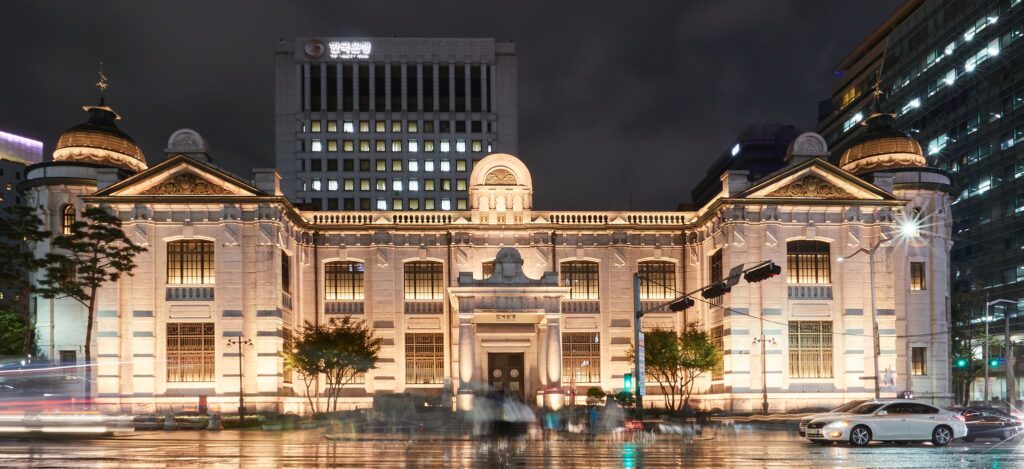
Feature image from The Bank of Korea.
KEI is registered under the FARA as an agent of the Korea Institute for International Economic Policy, a public corporation established by the government of the Republic of Korea. Additional information is available at the Department of Justice, Washington, D.C.