Search All Site Content
Total Index: 6943 publications.
Subscribe to our Mailing List!
Sign up for our mailing list to keep up to date on all the latest developments.
The Peninsula
Public Opinion and the Future of US-Korea-Japan Trilateral Cooperation
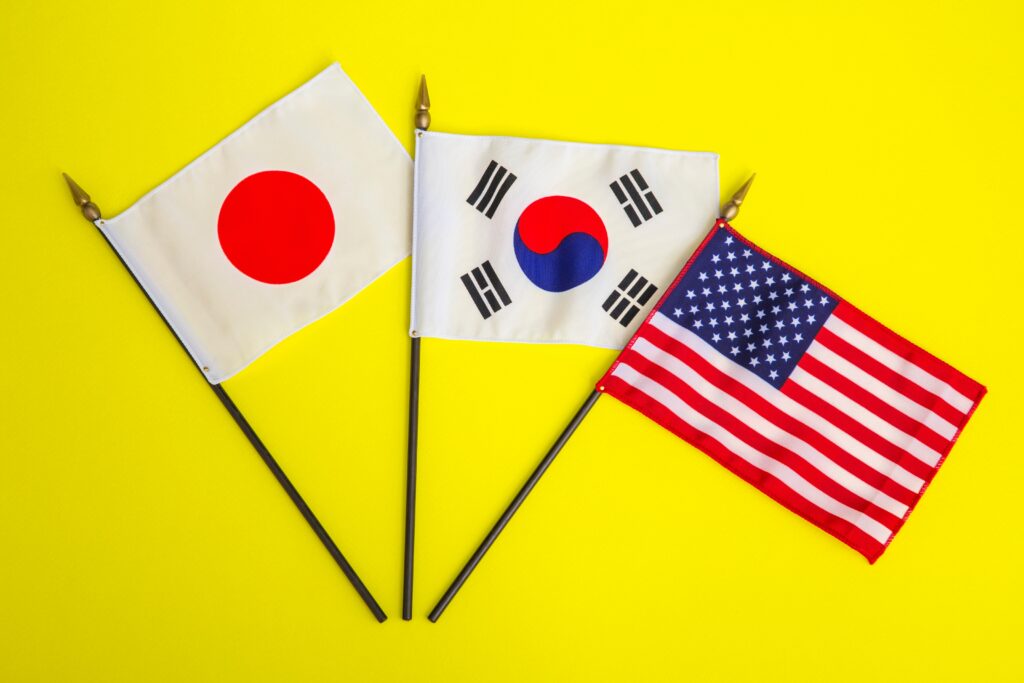
The August 2023 trilateral summit at Camp David marked a historic milestone in U.S.-South Korea-Japan relations, establishing new frameworks for crisis consultation, information-sharing, military exercises, and cooperation on critical supply chains. Two years on, the durability of that achievement is being tested by a turbulent second Donald Trump administration, rising Chinese assertiveness, an entrenched North Korean nuclear program, and unresolved historical tensions between South Korea and Japan. Whether the Camp David framework endures will depend not only on the decisions of leaders but on the publics whose support sustains them.
This report presents findings from comprehensive public opinion surveys conducted in the United States, South Korea, and Japan in August 2025. It examines where the three countries’ publics converge, where they diverge, and what those patterns mean for the future of trilateral cooperation.
Read the full report by clicking here.
Key Findings
Alliance Commitment Outlasts Political Friction: Despite deeply unfavorable views of President Trump in both allied capitals (73 percent in South Korea; 70 percent in Japan), 73 percent of South Korean respondents view the United States favorably as a country, and 86 percent of Japanese respondents affirm the importance of the U.S.-Japan relationship. Both publics clearly distinguish between frustration with current U.S. leadership and their support for the alliance itself.
Shared Threat Perception Anchors Cooperation: Majorities in all three countries identify China, North Korea, and Russia as their primary security concerns, providing a common strategic rationale for deeper coordination, even when the relative rankings differ. Americans view both South Korea (62 percent) and Japan (78 percent) favorably, and majorities consider both as trustworthy partners.
The South Korea-Japan Axis Is the Structural Weak Point: Both publics acknowledge the importance of the bilateral relationship (87 percent in South Korea; 54 percent in Japan), but underlying trust is underdeveloped. This survey suggests that a majority of Japanese citizens hold unfavorable views of South Korea and identify trust as a precondition for progress. In South Korea, attitudes toward Japan are heavily shaped by ideological and partisan orientation, leaving trust-building vulnerable to changing political winds in Seoul.
Divergent Views on Nuclear and Taiwan Contingencies: Publics in all three countries prefer diplomatic and humanitarian responses to a Taiwan contingency over direct military involvement, but perceptions of the threat’s imminence vary sharply. Roughly 72 percent of South Koreans believe a conflict is imminent, compared with more uncertain publics in the United States and Japan. On nuclear armament, 68 percent of South Koreans support an indigenous nuclear weapons program if North Korean nuclearization continues, while the American and Japanese publics remain closely divided.
Broad Opposition to Tariffs, Continued Support for Free Trade: Majorities in all three countries continue to endorse the free trade norms that have underpinned the postwar international order. Strong pluralities in the United States (45 percent) and South Korea oppose Trump-era tariffs on allied partners, while nearly 77 percent of the Japanese respondents answered negatively. The gap between current policy and public preference is itself a finding of consequence.
Eight months after this survey went into the field, the pressures it documented have not eased. The Trump administration’s tariff posture toward allied partners remains controversial in both Seoul and Tokyo, the North Korean nuclear program remains as strong as ever, and the strategic logic that brought the three governments to Camp David has only sharpened. The data show that the South Korean and Japanese publics have, so far, been able to hold the alliance steady amid U.S. unpredictability. Policymakers who treat the Camp David framework as a finished accomplishment rather than an active investment will find that public support, while durable, is also finite.
Dr. Je Heon (James) Kim is a Director of the Korea Program at The Stimson Center. All views presented are the author’s alone.
Feature image from Shutterstock.
KEI is registered under the FARA as an agent of the Korea Institute for International Economic Policy, a public corporation established by the government of the Republic of Korea. Additional information is available at the Department of Justice, Washington, D.C.