Search All Site Content
Total Index: 6887 publications.
Subscribe to our Mailing List!
Sign up for our mailing list to keep up to date on all the latest developments.
The Peninsula
Korea Policy Series: U.S.-South Korea Cooperation amid Heightened North Korea-Russia Ties
The following policy brief is part of a limited series from the Korea Economic Institute of America inspired by the latest edition of Korea Policy, Volume 3 Issue 2. You can read the author’s full paper by clicking here.
Executive Summary
At a time of escalating cooperation between Russia and North Korea within and beyond the security domain, the role of the U.S.-South Korea alliance in the security of the Korean Peninsula and the East Asian region has never been greater. The second Donald Trump administration in Washington and the Lee Jae Myung administration in Seoul face multiple threats from North Korea, not limited to the country’s expanding vertical proliferation of nuclear weapons and delivery systems. This year, cooperation between North Korea and Russia is expanding across sectors, and these two states, together with China and—albeit less so—Iran, have also sought to present a united front in opposing the United States, its alliances, and its leadership of the postwar international order. In response, the United States and South Korea should seek to strengthen their relationship, avoid taking hasty steps that could offer North Korea an opportunity to exploit weaknesses in the U.S.-South Korea alliance, and deepen cooperation in both existing and new areas.
Background
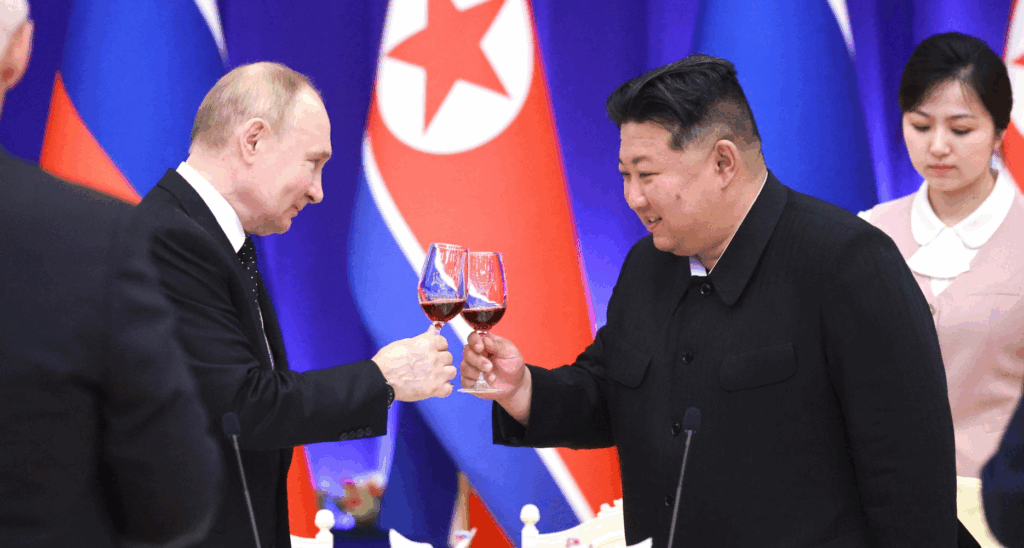
As the ongoing Ukraine War nears the end of its third year, recent developments in the relationship between Russia and North Korea have highlighted how cooperation between the two states has extended beyond the security domain. In line with the “Comprehensive Strategic Partnership Treaty” the two countries signed on June 19, 2024, Moscow and Pyongyang have striven to broaden their cooperation to include, inter alia, the domains of culture, artificial intelligence, and disaster management. At the same time, this widening partnership has occurred amid an ongoing bolstering of security ties, with North Korea thus far having deployed approximately 14,000 troops to assist in Russian President Vladimir Putin’s war; pledged to send another deployment of 5,000 construction workers and engineers to rebuild the Kursk region; and procured advanced missile and military technology from Russia.
Within this geopolitical context, the Lee and second Trump administrations take power at a time when North Korea is increasingly emboldened in its accelerated development of nuclear and missile capabilities while benefiting from Russian support. Such support looks as if it will continue following a conclusion to the Ukraine War, even if the areas of cooperation are likely to change in any such scenario. Though both Lee and Trump have emphasized the importance of engaging in dialogue with the Kim Jong Un regime, they should not pursue talks for their own sake. The United States and South Korea must not abandon the importance of North Korea’s complete, verifiable, irreversible denuclearization as a core policy objective. Although the Trump administration seeks to prioritize the deterrence of China over North Korea, the United States and South Korea must seek clarity as to their respective commitments to the alliance; bolster trilateral cooperation involving Japan; and avoid any hasty actions that North Korea may interpret as weakening the ironclad alliance. As the combination of North Korea, Russia, China, and Iran—while not an alliance per se—seeks to undermine the postwar international order, the United States and South Korea must also find new areas for cooperation.
Policy Recommendations
- South Korea and the United States must affirm and specify their prioritization of the denuclearization of North Korea.
- Although both Presidents Lee and Trump have outlined the importance of denuclearization of the Korean Peninsula—albeit not explicitly at their first bilateral meeting on August 25, 2025—the two leaders must clarify their common stance on denuclearization. During the first Trump administration, the joint statement between the United States and North Korea following the Singapore summit on June 12, 2018 affirmed Kim’s “unwavering commitment to the denuclearization of the Korean Peninsula” (emphasis added), phrasing which North Korea expectedly exploited to avoid offering any tangible concessions on its nuclear program. Through greater clarity, the United States and South Korea can also consider longer-term measures such as arms reduction, given how North Korea remains more unwilling than ever before to abandon its nuclear capabilities.
- Robust assurance of U.S. commitments to South Korea and clarity of each ally’s role in the U.S.-South Korea alliance
- Within the backdrop of growing regional and global instability posed by North Korea-Russia cooperation, the second Trump administration’s foreign policy toward the Korean Peninsula remains uncertain. In this vein, clear expectations of South Korea’s and the United States’ respective roles in the U.S.-South Korea alliance is vital to strengthen deterrence against North Korea and the North Korea-Russia relationship, such as with respect to the role of United States Forces Korea (USFK). Moreover, South Korea should follow through on its positive step to increase defense spending, while at the same time be prepared to increase its financial contributions for U.S. extended deterrence. Both South Korea and the United States must caution against agreeing to any hasty transfer of wartime operational control (OPCON) of South Korea’s armed forces to South Korea given the likelihood of North Korea exploiting any such decision to further its provocations against the South.
- A clear expectation of the commitments of each ally to the U.S.-South Korea alliance involves delineating expectations and likely scenarios the alliance may face. On the part of the United States, questions of “strategic flexibility” and the likelihood of the redeployment of USFK to serve a broader regional role must be answered and communicated to South Korea. At the same time, South Korea must be clear as to its readiness to consider (or not) a wider role for USFK.
- Develop new areas of cooperation between the United States and South Korea while strengthening cooperation between the United States, Japan, and South Korea, particularly in enforcing sanctions.
- South Korea and the United States must not sacrifice robust enforcement of sanctions, in collaboration with like-minded actors such as Japan, in favor of engaging in dialogue with Kim. Recent history has made clear North Korea’s propensity to exploit any relaxation of sanctions and, in addition, how mounting North Korea-Russia cooperation has only enhanced sanctions violations on the part of both countries.
Washington and Seoul should also strive to find new areas in which to strengthen their cooperation, not least in civil nuclear energy. Doing so would fulfill a core goal of the second Trump administration to expand nuclear power and deploy advanced nuclear reactor technologies, while also benefiting South Korea as one of the world’s largest low-cost providers of civil nuclear energy.
Conclusion
The importance of bolstering the U.S.-South Korea alliance has never been greater considering that North Korea’s expanding cooperation with Russia continues to undermine regional and global security. Recent U.S.-South Korea summitry between Lee and Trump highlights the potential for the United States and South Korea to work together in combating common threats, not least from the North Korea-Russia partnership, and to cooperate in security, economic, and energy domains. Yet the possibility that such ties stagnate or become dominated by personalistic desires to engage in dialogue with North Korea remains and should be avoided. While the U.S.-South Korea alliance should prioritize deterring the increasingly multifaceted North Korean nuclear threat, the two states must also find new areas of cooperation to ensure the alliance’s continued robustness beyond Trump 2.0.
Edward Howell is Lecturer in International Relations, Department of Politics and International Relations, University of Oxford, and Korea Foundation Fellow at Chatham House. All views are the author’s alone.
Feature image from the Russian presidential office.
KEI is registered under the FARA as an agent of the Korea Institute for International Economic Policy, a public corporation established by the government of the Republic of Korea. Additional information is available at the Department of Justice, Washington, D.C.