Search All Site Content
Total Index: 6899 publications.
Subscribe to our Mailing List!
Sign up for our mailing list to keep up to date on all the latest developments.
The Peninsula
Korea Policy Series: The Perils of U.S. Illiberal Retrenchment
The following policy brief is part of a limited series from the Korea Economic Institute of America inspired by the latest edition of Korea Policy, Volume 3 Issue 1. You can read the author’s full paper by clicking here.
The return of U.S. President Donald Trump to the White House in 2025 has brought a renewed emphasis on “America First” foreign policy, marked by a strategic retrenchment that challenges the postwar liberal international order. This approach threatens U.S. alignment with democratic allies and reconfigures the geopolitical landscape into spheres of influence. For South Korea, these shifts come at a moment of domestic political transition, introducing significant uncertainties in alliance management and regional security. The decreasing reliability of the United States as a global leader may embolden adversarial powers and complicate South Korea’s ability to balance between the United States and China.
President Trump’s return to office signals a renewed phase of illiberal retrenchment in U.S. foreign policy, departing sharply from the multilateral, values-based approach of the Joe Biden era. Emphasizing America-First priorities, Trump’s unilateral and transactional diplomacy has strained alliances and weakened the liberal international order. His administration’s diminished commitment to democratic norms and willingness to engage authoritarian regimes, including China and Russia, has alarmed democratic allies and contributed to growing global instability.
In Europe, Trump’s criticism of NATO and divisive rhetoric have undermined transatlantic unity. Similar doubts are surfacing in the Indo-Pacific, where U.S. credibility as a security partner is under scrutiny. For South Korea, this uncertain landscape is particularly challenging. Following former President Yoon Suk Yeol’s impeachment, newly elected President Lee Jae Myung is pursuing a more pragmatic foreign policy, maintaining ties with the United States and Japan while seeking improved relations with China and North Korea. This may shift Seoul away from the values-based diplomacy of the previous administration and complicate alignment with other democracies.
Meanwhile, Trump’s calls for increased defense burden-sharing and hints at reducing the U.S. military presence add pressure on South Korea to shoulder more responsibility amid unclear security guarantees. His interest in renewing talks with Kim Jong Un, potentially downplaying the goal of denuclearization, further complicates South Korea’s strategic calculus.
Overall, Trump’s foreign policy is accelerating a shift toward global multipolarity, as U.S. leadership wanes and powers like China and Russia assert greater influence. With alliances fraying and U.S. credibility in question, middle powers such as South Korea are increasingly exploring strategic alternatives. The international order is not just evolving—it may be fragmenting, demanding careful navigation from Seoul.
The Trump administration’s illiberal retrenchment risks dismantling the postwar liberal order and leaves U.S. allies like South Korea vulnerable to strategic ambiguity. As U.S. influence wanes and multipolar dynamics intensify, South Korea must adapt to a more fragmented security environment. Whether the United States can restore coalition-based leadership—or whether countries like South Korea will increasingly be forced to act independently—will shape the Indo-Pacific’s future security architecture.
Policy Recommendations
- U.S. policymakers should reaffirm commitments to traditional allies to restore trust in U.S. leadership and deter adversarial alignment. In doing so, the United States should maintain forward military presence and institutional cooperation mechanisms to ensure Indo-Pacific stability.
- U.S. leadership should avoid transactional approaches to alliances that reduce strategic cohesion and amplify uncertainty.
- South Korea should maintain close communication with the United States and minimize any gaps in policy coordination. At the same time, the country should also diversify minilateral cooperation with like-minded countries to offset U.S. unpredictability.
- The new South Korean government should not dichotomously distinguish between values-based diplomacy and pragmatic diplomacy.
Kuyoun Chung is Associate Professor in the Political Science Department at Kangwon National University. Views expressed here are the author’s alone.
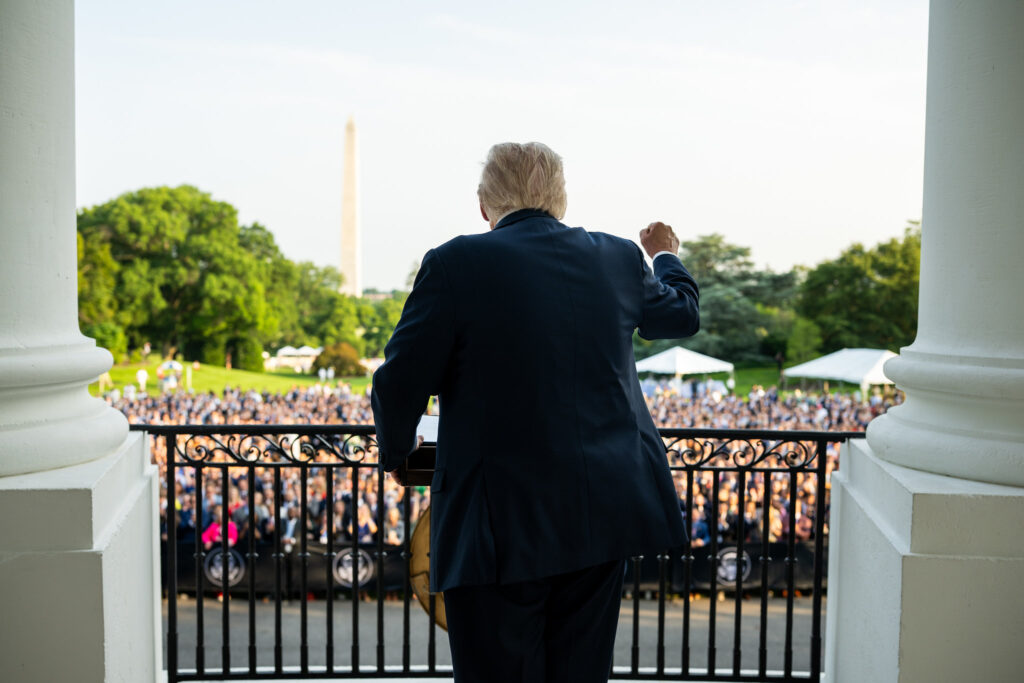
Image from the White House Flickr account.
KEI is registered under the FARA as an agent of the Korea Institute for International Economic Policy, a public corporation established by the government of the Republic of Korea. Additional information is available at the Department of Justice, Washington, D.C.