
Search All Site Content
Total Index: 6910 publications.
Subscribe to our Mailing List!
Sign up for our mailing list to keep up to date on all the latest developments.
The Peninsula
Korea Policy Series: Overcoming Barriers to U.S.-South Korea Shipbuilding Cooperation
Published December 22, 2025
Author: Je Heon (James) Kim, Lydia Shanklin Roll
Category: Economic Security, South Korea, United States, US-Korea alliance
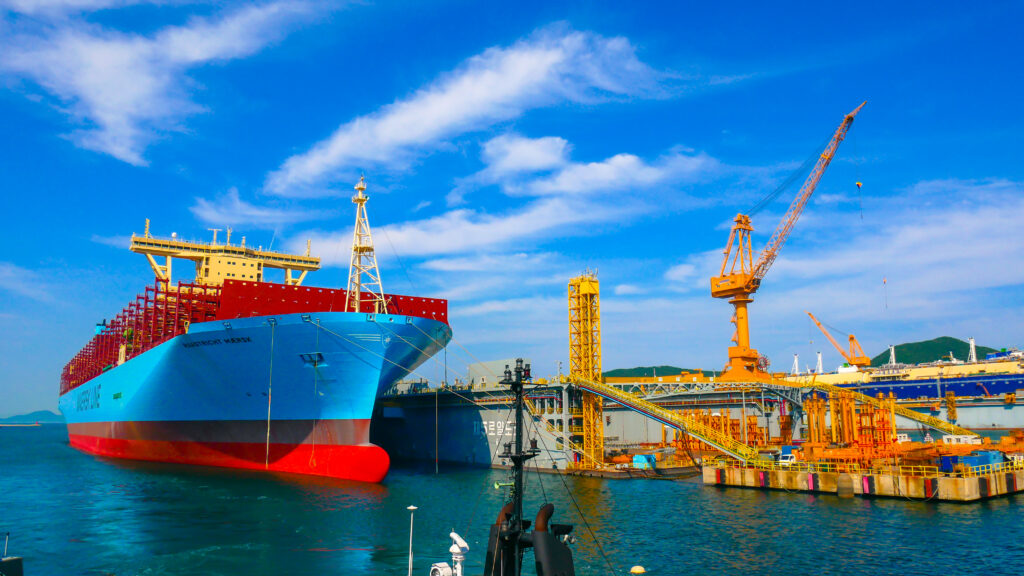
The following policy brief is part of a limited series from the Korea Economic Institute of America inspired by the latest edition of Korea Policy, Volume 3 Issue 2. You can read the author’s full paper by clicking here.
Executive Summary
The U.S. shipbuilding industry reached its zenith during World War II, after which it has been in a precipitous decline. The United States’ current global market share in commercial shipbuilding is 0.04 percent, an output insufficient to meet commercial and military shipbuilding needs. Working with allies, however, may offer the best path to rebuilding the U.S. maritime industry. South Korea, a key U.S. ally, has the second-largest shipbuilding industry globally, built on a high-efficiency, high-output model that is known for its innovative approaches. For this partnership to succeed, however, South Korean shipbuilding investments need to overcome significant structural hurdles related to labor, supply chain, and market demand.
Background: Three Challenges to Revitalizing U.S. Shipbuilding
One challenge is the labor shortage. While there are signs of a post-pandemic recovery in the shipbuilding labor force, recovery has been slower than in other sectors, and the long-term trend still shows that the recent uptick is hardly enough to make up for a general workforce decline dating back to 1980. The problem with labor is really recruitment and retention. The industry average for labor turnover in shipbuilding is approximately 20 to 30 percent, while first-year employee attrition is about 50 to 60 percent. Many experts point to wage differentials and working conditions as the root of these problems.
The second structural challenge is an adequate supply of affordable, high-quality inputs (i.e., raw materials, parts, and components)—or the lack thereof. The top three South Korean shipbuilders each have anywhere between 1,300 and 2,400 suppliers (HD Hyundai: 2,420; Samsung Heavy Industries: 1,430; Hanwha Ocean: 1,334) near their shipyards that can be called upon at any given moment to provide needed parts or labor within days, if not hours. The supply network in the United States is likely substantially smaller than in South Korea, except in the case of special vessels (e.g., nuclear submarines). In fact, Japanese shipbuilders have cited poor supply chains as a major reason for passing on the opportunity to invest in the United States. The supply and price of raw materials such as iron, copper, and aluminum are also important considerations for U.S. shipbuilding.
The final structural challenge is demand. Even if South Korean shipbuilders can address challenges related to the workforce and supply chains to lay the foundation for domestic U.S. shipyards, there must be sufficient demand to justify the long-term investment by guaranteeing profit margins. The UN Trade and Development (UNCTAD) data shows that East Asia accounted for nearly 98 percent of all ships delivered globally in terms of gross tonnage (72 million tons). The United States accounted for only about 0.04 percent (31,000 tons), a record low.
Policy Recommendations
While the above hurdles are not insurmountable, they are difficult to overcome without some much-needed help from the U.S. government. In this regard, the U.S. government should consider the following measures:
- Implementing regulatory reform, which may involve revising, in part or whole, the regulations that restrict foreign purchases of ships or ship parts, which are significantly cheaper and better quality than those purchased in the United States.
- Adopting a phased, combined approach to meet both the immediate need for ships in the United States and the time required for South Korean investments to yield a more robust U.S. shipbuilding industry with the capacity to fill orders efficiently.
- The first phase involves purchases of a limited number of Coast Guard or naval logistics ships (e.g., oilers, support ships, and hospital ships) from allied shipyards that are also investing in U.S. shipyards. The focus during this initial phase of cooperation should be limited to ships that U.S. shipyards have not built or are less efficient in producing.
- The second phase begins when South Korean investments in U.S. shipyards expand domestic capacity. This step involves purchasing some components or modules from South Korean shipyards for final assembly in U.S. shipyards. Again, this medium-term cooperation would address capacity concerns while simultaneously minimizing any adverse impact on domestic shipyards and workers.
- The third phase occurs when U.S. shipyards operated by South Korean subsidiaries have established updated and globally competitive shipyards that are operational at full capacity. In this final phase, the entire shipbuilding process can move to shipyards on U.S. soil, which can compete globally to fill orders for commercial and military ships. Thus, this phase realizes the promises of the Restoring American Maritime Dominance Executive Order and the SHIPS for America Act.
- Providing financial support for the labor training programs that South Korean shipbuilding companies have already committed to and further expanding the annual quota for skilled worker visas in the shipbuilding industry, which would enable more experienced South Korean workers to be recruited to train workers in U.S. shipyards.
- Creating favorable conditions that encourage South Korean investment in U.S. shipyards, such as passing the Building Ships in America Act and SHIPS for America Act.
- Working closely with the shipbuilding industry to weigh in their concerns when it comes to major changes in U.S. trade and tariff policy. It would also help to consider selective waivers, sectoral based quotas, or a phased in tariff schedule that would either shield or help the shipbuilding sector establish a more resilient domestic supply chain.
- Addressing the collateral risk. The announcement by the Chinese government to impose trade bans against the U.S. subsidiaries of a South Korean shipbuilding firm serves as a stark reminder to the South Korean government and corporate entities that sizable investment and business stake in the United States can come at a price not only to their business interests in the United States but also to their facilities elsewhere around the world.
Conclusion
At present, the U.S. shipbuilding industry is plagued by massive time and budget overages. While the United States can address some of these problems through bold reforms and targeted investment, revitalizing the U.S. shipbuilding industry will require a combination of political will, time, and resources. The most important first step is recognizing the reality of this challenge and establishing a baseline consensus on how to address these issues. The good news is that the United States is not alone in this endeavor; there is an eager partner and ally in South Korea, which has a track record for delivering world-class ships on time and at cost. The question is whether U.S. leadership has the courage to take the necessary steps to create the conditions that will make American shipbuilding great again.
Dr. Je Heon (James) Kim is a Director of the Korea Program at The Stimson Center. Dr. Lydia Shanklin Roll is Anthropology Adjunct Faculty at Southern New Hampshire University. All views are the authors’ alone.
Feature image from Shutterstock.
KEI is registered under the FARA as an agent of the Korea Institute for International Economic Policy, a public corporation established by the government of the Republic of Korea. Additional information is available at the Department of Justice, Washington, D.C.