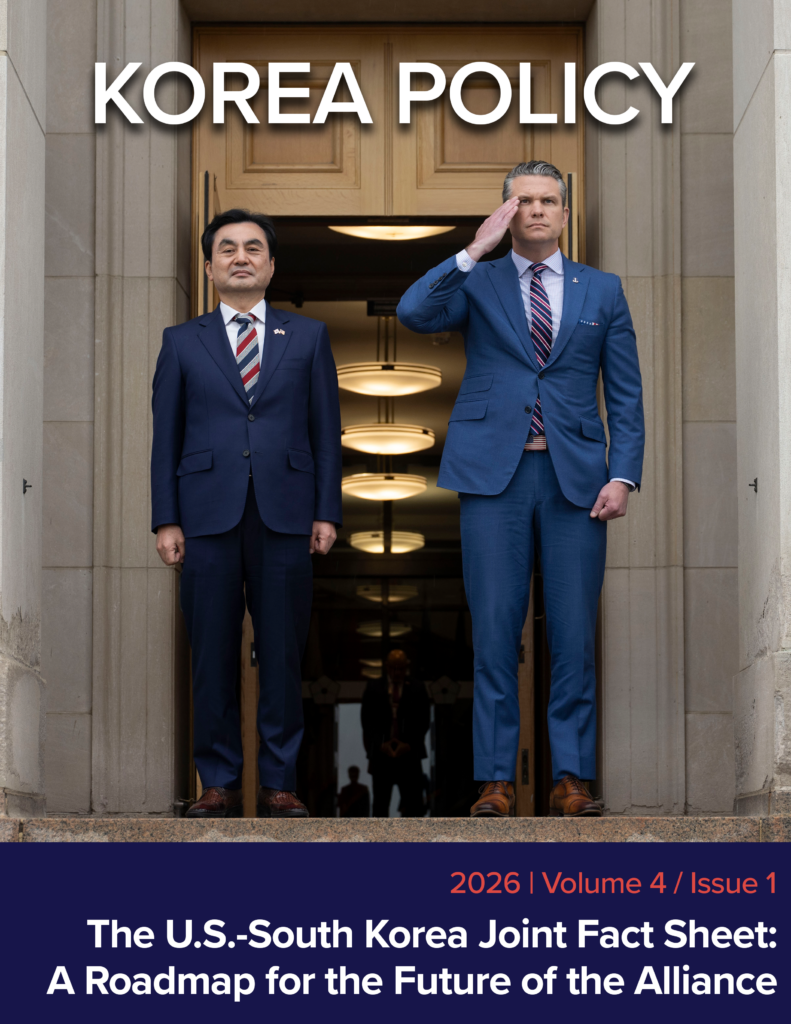
The following policy brief is part of a limited series from the Korea Economic Institute of America inspired by the latest edition of Korea Policy, Volume 3 Issue 2. You can read the author’s full paper by clicking here.
Executive Summary
This paper examines the Lee Jae-myung administration’s China policy, which seeks to balance relations between Washington and Beijing through a strategy of “maximum flexibility.” While Lee has emphasized the U.S.–South Korea alliance as the foundation of his pragmatic diplomacy, he has also expressed a strong desire to improve ties with China. The Lee administration’s pursuit of simultaneity—engaging both powers at once—distinguishes it from its predecessors: the Moon Jae-in government’s pro-China tilt and the Yoon Suk-yeol administration’s pro-U.S. orientation. The strength of this approach lies in avoiding immediate punishment or retaliation from either side, but its weakness is the gradual erosion of trust in both capitals. Despite these risks, maximum flexibility may be the only pragmatic option for the Lee government amid intensifying U.S.–China rivalry and uncertainty surrounding a second Trump administration. This paper analyzes President Lee’s evolving views on China, the structural constraints shaping his policy, and Beijing’s perception of his diplomacy by drawing on Chinese-language sources, including newspapers, academic journals, and expert commentaries.
Background
South Korea’s China policy and the U.S.–South Korea alliance are closely intertwined, like two sides of the same coin. If Seoul moves too close to Beijing, U.S. policymakers may worry about the integrity of the alliance. Indeed, when Lee Jae-myung was elected president of South Korea, there were lingering anxieties in Washington about a potential resurgence of anti-American sentiment under his leadership, given his previously perceived pro-China stance. This concern has led to arguments that the Lee administration must send clear and consistent signals underscoring the importance of the alliance from the outset. To this end, both during the campaign and after his inauguration, Lee has repeatedly stressed that the U.S.–South Korea alliance is the foundation of South Korea’s pragmatic diplomacy. At the same time, however, he has also expressed a strong desire to improve ties with China. This dual messaging once again renders South Korea’s diplomacy ambiguous.
Policy Recommendations
1. For South Korean policymakers: Address challenges posed by China effectively
South Korea should develop strategies to address shared concerns about China. Both the Moon Jae-in and Yoon Suk-yeol administrations emphasized peace and stability in the Taiwan Strait in their joint statements with President Biden—a position the Lee Jae-myung government should uphold. Although raising such issues directly with Beijing may be difficult, Seoul can strengthen its voice through collective expressions of concern in multilateral forums such as the U.S.–ROK–Japan security dialogue.
2. For U.S. policymakers: Recognize Seoul’s strategic constraints and its exercise of flexibility
Washington should recognize that South Korea’s need for strategic space is not a sign of weakening alliance commitment but a necessity for stability on the Korean Peninsula. Encouraging Seoul’s constructive engagement with Beijing—especially on North Korea and regional economic issues—would advance shared interests. Demonstrating the United States’ own flexibility toward the Lee Jae-myung administration’s approach will, in turn, strengthen alliance durability and trust.
3. For both sides: Establish structured dialogue on China policy coordination
A regular bilateral working group dedicated solely to China-related strategic coordination would help prevent misunderstandings over each side’s red lines and objectives. Such dialogue should address economic security, technological cooperation, and regional crisis management. By institutionalizing consultation, Seoul and Washington can advance their respective interests while preserving alliance cohesion amid intensifying U.S.–China rivalry.
Conclusion
The Lee administration has pursued a strategy of maximum flexibility in dealing with China, and so far China has reciprocated with measured responses. This pattern of mutual restraint was evident during the 2025 APEC summits in South Korea. As noted earlier, on October 29, during his meeting with President Trump, President Lee made a surprising request for U.S. support in acquiring a nuclear-powered submarine. The following day, the Chinese government responded by urging South Korea to “fulfill [its] nuclear non-proliferation obligations.” Nonetheless, it is noteworthy that China’s statement emphasized general principles but stopped short of threatening retaliation. On November 1, after his summit with Xi, Lee declared the meeting a success and stated that the two countries had “fully restored” bilateral relations. In this way, while the Lee administration signaled its intention to work more closely with the United States, it also sought to reassure China of its commitment to maintaining stable ties. Recognizing this balancing effort, Beijing appears willing—for now—to manage the bilateral relationship in a cautious and stable manner in kind.
Seong-ik Oh is the Director General for Cadastral Resurvey Planning at Korea’s Ministry of Land, Infrastructure and Transport. All views are the author’s alone.
Feature image from the South Korean Presidential Office.
KEI is registered under the FARA as an agent of the Korea Institute for International Economic Policy, a public corporation established by the government of the Republic of Korea. Additional information is available at the Department of Justice, Washington, D.C.