Search All Site Content
Total Index: 6868 publications.
Subscribe to our Mailing List!
Sign up for our mailing list to keep up to date on all the latest developments.
The Peninsula
A Positive but Guarded Outlook for the U.S. and South Korean Economies
Published August 12, 2025
Author: William Brown
Category: Economic Security, Economics, Indo-Pacific
The U.S. and South Korean economies rebounded faster than expected in the second quarter this year, with annualized rates rising 3 percent and 2.4 percent, respectively. Growth remains steady despite widespread predictions of recessions in both countries, driven in part by political changes in Korea and large tariff announcements in the United States. Forecasts for the rest of the year are wary but generally favorable.

The Bank of Korea (BOK) released data just as Washington and Seoul agreed to a flat rate of 15 percent on most Korean exports to the United States. The tariffs will likely reduce—but not end—South Korea’s trade surplus. High levels of direct and portfolio investments by Korea in the United States will no doubt continue. The deal is similar to the U.S. deals with Japan and the European Union, suggesting no country is getting a large advantage over the other with respect to the giant U.S. market. South Korea may lose some advantages it had with the U.S.-Korea Free Trade Agreement (KORUS FTA), but it will likely gain from tougher U.S. tariffs on China and other countries.
Bank of Korea’s GDP Announcement
The BOK announced preliminary 0.6 percent quarter-to-quarter growth in the second quarter, which approximates a 2.4 percent seasonally adjusted annual rate (SAAR), the headline method used by the United States. This defied expectations, coming after the first quarter decline and amid the imposition of 10 percent U.S. tariffs. The composition of the growth, however, is somewhat less promising, with government spending contributing a third of the growth (0.2 percentage points) and private investment continuing to slide. Export growth was the surprise on the upside, but it faces new challenges with the U.S. tariffs.
The chart below shows the makeup of this growth in the standard expenditure approach to GDP. Data is in percentage points, additive to the GDP total, and not annualized.

Government and private consumption both contributed 0.2 percent, each one-third of the 0.6 percent quarter-to-quarter growth. Government spending increases were largely focused on healthcare, as the population begins to age quickly. The drop in fixed private investment, a 0.4 percent deduction to GDP growth, accelerated from the first quarter as declines in plant and equipment added to large drops in construction. Large inventory investments offset some of that, contributing 0.2 percent to growth, as companies struggled to deal with the changing trade situation.
Exports rebounded from the first quarter, adding 1.9 percentage points to growth, despite the 10 percent U.S. tariffs and weaker demand for Korean imports in China and Europe. Semiconductors, fueled by global AI investment, and auto exports remained strong. Meanwhile, firms may also have been shipping ahead of expected higher third-quarter tariffs.
The new 15 percent tariff began on August 7, though it is not yet clear how they will impact Korean companies. Japan and Mexico, for example, are tariffed as well, and Korean firms may be able to effectively compete. Vietnam and Taiwan, at least for the moment, face even higher tariffs on their exports to the United States, a boon to Korea. Most importantly, the highly competitive Chinese auto industry continues to be shut out of the U.S. market, at least for now.
Imports, subtracted in GDP calculations because they are embedded in other spending categories but not domestically produced, rose sharply as well. Exports of Korean cars, for example, include components imported from China. Adjustments to its import trade, including new antidumping charges against Chinese steel, will also change Korea’s balances. Altogether, net exports added 0.3 percentage points, or about half of the GDP increase in the second quarter.
The BOK has not changed its full-year forecast of 0.8 percent GDP growth, but sources indicate it may raise it slightly.
Second Quarter U.S. GDP
U.S. aggregate output also surpassed expectations with 3 percent growth from the first quarter. Analysis is complicated because the main contribution came from a sharp drop in imports, adding a huge 5.2 percentage point to growth as measured by the U.S. Bureau of Economic Analysis (BEA). Imports only indirectly relate to GDP, as fewer imports mean more of the content of other components is domestically produced, hence the positive impact. Some of the increase in these categories would have come out of inventories that were built up in the first quarter and not newly produced, so BEA estimates inventory disinvestment subtracted 3.2 percentage points.

Personal consumption contributed one percentage point, one-third of all growth, substantially more than expected. Auto sales were the largest contributor. But fixed private investment provided only 0.1 percentage points, held back by a drop in housing and other construction. Relatively high mortgage rates continue to limit housing construction, a cause of disagreement between President Donald Trump and the Federal Reserve.
Exports declined slightly, reducing overall growth by 0.2 percentage points. Finally, in probably the best news for the administration, reduced federal spending took 0.24 percentage points off GDP growth, while state and local spending added 0.32 percentage points. Federal spending usually adds rather than subtracts from growth, but the Trump administration says it wants to reduce the large fiscal deficit, which stands at USD 1.34 trillion for FY 2025.
The bottom line for the United States is that trade measurement issues likely exaggerated the first quarter decline, as they did the second quarter upturn. The average for the first half suggests about 2 percent annual growth—the average rate since the pandemic. Indeed, a first look at the third quarter provided by the Federal Reserve Bank of Atlanta suggests that the economy is currently growing at a 2.5 percent rate based on data from July, though this forecast does not necessarily apply to the whole quarter or year.
An Imbalanced but Complimentary Relationship
Aggregate data over the past year shows the United States and South Korea are closely related despite sharply different macroeconomic conditions. The United States is growing somewhat faster, but so is its labor force and population, yet it faces huge federal and foreign trade deficits, relying on inflows of foreign savings for domestic investment and productivity growth.
Data from Trading Economics pegs the U.S. budget deficit at 6.2 percent of GDP, the largest of all developed countries except Israel, and the current U.S. account deficit, 3.9 percent relative to GDP, is the largest of developed countries except for New Zealand. South Korea, in contrast, is running a growing but smaller government deficit at 3.9 percent of GDP while its current account surplus is one of the largest in the world, at 5.3 percent of GDP. Private Korean savings, made possible by the country’s trade surplus, finance a significant share of the United States’ “twin” deficits and investment. But money leaving Korea to purchase U.S. securities depresses its exchange rate and diminishes domestic investment and potential growth.
Both countries are working to address these issues. President Trump is attacking the U.S. deficits using a combination of tariffs—raising federal income by about a billion dollars a day—and federal spending cutbacks. In contrast, the Lee Jae Myung administration is trying to fend off a drop in domestic demand and weak investment by increasing government spending, lowering interest rates, and allowing—intentionally or not—a cheaper won to improve global competitiveness.
Compounding these policy challenges is the fact that the imbalances are partly driven by different demographics that are difficult to ignore. The United States needs stronger investments, from either domestic or foreign sources, to continue productively employing its growing population. Meanwhile, Korea needs productive investments and higher returns on private savings to support its rapidly aging population and maintain its high-tech economy.
How the new investment fund envisioned in the new U.S.-Korea tariff agreement, a huge USD 350 billion mix of direct and portfolio investments, will influence these imbalances is not yet known. It is unlikely to make much difference in the short run because Koreans will continue to help fund the U.S. trade deficit, in effect lending the money Americans need to buy their products. In fact, the deal seemed to have little impact on the USD/KRW exchange rate. The deal also does not mention any reverse flow of U.S. investments into Korea. As noted in this author’s first quarter GDP article, both countries should invest in each other, maximizing opportunities for the productive use of capital. South Korean officials may raise the issue to assuage domestic concerns of a loss of capital. U.S. firms, for instance, might invest in South Korean military technology production.
Korea should prepare, however, for concerns raised by the U.S. Department of the Treasury that it is lowering the value of the won to offset the costs of higher tariffs. It might respond by saying a reduction in U.S. short-term interest rates—which, at 4.25–4.5 percent for Federal Funds, are double the BOK’s short-term rates—would help Korea’s predicament.
The finance deal is designed to shift Korean investments in U.S. Treasury securities to riskier but potentially more profitable direct investments in U.S. industries, especially shipbuilding. The key for both economies is that these investments enhance the productivity of U.S. labor, raising output and net exports while stimulating positive returns for the Korean investors.
William B. Brown is Distinguished Fellow at the Korea Economic Institute of America and the principal of Northeast Asia Economics and Intelligence, Advisory LLC (NAEIA.com). The views expressed here are the author’s alone.
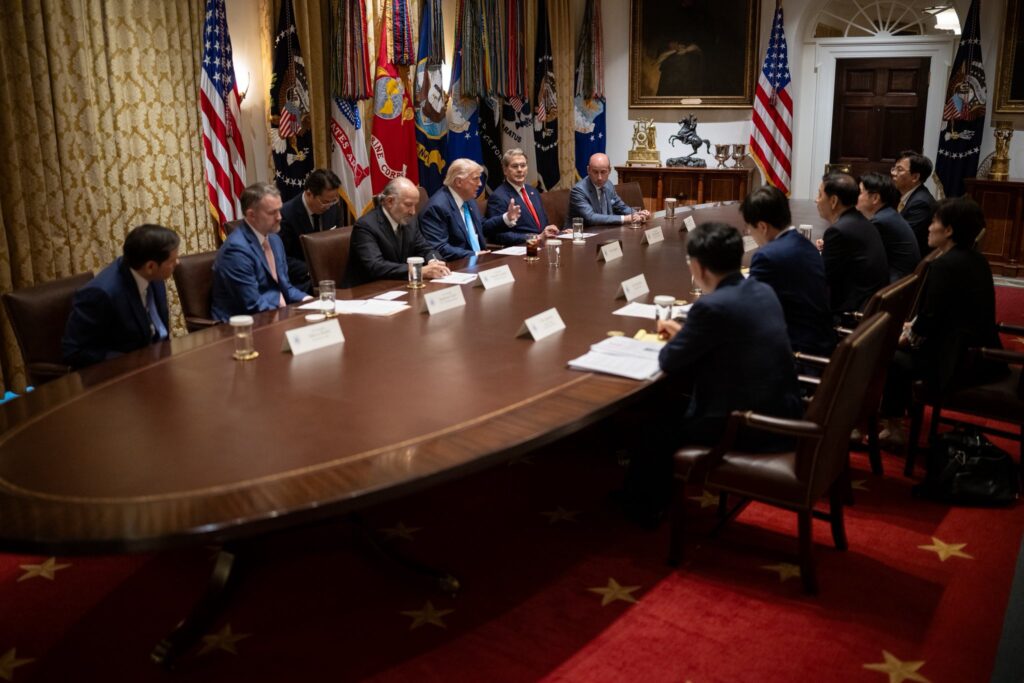
Photo from the U.S. Treasury.
KEI is registered under the FARA as an agent of the Korea Institute for International Economic Policy, a public corporation established by the government of the Republic of Korea. Additional information is available at the Department of Justice, Washington, D.C.