Search All Site Content
Total Index: 6896 publications.
Subscribe to our Mailing List!
Sign up for our mailing list to keep up to date on all the latest developments.
The Peninsula
2025 Year in Review: South Korean Corporate Strategy in the U.S. Market
The following is part of a new miniseries from KEI surveying the most important developments and trends in the U.S.-South Korea relationship in 2025. You can read all year-in-review pieces by clicking here.
Throughout 2025, economic policy and national security became increasingly interconnected, with the United States treating trade deficits and supply chain vulnerabilities as national security concerns. Under the America First Trade Policy, the Donald Trump administration emphasized investment, industrial capacity, and economic strength as key components of national security. The 2025 National Security Strategy also defined economic security as fundamental to national security, including the strength of the industrial and defense base, secure access to energy and critical supply chains, and close coordination with trusted allies.
On April 2, the Trump administration issued an executive order on reciprocal tariffs under the International Emergency Economic Powers Act (IEEPA). The order characterized large and persistent U.S. trade deficits in goods and non-reciprocal trade practices as risks to national economic security and in response authorized country-specific tariff schedules using emergency powers. Around the same time, the administration issued a separate executive order directing a Section 232 investigation into processed critical minerals and derivative products. The investigation focused on U.S. reliance on foreign sources for essential inputs and assessed the potential effects of supply disruptions on both economic activity and defense-related industries. Through these actions, the administration treated trade imbalances and supply chain dependence as national security issues rather than conventional commercial policy matters.
This strategy was also visible in bilateral U.S.-South Korea cooperation. The U.S.-South Korea Joint Fact Sheet situated trade and investment more explicitly within the alliance’s economic and national security objectives, with an emphasis on shipbuilding, energy, semiconductors, and critical minerals. Instead of presenting economic cooperation as a standard feature of a commercial relationship, the document tied South Korean investments to U.S. priorities around industrial capacity, supply chains, and alliance security.
Among these sectors, shipbuilding stood out as the area where South Korean firms’ strategic positioning most clearly corresponded with U.S. priorities, particularly given the April 2025 executive order on restoring America’s maritime dominance.
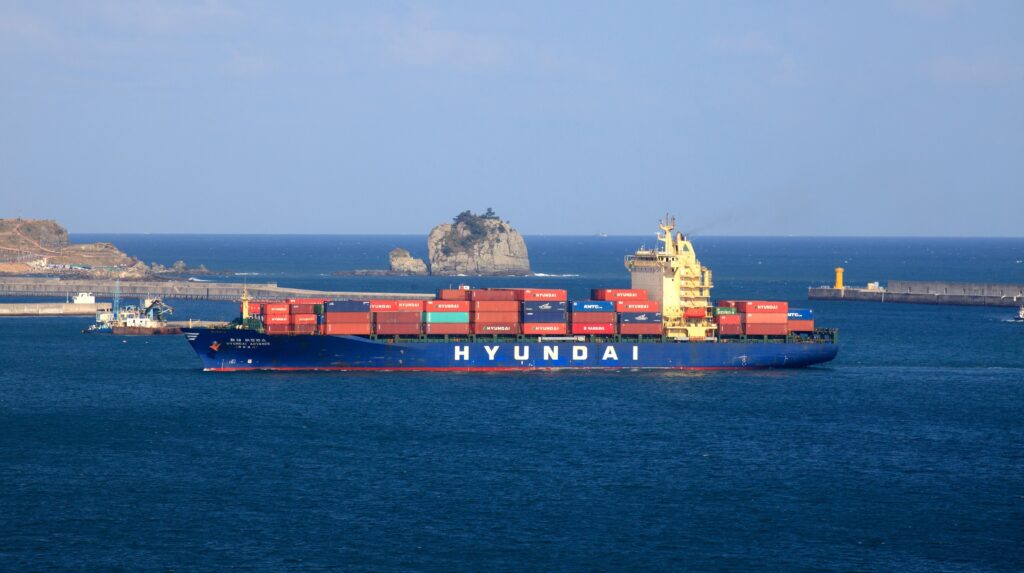
Hanwha Ocean’s U.S. activities increasingly took place within the U.S. defense industrial base, from expanded operations at its U.S. shipyard to playing a larger role in maintenance, repair, and overhaul work for U.S. Navy vessels. HD Hyundai, for its part, engaged in partnerships with U.S. defense and technology firms connected to auxiliary naval vessels and autonomous surface ships. In both cases, participation in the U.S. market became more closely associated with supporting U.S. defense production and domestic shipbuilding capacity, rather than with commercial considerations alone.
A comparable pattern emerged in the energy sector. POSCO International has engaged in the Alaska LNG project, the only federally authorized liquefied natural gas (LNG) export project on the U.S. Pacific Coast. The project features in U.S. plans to expand LNG exports to allied markets and sustain a more secure Indo-Pacific energy supply network. POSCO’s participation as a steel supplier, long-term LNG offtaker, and pre-FID investor placed the company within a U.S. energy project with strategic relevance, illustrating how South Korean firms have taken prominent roles in U.S. energy security.
In 2025, the boundary between economic policy and national security in the United States became noticeably narrower. Trade, investment, and industrial policy were increasingly handled as part of national security, rather than as separate economic issues. This environment led South Korean companies to take a closer look at how their investments related to U.S. priorities. By 2026, these considerations are likely to form a baseline condition for firms operating in the U.S. market, requiring strategic reassessment across sectors to align with U.S. strategic interests rather than traditional market efficiency.
Soobeen Park is a Research Intern at the Korea Economic Institute of America (KEI). All views presented here are the author’s alone.
Feature image from Shutterstock.
KEI is registered under the FARA as an agent of the Korea Institute for International Economic Policy, a public corporation established by the government of the Republic of Korea. Additional information is available at the Department of Justice, Washington, D.C.