
Search All Site Content
Total Index: 6902 publications.
Subscribe to our Mailing List!
Sign up for our mailing list to keep up to date on all the latest developments.
The Peninsula
2025 Year in Review: Progress, Tensions, and What Comes Next for South Korea and Japan
Published January 16, 2026
Author: Terrence Matsuo
Category: Indo-Pacific, Japan, South Korea, U.S.-Korea-Japan
The following is part of a new miniseries from KEI surveying the most important developments and trends in the U.S.-South Korea relationship in 2025. You can read all year-in-review pieces by clicking here.
2025 was a comparatively and unexpectedly calm year in South Korea-Japan relations. Global politics were in flux with the return of President Donald Trump in the United States, and leadership changes in both South Korea and Japan meant that a new dynamic in their bilateral relationship could emerge. Perennial irritants related to history remain, and there is always the possibility that new disputes may erupt. But a look back at South Korea-Japan relations in 2025 shows more continuity than change.
The elections of South Korean President Lee Jae Myung and Japanese Prime Minister Sanae Takaichi were the biggest development in the bilateral relationship this year. The former is a progressive, and given their general skepticism of Japan, his rise to power raised concerns about the trajectory of South Korea-Japan relations. But Lee made a centrist pivot on the campaign trail, saying that he valued U.S.-South Korea-Japan trilateral cooperation. His proactive outreach to Tokyo and other actions as president suggest that this was not simple campaign rhetoric.
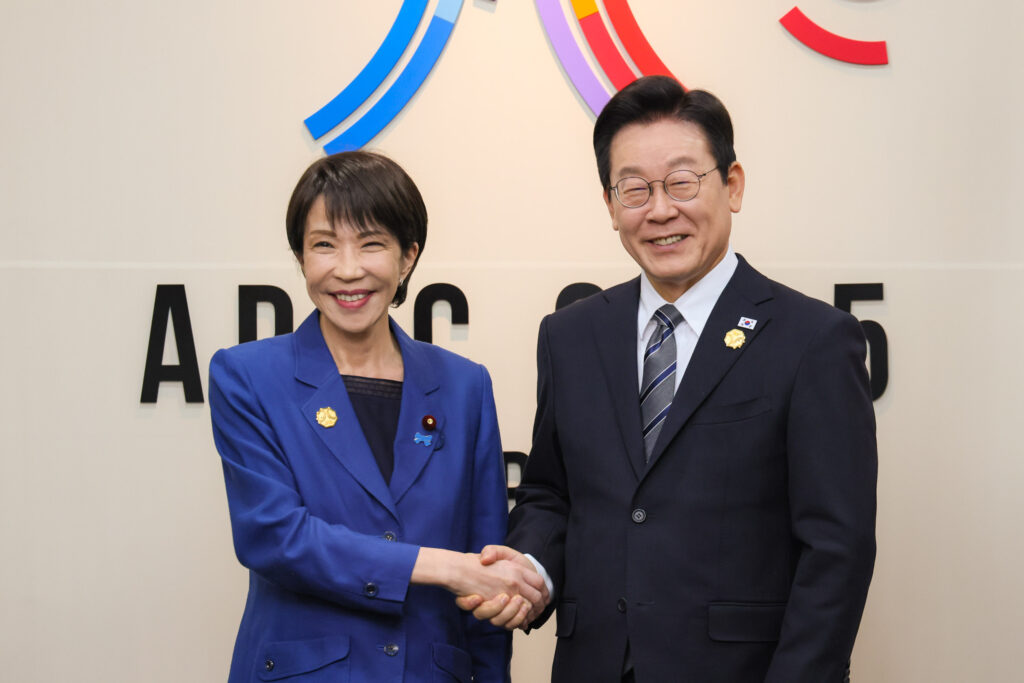
In August, Lee held a summit with then Japanese Prime Minister Shigeru Ishiba, which was notable because it took place before the customary trip to Washington. “Guided by the principle of pragmatic, national interest-focused diplomacy, we will seek forward-looking, mutually beneficial cooperation with Japan while holding frequent meetings and frank dialogues through shuttle diplomacy,” said Lee in Tokyo. This approach is all the more surprising given that Lee’s current counterpart is a staunch conservative and ally of the late Prime Minister Shinzo Abe, who is not particularly well-liked in South Korea. But she too has recognized the importance of a calm bilateral relationship. The two met on the sidelines of the Asia Pacific Economic Cooperation (APEC) summit in Gyeongju, where Lee gifted Korean seaweed and cosmetics to Takaichi. She appreciated the gesture by noting her fondness for the snacks, and said that South Korea was an “important neighboring country.” Lee is preparing to start the new year strong, with a January visit to Nara prefecture in Japan, Takaichi’s hometown. Despite their very different domestic political orientations, many observers have sighed with relief that bilateral relations have remained rather positive.
But there are already a few challenges on the horizon for South Korea as it manages its relations with Japan. The first concerns the sovereignty of the Dokdo Islands, a dispute that has long bedeviled the bilateral relationship. “Dokdo is an integral part of Korean territory historically, geographically and under international law,” said a senior presidential official at the end of 2025. “We will sternly and firmly respond to Japan’s unjust claims over Dokdo.” The statement was in response to a comment Takaichi made during a parliamentary session that the islands were Japanese territory. Progressive politicians in South Korea are known to benefit from criticizing Japan, and renewed criticism is possible if Lee faces domestic political challenges.
Another challenge for South Korea will be navigating renewed Japan-China tensions, which began after Takaichi said in November that a naval blockade of the island of Taiwan would “constitute a situation that could be deemed a threat to Japan’s survival.” It is an open question as to what South Korea would do in the event of a contingency in the Taiwan Strait, and South Korea is understandably interested in preventing a blowup in relations with either Japan or China.
2025 was always going to be significant for South Korea-Japan relations because it was the fiftieth anniversary of the two countries establishing diplomatic relations. The elections of progressive Lee and conservative Takaichi could have heralded a major downturn in relations, but the two leaders have so far focused on maintaining the upward trend established by their predecessors. As South Korea and Japan welcome 2026, it remains to be seen if this will continue, or if changes in the international environment or domestic pressures will freeze diplomacy.
Terrence Matsuo is a Non-Resident Fellow at the Korea Economic Institute of America. The views expressed here are the author’s alone.
Feature image from Prime Minister Takaichi via X.
KEI is registered under the FARA as an agent of the Korea Institute for International Economic Policy, a public corporation established by the government of the Republic of Korea. Additional information is available at the Department of Justice, Washington, D.C.