
Speakers


Irene Kyoung
Research Associate, Korea Program
Walter H. Shorenstein Asia-Pacific Research Center, Stanford University

Salome Da Silva Duarte Lepez
International Health Law, COVID Vaccine Policy & Biostatistics
Johns Hopkins Bloomberg School of Public Health, MPH ’22
Speakers

Event Details
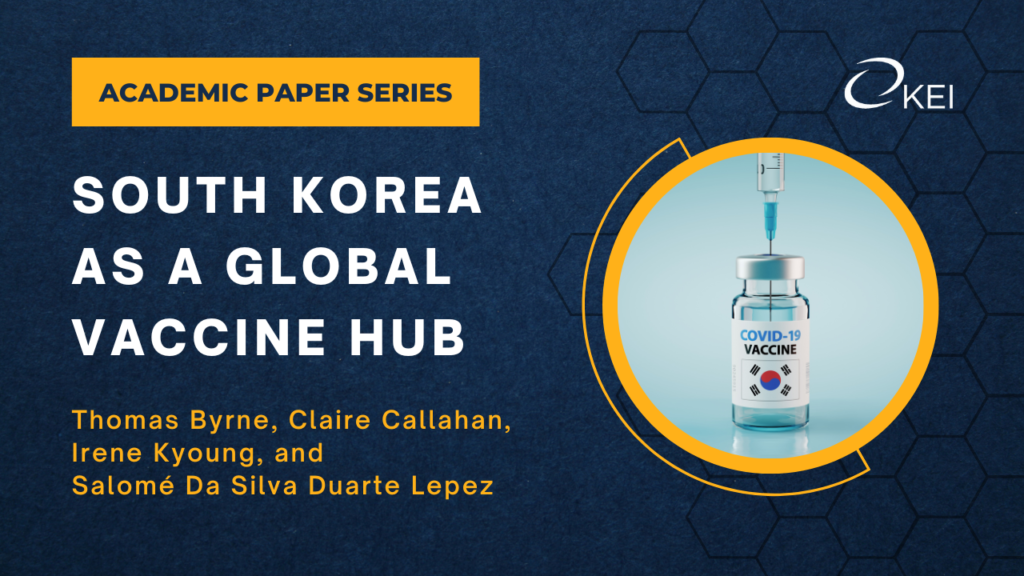
Early in the pandemic, South Korea drew widespread praise for the speed and efficiency of its response to slowing the spread of the virus and saving lives. However, despite this initial success, South Korea faced vaccine nationalism and other access challenges in its effort to secure Covid-19 vaccines. Spurred by these challenges, South Korea established a national strategic policy to become a global vaccine hub, not only to meet the current and future public health needs of its own population but also to assist low- and middle-income countries (LMICs) facing even starker obstacles in accessing safe and effective vaccines.
Please join KEI for a discussion with the Thomas Byrne, Claire Callahan, Irene Kyoung, and Salome Da Silva Duarte Lepez about how global vaccine access and equity was hindered by the shortcomings of national and bilateral vaccine diplomacy and multilateral mechanisms during the Covid-19 pandemic, and how South Korea’s demonstrated capabilities to rise as global vaccine development, manufacturing and training hub will help bolster global public health capacities in the future.