
By Tom Ramage
The Shared Economic Interests at the Center of Korea-Japan-China Trilateralism
Amidst a shifting global economic order, the meeting brought a new sense of dynamism to economic cooperation among the three countries.
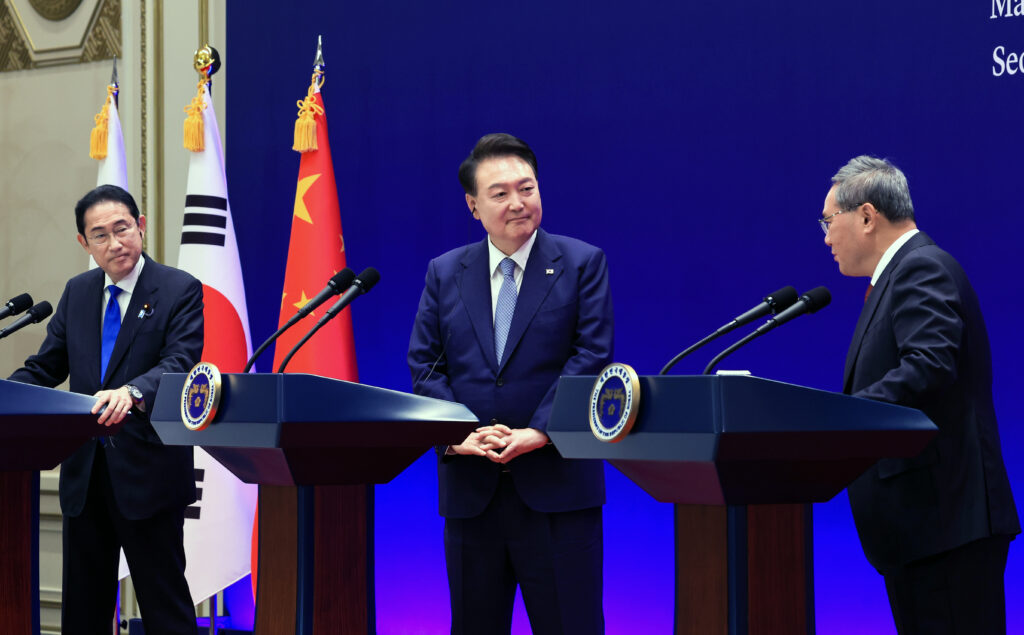
The Ninth Korea-Japan-China Trilateral Leader Summit, hosted in Seoul on May 27, marked the first meeting since the annual event went on hiatus after 2019. Amidst a shifting global economic order, its proclamations affirmed continued trade relations with China by Korea and Japan and brought a new sense of dynamism to economic cooperation among the three countries.
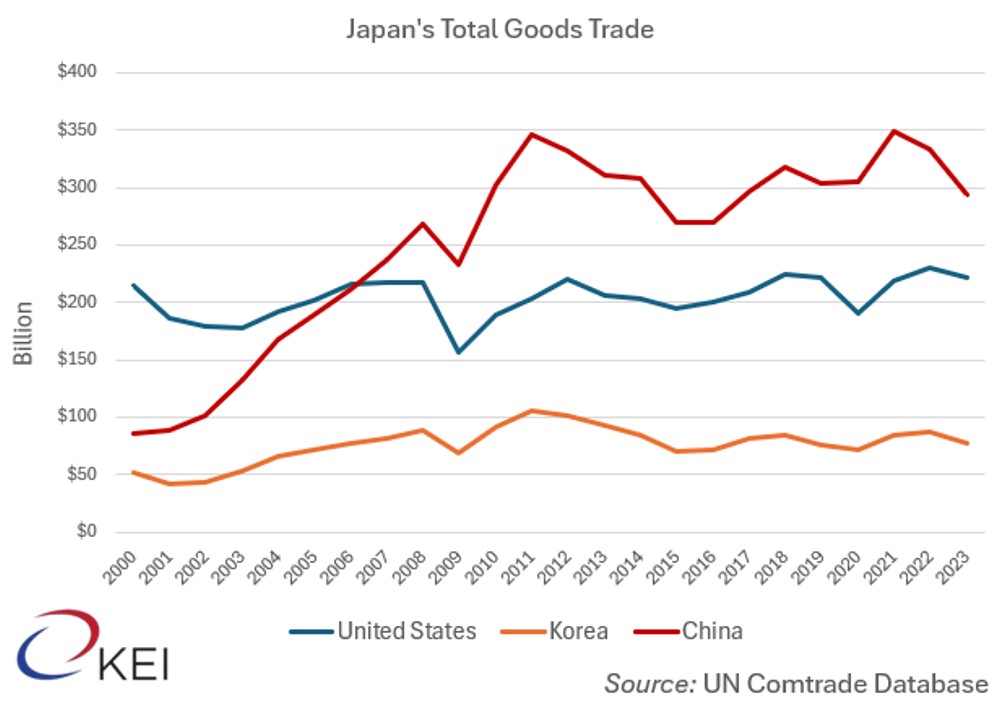
The three East Asian nations combined comprise nearly a quarter of the world’s GDP, as Korean President Yoon Suk Yeol highlighted in his introductory remarks at the summit. Where Korea and Japan seek to find their footing in overlapping economic and security partnerships, China seeks to maintain its primacy as the top total trading partner for both countries. This divergence gives a particular nuance to the resumption of talks and validates the role of shared trade ties as a foundation for ongoing engagement. Accordingly, even with increasing military and economic polarity in the region, the affirmations on the trilateral’s institutionalization economic commitments are strong indicators that Korean and Japanese economic engagement with China is likely to continue.

Trade relations formed a linchpin of the summit’s discussion topics. President Yoon called for the prompt resumption of suspended negotiations on the Korea-Japan-China free trade agreement (FTA) and stated that, “if businesspeople from Korea, Japan, and China join forces, the three countries can become leading figures in leading the world.”
Along similar lines, Chinese Premier Li Qiang elucidated a five-point proposal for enhancing Korea-Japan-China cooperation. His second point called for completing negotiations on the Korea-Japan-China FTA as soon as possible, and he noted that the three countries should increase their contributions to regional prosperity and stability.
Japanese Prime Minister Kishida Fumio took the chance to address specific trade issues in separate bilateral meetings with President Yoon and Premier Li. Kyodo News reported that Prime Minister Kishida asked for an immediate lifting of China’s blanket import ban on Japanese seafood, which has been in place since August 2023, while a separate bilateral discussion between President Yoon and Prime Minister Kishida covering energy, technology, and supply chains partly centered on the two countries’ recent spat over Korean tech firm Naver.
All three countries were brought together in a joint declaration that included economic cooperation and trade as one of the six areas for collaboration and committed to continuing the trilateral summit on its annual basis. Seeking to “narrow the regional development gap and achieve common development,” it singled out supporting the World Trade Organization (WTO), Regional Comprehensive Economic Partnership (RCEP) Agreement, and ASEAN+3 arrangement while advocating for a functioning dispute settlement mechanism in the WTO by the end of 2024. To this end, it furthermore welcomed the Trilateral Entrepreneurs Forum as the next step for continuing business exchanges and echoed leader-level declarations in calling for the accelerated completion of an FTA.
A commitment focusing on intellectual property (IP) was also introduced. Dubbed the “10 Year Vision for Trilateral IP Cooperation,” or “Trilateral+X IP Cooperation,” it syndicates shared efforts to introduce an overhauled trilateral IP system and eyes its potential as a broader regional framework by calling for its expansion to areas “beyond the three countries.” Promoting technology cooperation between Seoul, Tokyo, and Beijing, the deliverables inside complement tech initiatives laid out in the joint declaration, such as the continuation of the Yellow Sea Rim Economic and Technology Exchange Conference, and make use of IP dialogues as a pathway forward to reconcile the many areas of technology overlap in the region.
Beyond this, the summit was significant in shaping a broader geopolitical New Great Game. Some see China as building an “alternative order” to counter perceived US hegemony. It can be argued that, for Beijing, the summit was a counterweight to the solidifying US-Korea-Japan trilateral that China views as inimical to its influence. Although there seemed to be no reciprocity by either President Yoon or Prime Minister Kishida on this, to the theory’s credit, Premier Li urged the need to “promote multipolarity in the world and oppose the formation of blocs or camps” during the summit discussions.
At the very least, all of this suggests that China views engagement with Korea and Japan as central to its strategy in Asia and that shared trade ties will continue to drive diplomatic engagement between the three countries. While the United States seeks to increase its own cooperation with Korea and Japan, for example, by mirroring the institutionalization of the Korea-China-Japan trilateral office, China’s return to the trilateral meeting is a sign that it is competing for the same level of deeper cooperation. How this will shape foreign policy priorities or reshape the world’s economy will be watched with much anticipation.
Tom Ramage is an Economic Policy Analyst at the Korea Economic Institute of America. The views expressed here are the author’s alone.
Photo by Shin Yug-yeong on the Republic of Korea’s official Flickr account.
KEI is registered under the FARA as an agent of the Korea Institute for International Economic Policy, a public corporation established by the government of the Republic of Korea. Additional information is available at the Department of Justice, Washington, D.C.