
What Japan’s 2026 Defense White Paper Says About South Korea
Japan’s 2026 defense white paper indicates that the country is looking to supplement the U.S.-Japan alliance with expanded partnerships, and South Korea should take advantage of emerging new opportunities for cooperation.
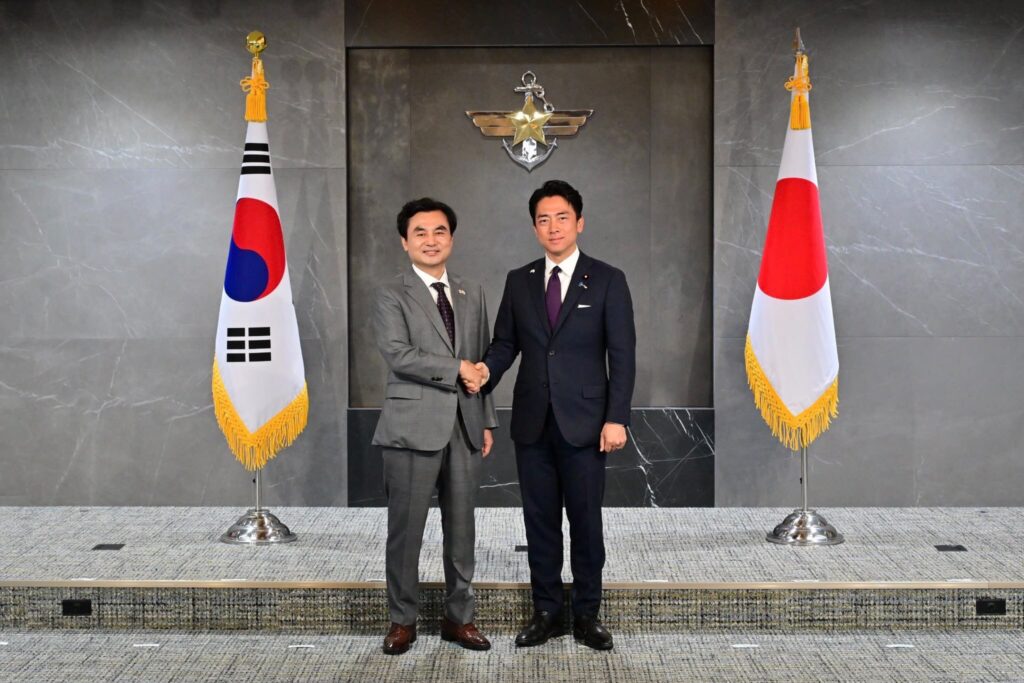
Japan will rewrite three core security documents before the end of the year, and its 2026 defense white paper, released August 4, is the last public preview of what the revisions will say about South Korea. Tokyo sees a region growing more dangerous and Pyongyang’s missile programs as a continuing threat. It also wants more defense partners than the United States alone, especially for what Minister of Defense Shinjiro Koizumi calls a “new way of warfare.” South Korea is an obvious candidate for ongoing and greater defense cooperation.
Japan’s annual white paper lays out the country’s core national security challenges and outlines how it will work to overcome them. In the English-language translation of his foreword, Defense Minister Koizumi said that “it is imperative that Japan further reinforce and transform its defense capabilities with a stronger sense of urgency and crisis than ever before.” Under the leadership of South Korean President Lee Jae Myung and Japanese Prime Minister Sanae Takaichi, relations between South Korea and Japan are on an upswing. The Japanese white paper shows that the two countries still have new areas of cooperation to pursue.
The white paper’s description of the Korean Peninsula shows that Japan views it as a major area of concern. Stability on the peninsula “is an exceedingly significant problem not just for our country, but the peace and stability of the entire East Asia region.” Japan also warned that North Korea is “pursuing operationalization of long-range cruise missiles designed to carry a nuclear warhead.” These illicit North Korean technologies are an existential threat to Japanese security and, along with the abduction of citizens by North Korean agents, will remain a priority for Japanese policymakers.
Meanwhile, “South Korea is an important neighboring country that [Japan] should cooperate with as a partnership to address various challenges in international society,” says the white paper, noting that the two countries share an interest in cooperating against North Korean nuclear weapons development, counterterrorism, and natural disaster response, among other pressing challenges. To deepen cooperation, the white paper notes high-level exchanges between South Korea and Japan, both at the senior level and between specific services. It also highlights major joint exercises done with South Korea under the trilateral partnership with the United States. “The importance of Japan-Korea coordination is becoming more important,” the white paper says.
At the same time, Japan says it is looking to expand its security cooperation with like-minded states. The white paper says the U.S.-Japan alliance remains the foundation of Japan’s national security policy, but the country will also “proactively promote diverse and multi-layered defense cooperation and exchanges.” The goal of these initiatives will be the “implementation of systematic frameworks of defense material and technology transfer arrangements such as including reciprocal access agreements and acquisition and cross-servicing agreements.”
South Korea should similarly consider deepening relations with Japan to supplement the U.S.-South Korea alliance. One short-term way to do this is through port calls by Japanese Maritime Self-Defense Force (JMSDF) ships. Although the Japanese Ministry of Defense held over five “high-level exchanges” with South Korea, there were no recorded port calls made by the JMSDF in South Korea. To be sure, Japanese personnel have trained with South Korean colleagues in military exercises like Freedom Edge to promote military readiness, but as a type of people-to-people exchange, port calls can allow sailors on both sides to develop personal, informal relationships that can help insulate the bilateral relationship. The last publicized port call by a Japanese ship was back in May 2023, when the JS Hamagiri participated in the Eastern Endeavor 23 exercises in Busan. Colonial legacies and disagreements over their resonance and impact, including views of the rising sun in the JMSDF’s naval ensign, have contributed to fewer port calls than may otherwise occur. These historical issues remain sensitive in South Korea, but may become less of an obstacle over time if the political environment improves and relations at the top remain warm and friendly.
In addition to strengthening individual relations, South Korea may also consider broader agreements with Japan that expand interoperability and reduce obstacles to sharing defense materiel. Reciprocal access agreements (RAAs) govern the activities of one state’s defense personnel while in the jurisdiction of another, with the goal of enhancing cooperation and coordination. Japan inked its first RAA with Australia in 2022 and another with the Philippines in 2024. An acquisition and cross-servicing agreement (ACSA) is defined by the U.S. Department of Defense as an agreement that “allows for reciprocal provision of logistic support, supplies, and services on a reimbursement basis,” and makes it easier for states to obtain, transport, and pay for the necessary equipment in the event of a crisis. South Korea and Japan have signed ACSAs with other states, but the two do not have an agreement of their own. As defense cooperation between Seoul and Tokyo continues to deepen, these types of agreements support greater interoperability that will be necessary during a crisis.
Finally, Japan’s white paper suggests that jointly developing defense technology with South Korea is another area of opportunity. Defense Minister Koizumi says that a “new way of warfare” is emerging, pointing to Russia’s invasion of Ukraine and that states are preparing “mass employment of unmanned assets, as well as getting ready for prolonged conflicts, bringing accelerated changes to the security environment in a wide range of domains.” To address this changing environment, the white paper says Japan must support defense technology innovation in both the private and public sectors. Drone/anti-drone warfare is one possible area of cooperation, given North Korea’s growing experience via its involvement in Ukraine.
Space and related technologies are another area where experts have long advocated cooperation between South Korea and Japan. The white paper states that authorities will reorganize the Japanese Air Self-Defense Forces to include space—in support, South Korea should step up its cooperation with the U.S. Space Force. Sharing views on reforming their respective air forces to include the space domain could be an area for deeper cooperation.
White papers and similar documents do not necessarily dictate policy, but they do offer insight into how policymakers think and what they prioritize. Japan’s most recent white paper indicates that Japan views its regional security environment as deteriorating and continues to have concerns about North Korea. It also shows that Japan is looking to supplement the U.S.-Japan alliance with expanded partnerships and cooperation with like-minded states, especially to deal with the “new way of warfare.” As an important neighbor with shared interests and values, South Korea should take advantage of this mindset and look for ways to deepen its relationship with Japan. While these may face the usual difficulties, neither South Korea nor Japan should let the past derail cooperation in the present and ensure a safe and prosperous future.
Terrence Matsuo is Nonresident Fellow at the Korea Economic Institute of America (KEI). The views expressed here are the author’s alone.
This material is distributed by KEI on behalf of the Korea Institute for International Economic Policy. Additional information is available at the Department of Justice, Washington, DC.