
By Clint Work
Can Seoul Take the Lead & The Alliance Expand Its Aperture?
The drivers for a South Korean lead role on the peninsula and a broader role for the alliance’s combined defense posture beyond it may be greater than ever.
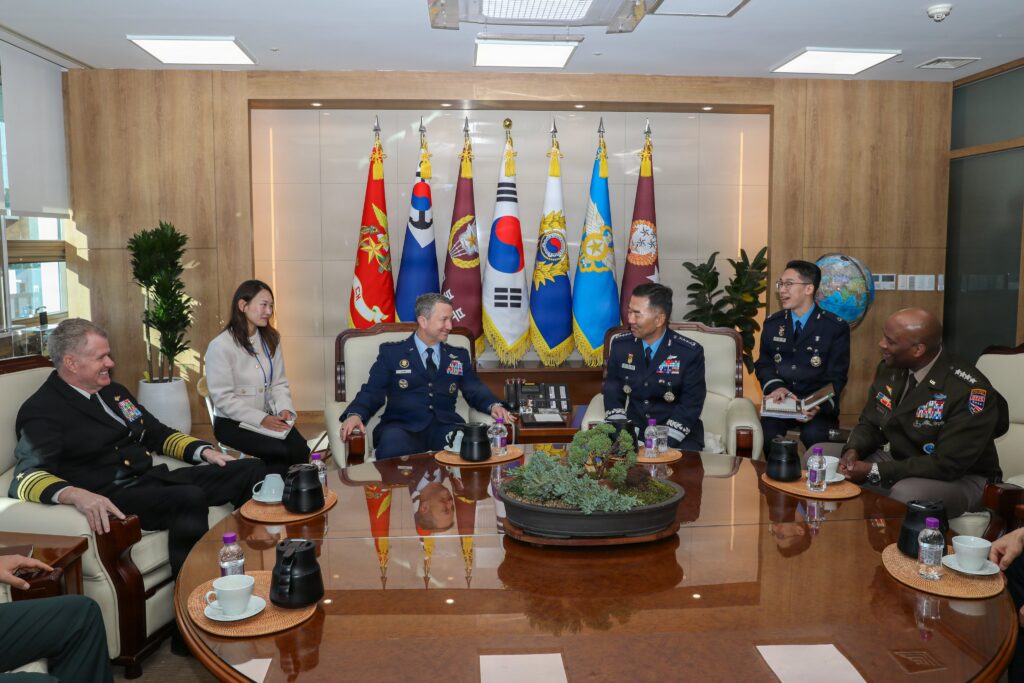
U.S. and South Korean defense authorities met for the fifty-seventh Security Consultative Meeting (SCM) on November 4 in Seoul. Conventionally, the SCM Joint Communiqué is released at the conclusion of the meeting; however, this year it was delayed, coinciding with the release of the long-awaited Joint Fact Sheet on U.S. President Donald J. Trump’s meeting with South Korean President Lee Jae Myung.
In some areas, the communiqué’s language reveals continuity in alliance policy. In others, the revision, removal, or reintroduction of language can indicate subtle or even significant policy shifts. To properly analyze any single communiqué, it must be placed in proper context, including in relation to other U.S, South Korean, and joint alliance statements, current and past trends in the relationship, and previous joint communiqués. The following provides such contextualized analysis, specifically focused on the issue of wartime operational control (OPCON) transition and its connection to a rhetorical broadening of the alliance’s regional aperture.
A Leading Role in the Defense of the Korean Peninsula
In the communiqué’s first substantive section, South Korean National Defense Minister Ahn Gyu-Back “emphasized that the ROK will assume the leading role in the defense of the Korean Peninsula,” which U.S. Defense Secretary Pete Hegseth welcomed. President Lee—in the context of self-reliant defense and striving to complete wartime OPCON transition within his term of office—has emphasized the same point.
Language on South Korea taking the lead role in the defense of the Korean Peninsula is hardly new; it goes back to early post-Cold War U.S. regional policy initiatives in the 1990s, was repeated in the 2009 Joint Vision Statement, and was mentioned several times over the last decade in the sections on wartime OPCON transition in SCM communiqués. Rhetorically speaking, the alliance has been here before.
At the 2017 Trump-Moon Jae-in summit, both leaders decided to “expeditiously enable the conditions-based transfer” of wartime OPCON. Months later, the 2017 SCM communiqué stated that U.S. and South Korean defense authorities were going to “implement steadily” the leader-level political decision to “enable the expeditious” transfer. However, by 2019 only South Korean officials continued to unilaterally mention an expeditious process. While Moon administration officials pushed for a time-based approach to complete wartime OPCON transition before President Moon left office in early 2022, they failed to achieve the goal and caused pushback and frustration among U.S. officials.
Ultimately, though, the friction was fruitful. Officials learned lessons and in 2022 better synchronized elements of the Conditions-based OPCON Transition Plan (COTP) by aligning South Korea’s acquisition of critical capabilities with the process by which its ability to lead the combined defense posture was assessed and certified. Meanwhile, the Yoon Suk Yeol administration deemphasized taking the lead role and instead pushed intra-alliance bargaining for a more robust extended deterrence commitment.
The reemergence and prominent placement of language in the latest communiqué about South Korea taking the lead role reflects alignment between the Lee administration’s priorities and the Trump administration’s push for allies to take on a greater burden in defense spending and in military roles. It also tracks with similar language in the joint fact sheet, which states: “With the support of the United States, the ROK pledged to accelerate efforts to strengthen its military capabilities necessary to lead the combined conventional defense against the Democratic People’s Republic of Korea (DPRK).” Consistent with language used since 2020, the latest communiqué reaffirms that the “conditions stated in the bilaterally approved COTP must be met before wartime OPCON is transitioned,” but the use of words like “expedite” and “accelerate” in the communiqué and joint fact sheet further shows this added political impetus. Yet challenges remain.
The Devil is in the Details
Within South Korea, there is widespread ignorance about COTP’s conditions—even among defense analysts—and a lingering belief that they are arbitrarily or unrealistically set. However, conditions #1 and #2—Seoul’s acquisition and development, respectively, of critical South Korean and alliance military capabilities—are quite clear and concrete, as is the three-phase process by which they are assessed and certified. But condition #3—a security environment on the Korean Peninsula and in the region that is conducive to a stable OPCON transition—is open to interpretation. Furthermore, wartime OPCON transition has been alliance policy since 2007 but has gone through several different plans, including several revisions to COTP itself. Some wonder why it can’t be revised again.
Nonetheless, as noted, all indications are that COTP was refined through a contentious yet constructive process into a coherent, achievable plan. If the latest communiqué’s mention of a “roadmap” to acquire the capabilities necessary to expedite the fulfillment of conditions and pursue the certification of Full Operational Capability (FOC)—when capability and system development is complete, all designated units or organizations have received the system, and those organizations can operate and maintain it—is geared to proactively complete COTP, and both sides are in concert, then it may be a positive sign.
However, if the “roadmap” is viewed by South Korean officials as means to cut corners on mutually agreed-upon conditions and U.S. officials are not supportive or oppose the effort, it could result in alliance frictions and another delay in a two-decades-long alliance policy. It bears note that the reason FOC certification has not occurred thus far is that Seoul has not acquired all required South Korean and alliance capabilities to lead the combined defense. Does it want certification without doing so? If so, is it prepared for the consequences of that decision?
To be fair, U.S. officials have historically approached the issue of OPCON with a “control rod” logic which, as I describe elsewhere, “holds that by having a U.S. commander in the lead role (i.e. the control rod), the United States can maintain control or, more accurately, a degree of relative if still considerable influence over the security environment on the peninsula.” The logic is that this ensures credibility in deterring North Korea, mitigates crisis escalation including restraint of disproportionate ROK retaliation, and, if necessary, allows the U.S. to lead in a conflict and shape an outcome consistent with U.S. interests.
At times, such logic has delayed wartime OPCON transition, and aspects of this U.S. mindset are rooted in the stark patron-client origins of the alliance and are overly hierarchical. However, U.S. reticence to move forward with wartime OPCON transition without South Korea meeting mutually agreed-upon conditions is also grounded in prudent and reasonable concerns not only about whether South Korea has acquired and integrated the proper military hardware but also whether it has the right software to lead a combined fight, to which the United States remains treaty bound.
On the South Korean side, proponents of wartime OPCON transition seem unaware of various important facts about the transition, opening the door to unintended consequences. The ROK/U.S. Combined Force Command (CFC) does not, in practice, violate either country’s highest sovereign authority. The CFC Commander is a four-star U.S. officer and his Deputy Commander a four-star South Korean officer, but the CFC operates on a binational basis through established bilateral consultative mechanisms, including both countries’ highest military and defense authorities, and both presidents retain their inviolate authority as commanders-in-chief of their respective armed forces.
In U.S. Joint Doctrine, operational control is not the same as command authority. It is derivative of command authority, is transferred for a specific period and mission, and consists of passing to the CFC Commander the authority to assign tasks to forces and units already deployed by both presidents, as the commanders-in-chief. The CFC Commander cannot change the mission of or deploy South Korean forces outside the area of responsibility agreed upon by both countries’ commanders-in-chief. The CFC Commander is under the firm direction and guidance of both nations’ political and military leaders in a consultative manner, receiving strategic guidance from the U.S. Joint Chiefs of Staff (JCS) and Secretary of Defense and the South Korean JCS and Minister of National Defense alike.
If wartime OPCON transition is complete and the alliance transitions to a South Korea-led Future Combined Forces Command (F-CFC), a four-star South Korean officer will become the Commander and a four-star U.S. officer the Deputy Commander, but the overall structure and consultative processes will remain the same. Nonetheless, it seems as though some of the South Korean political hands that are the firmest proponents of wartime OPCON transition are more interested in the optics and symbolism of the transition than they are the mechanics of the combined command. Or they may have mistaken ideas about the authority the South Korean Commander will have because of wartime OPCON transition.
Perception Versus Reality
There is a longstanding tendency within South Korea to see United States Forces Korea (USFK)’s capabilities as belonging to the Korean Peninsula. Seoul’s lack of speed in acquiring certain capabilities required by COTP appears grounded in the belief that it can indefinitely depend upon U.S. capabilities. With wartime OPCON transition, some in South Korea may think they will have gained greater ownership over U.S. capabilities. Not only is this incorrect, but U.S. officials may well decide that some capabilities can be moved elsewhere because of the transition. The Lee administration may hope to fast track the process, but it needs to think about how this may affect U.S. force posture and structure.
Additionally, there may be misconceptions in Seoul about what wartime OPCON transition entails regarding ROK authority over the employment of U.S. forces and capabilities in the event of a conflict. Such misconceptions should be worked through in the process of developing the alliance’s operational plans for a post-transition environment. Yet if ROK authorities assert themselves in ways that run counter to U.S. joint doctrine or think they challenge national authorities that wartime OPCON transition does not effect, it may result in friction particularly during a crisis.
Additionally, the political optics of wartime OPCON transition may have powerful effects in Washington. Sovereignty (or the perception thereof) goes both ways. For years, lawmakers in the U.S. Congress have expressed reservations about putting U.S. forces under wartime OPCON of a South Korean officer, which likely explains why specific oversight language about wartime OPCON transition has made its way into the recent National Defense Authorization Act (NDAA). In an America First policy context, such sentiments are amplified. One can try to explain to a representative or senator that a South Korea-led F-CFC (like the current CFC) does not violate national sovereignty. But it looks like it does. This may not prevent wartime OPCON transition from happening, but it may result in a fundamental reconsideration of the U.S. presence and commitment in a post-transition environment.
It’s About More than North Korea and the Korean Peninsula
It is critical to note that following the language in the communiqué on South Korea taking the leading role, it states: “The United States and the ROK will enhance U.S. conventional deterrence posture against all regional threats to the Alliance, including the DPRK.” In other words, South Korea taking a lead role in conventional deterrence of North Korea, embodied through wartime OPCON transition, appears linked, at least discursively, with enabling the U.S. conventional posture on the peninsula to better handle multiple threats to the alliance on, around, and beyond it.
The Joint Statement of the fiftieth Republic of Korea and United States Military Committee Meeting (MCM), held the day before the SCM, sent an even clearer message. Following a description of growing North Korea-Russia cooperation, it noted, “the Alliance is effectively managing the threats through a strong combined deterrence,” and “that combined deterrence extends beyond the Korean Peninsula and contributes to regional deterrence.” Furthermore, USFK General Xavier T. Brunson, Commander of United Nations Command (UNC), CFC, and USFK, released an article recently that more concretely laid out the geographic and force posture advantages the peninsula offers in relation to North Korea, Russia, and China.
This emerging and increasingly amplified language on regional threats, alongside the push for South Korea to take the lead role on the peninsula, highlights an effort to reimagine and repurpose not just U.S. forces but also the alliance’s combined force posture, not only for deterrence of multiple threats other than North Korea on the peninsula but for deterrence of multiple threats beyond it. While U.S. officials and military officers have been sending this message in unilateral statements for years, the latest communiqué and fact sheet show the message is being featured more prominently in U.S.-South Korea joint statements.
What remains uncertain is whether the alliance is prepared for such a shift. Stating something in a high-level joint statement or communiqué does not make it so. To actualize the language examined above would require the alliance to prepare for third-party intervention during a crisis or conflict on the Korean Peninsula, a range of regional contingencies beyond it, and for how such scenarios could intertwine. Such efforts are incredibly sensitive. North Korea and China—both of which have already disparaged the latest statements—would criticize such efforts, use them to justify their own aggressive and coercive activities, and exploit differences between the United States and South Korea in the process.
Does the language in the latest communiqué represent a patchwork of unilateral statements and bilateral compromises or an integrated alliance strategy? The drivers for a South Korean lead role on the peninsula and a broadened role for the alliance’s combined defense posture beyond it may be greater than ever. Yet it remains to be seen if the alliance can navigate such a shift. At root, it will require the transformation of decades-old institutions and psychologies and a fundamental renegotiation of the alliance bargain.
Clint Work is a Research Fellow at the Institute for National Strategic Studies. The views expressed are the author’s alone.
Photo from United States Forces Korea.
KEI is registered under the FARA as an agent of the Korea Institute for International Economic Policy, a public corporation established by the government of the Republic of Korea. Additional information is available at the Department of Justice, Washington, D.C.