
Contemporary American Public Attitudes on U.S.-South Korea-Japan Trilateral Cooperation
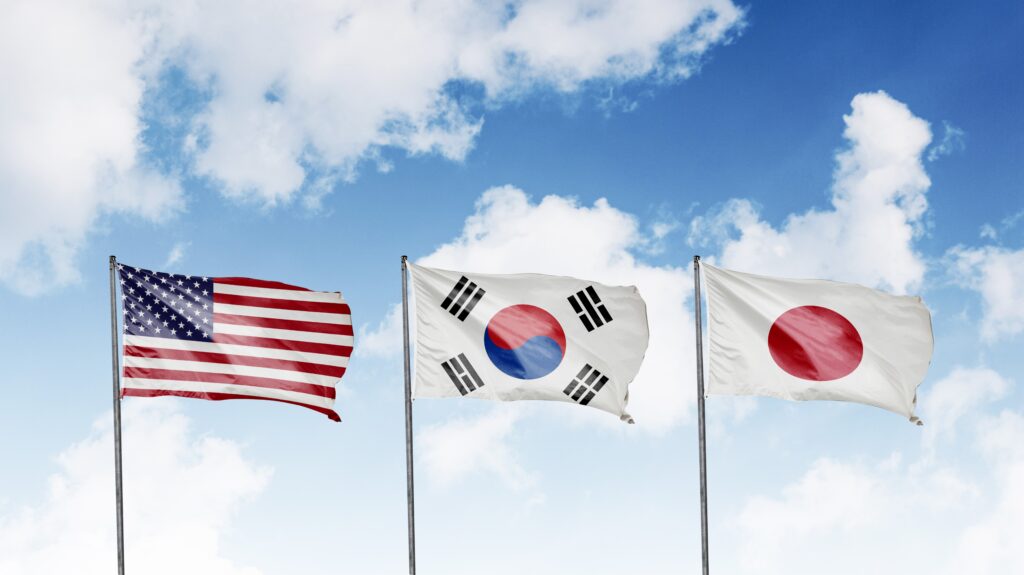
The August 2023 trilateral summit at Camp David marked a historic milestone in U.S.-South Korea-Japan relations, establishing new frameworks for crisis consultation, information-sharing, joint military exercises, and cooperation on critical supply chains. While the summit reflected growing bipartisan support in Washington for trilateral cooperation, skepticism remains about unresolved historical issues between Seoul and Tokyo, which could limit long-term progress.
This report examines American public attitudes toward trilateral cooperation, with selective comparisons to Korean and Japanese perspectives on issues of key interest in the Indo-Pacific. The findings highlight both opportunities and constraints for sustaining deeper collaboration.
Key Findings
- Positive Views of Allies: A majority of surveyed Americans view South Korea (62 percent) and Japan (78 percent) favorably. Favorability strongly shapes whether these countries are seen as partners or competitors, and it correlates with positive assessments of bilateral relations and economic ties.
- Trust as a Critical Variable: Most Americans trust South Korea (58 percent) and Japan (69 percent). Trust is linked to support for maintaining or increasing allied defense spending, while also reducing demands for greater cost-sharing—a dynamic that underscores the mediating role of trust in burden-sharing debates.
- Shared Threat Perceptions: Americans broadly align with Koreans and Japanese in identifying Russia, China, and North Korea as top threats, though the allies prioritize these differently. On Taiwan, nearly half of surveyed Americans remain unsure about the likelihood of conflict and prefer diplomacy and indirect aid over direct U.S. military intervention.
- Extended Deterrence and Nuclear Questions: Americans generally view U.S. security commitments as robust, but remain divided on whether South Korea and Japan should develop nuclear weapons or host U.S. nuclear deployments. Public opinion reveals no clear consensus on these sensitive issues.
- Trade and Tariffs: Roughly 45 percent oppose Trump-era tariffs on South Korea and Japan, but a bipartisan majority supports free trade. While Republicans show more tolerance for tariffs, both parties broadly endorse open markets, suggesting resilience in the foundation for economic cooperation.
The American public broadly supports strong ties with South Korea and Japan, but attitudes are conditional. Trust and fairness strongly influence views on defense spending, cost-sharing, and alliance modernization. On flashpoints like Taiwan or nuclear armament, however, Americans reveal uncertainty and ambivalence, underscoring the need for ongoing dialogue and leadership to shape consensus. These findings offer U.S. policymakers reasons for both optimism and caution. While the trilateral framework enjoys wide support in principle, its long-term success depends on cultivating public trust, managing historical sensitivities, and aligning strategies on the region’s most pressing security and economic challenges. Public opinion, though not determinative, remains a critical constraint that leaders must navigate with care to sustain the spirit of the Camp David Principles.