
Search All Site Content
Total Index: 6918 publications.
Subscribe to our Mailing List!
Sign up for our mailing list to keep up to date on all the latest developments.
The Peninsula
What the Ninth Party Congress Tells Us About Where North Korea Is Headed
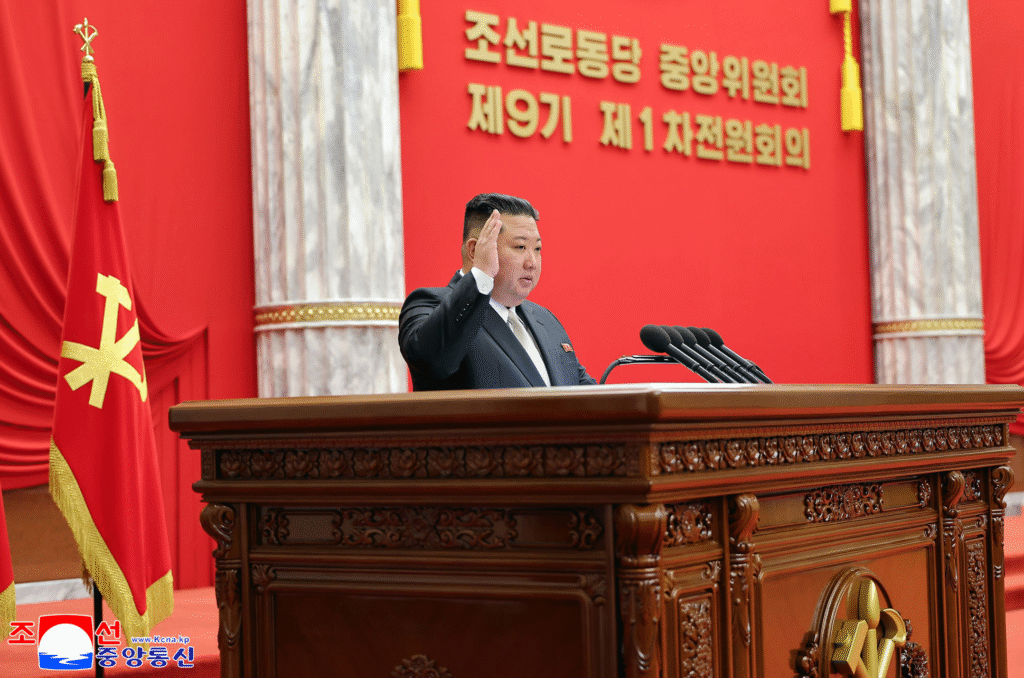
The Workers’ Party of Korea (WPK), North Korea’s only political party and the ruling party, held its Ninth Party Congress in Pyongyang on February 19–23, 2026. The congress, held every five years for the past several decades, establishes the country’s direction and policy focus for the next five years. This year’s party congress established the country’s next five-year plan, prioritizing economic development, standard of living, continued military development, and the reinforcement of self-reliance in the face of external instability.
Kim Jong Un Addresses the Party Congress
The principal aspect of the congress was a lengthy speech or a series of speeches from Kim to the assembled delegates. Kim’s report on the Central Committee of the WPK’s work from 2021 to 2025 and plans for the future spanned two or more days, including a “programmatic conclusion” outlining future goals. This was Kim’s longest speech thus far. Kim’s report at the Eighth Party Congress in 2021 lasted nine hours, and his first speech as leader at the Seventh Party Congress in 2016 lasted only about three hours.
In the speech, Kim said the five-year plan (2026–2030) would “stabilize and consolidate” the economy and should focus on the “qualitative development” of industry and agriculture rather than quantitative growth. He called for raising living standards and cited the completion of 50,000 new homes during the 2021–2025 period as a particularly important achievement. Kim said economic improvement and raising the standard of living were “heavy and urgent historic tasks.”
Because he was addressing the party leadership, Kim also called for greater dedication and commitment from the party faithful, criticizing some officials for “extreme negligence.” He called for rooting out “defeatism and incompetence” in the party, serving as a warning that party officials must be responsive to his demands.
Although strengthening the economy was the leading theme of his instructions, Kim reaffirmed the government’s efforts to develop nuclear weapons and missiles while also calling for strengthening conventional armed forces. The provision of North Korean soldiers to support Russian military efforts in Ukraine has significantly benefited the North Korean military. As of February 2026, some 15,000 North Korean troops have been sent to support Russia’s war against Ukraine, sustaining heavy casualties. This has been an important boon to flagging Russian troops, but it has also helped improve relations between North Korea and Russia. The Russian veto in early 2024 that ended UN Security Council sanctions against North Korea for its nuclear testing and production was very important for Kim. Since North Korean troops joined Russian troops in Ukraine, the two countries have had an even closer and more cordial relationship.
The Lee Jae Myung administration has made conciliatory gestures toward North Korea since June 2025, including removing loudspeakers along their shared border. Just days before the party congress, South Korea’s Minister of Unification acknowledged that three civilian South Koreans had sent drones across the border into North Korea on several occasions between September 2025 and January 2026. The minister announced the opening of an ongoing investigation and expressed “official regret” over the incident. Kim Yo Jong, Kim Jong Un’s sister and a senior party official, issued a response that the government “highly appreciated Seoul’s commitment to preventing a recurrence.” At the same time, she warned that “the borderline with the enemy should be firmly guarded” and that the South would face “terrible consequences” if such violations occurred again.
In his second term as U.S. president, Donald Trump has made only a few comments about resuming contact with Kim. He seems to be focusing on other, more pressing hotspots such as Gaza, Iran, and Venezuela. Trump has not initiated an effort to meet with Kim again. The North Korean leader has also been receiving considerable attention from Vladimir Putin for sending North Korean soldiers to Ukraine, which suggests that Kim sees little benefit from improved relations with the United States under the present circumstances. Kim’s failure to mention either the United States or South Korea in his lengthy addresses clearly indicates a lack of interest in improved U.S.-North Korea relations or inter-Korean dialogue.
Military Parade Highlights New Weapons
The grand finale of the party congress is always the military parade, which highlights North Korea’s modern, well-equipped armed forces. The parade is public, well-photographed, and highlights the country’s latest military equipment. An estimated 12,000 to 16,000 troops were involved in the extravaganza ending the congress. In addition, missiles and tanks highlight the North’s advanced technology and the quantity of equipment it has developed. Rehearsals for the parade were taking place in Pyongyang two months before the event.
Before the party congress sessions formally opened, Kim visited troops preparing for the military parade. North Korean media showed the leader in a leather military jacket behind the wheel of one of the new multiple rocket launchers for 600 mm rockets—the unveiling of the new capabilities. These weapons have the capability of reaching targets ranging up to 400 kilometers, which puts all of South Korea within range, and are capable of carrying tactical nuclear weapons. Newspaper photographs showed fifty mobile rocket launchers in front of the April 25 House of Culture, the venue of the party congress.
One of the reasons for the North Korean leader to tout his country’s offensive military capabilities, including its nuclear weapons and missiles, is the recent U.S. military actions in Venezuela with the seizure of President Nicolas Maduro, in addition to continued U.S. support for Ukraine.
All in the Family
The party congress also highlighted the Kim family’s grip on power in North Korea. Kim’s sister, Kim Yo Jong, was appointed headof one of the party’s departments, an important and prestigious post. She had previously served as deputy head of a party department. Kim Yo Jong remains one of the most closely followed North Korean officials, and it is clear that her brother relies on her to handle sensitive issues.
One of the more intriguing familial elements of the just-concluded congress is speculation that Kim Jon Un’s daughter may be designated heir apparent to the supreme leader. On the eve of the party congress, a member of the South Korean National Assembly told reporters that in a closed-door briefing with the South Korean National Intelligence Service (NIS), lawmakers were told that Kim’s daughter, Kim Ju Ae, had been formally designated his successor, while she was previously described as only “in study as successor.”
Other media reports during the party congress indicated that Kim Ju Ae was the “missile general director,” which is particularly unusual given that she is quite young and is unlikely to have the technical expertise to manage such an important, scientifically complex weapon. Missiles are particularly sensitive and important for North Korea’s military. If it is true that she holds that position, it is unlikely that she is a hands-on manager involved in missile development, testing, and production, but it is a clear indication of the party’s high priority on missile development. That action also gives the apparent successor an aura of importance and bolsters reports that she is the heir apparent.
However, there is no indication that she was formally acknowledged as a successor at the party congress. No mention of her presence at the opening session was made in the media, suggesting that her formal designation as her father’s successor is premature. If she had been present at the congress, however, that would have been a clear indicator of her successor status.
One interesting aspect of this story is that North Korea is not a country where women are given equal opportunity or treatment. UN Special Rapporteur Elizabeth Salmon, who reports annually to the UN Human Rights Council and UN General Assembly on human rights abuses in North Korea, has been particularly sharp in her criticism of officially sanctioned abuse of women in North Korea. Professor Salmon reported that Pyongyang has “failed to take any meaningful action to address the country’s intense and pervasive women’s rights violations, including sexual and gender-based violence, widespread discrimination, and enforcement of rigid gender stereotypes.”
The makeup of the delegates to the Ninth Party Congress confirms the persistent inequality in the treatment of women in North Korea. The congress had a total of 5,000 delegates, and of that number, only 413 were women (8.26 percent). Furthermore, that was a decline from the party congress ten years ago in 2016, when 501 of the delegates were women.
The personnel changes made at the Ninth Party Congress do not appear to be unusual. For the most part, the leadership changes, such as those on the Central Committee, largely appear to be generational shifts. Older cadres were given “senior advisor” positions elsewhere, or they were retired, while younger individuals are stepping in to replace them on the Central Committee.
Conclusion
The Ninth Party Congress leaves little room for optimism about near-term engagement with North Korea. Kim Jong Un has a new five-year plan, a closer relationship with Moscow, a sister with an expanded portfolio, and a daughter who may already be designated his successor, while offering no mention of the United States or South Korea. Trump, for his part, has shown little urgency about resuming dialogue, instead focusing on other geopolitical hotspots. Without diplomatic movement, North Korea’s nuclear and missile programs will continue to develop on their own timeline, and the window for meaningful leverage will narrow. The congress made clear that Pyongyang is comfortable with that trajectory. Washington and Seoul may not be able to say the same for long.
Robert King is a Non-Resident Distinguished Fellow at the Korea Economic Institute of America (KEI). The views expressed are the authors’ alone.
Feature image from North Korean state media.
KEI is registered under the FARA as an agent of the Korea Institute for International Economic Policy, a public corporation established by the government of the Republic of Korea. Additional information is available at the Department of Justice, Washington, D.C.