
By Ellen Kim
Trump and Lee Cut a Deal but the Devil in the Details Gets the Last Word
The full picture of the tariff and security negotiations may only become clear once the U.S. and Korea release mutual fact sheets or joint statements.
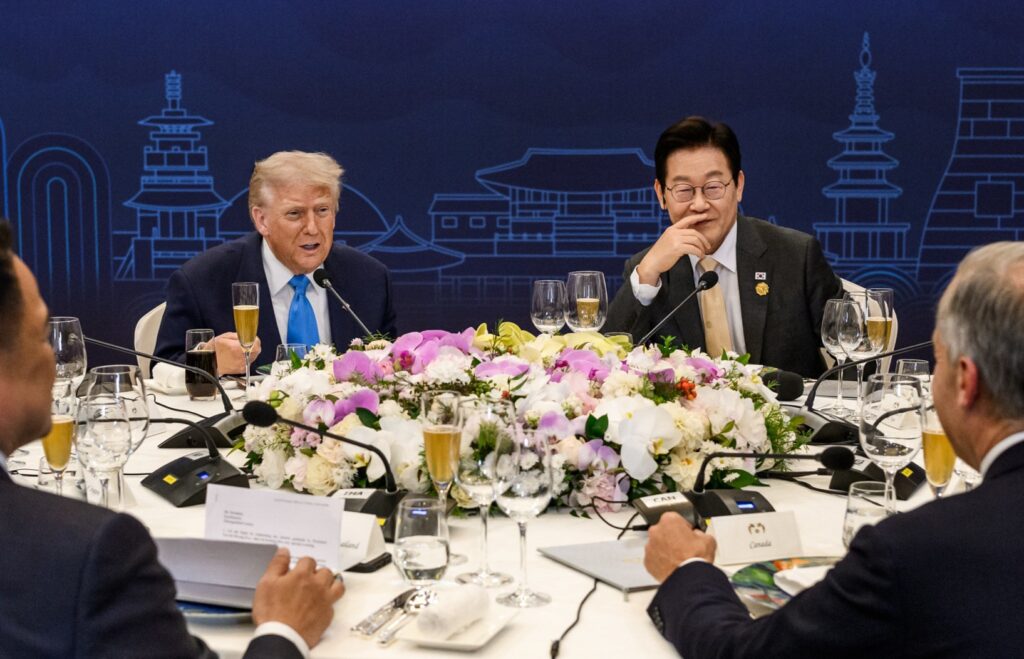
On October 28, U.S. President Donald Trump visited Gyeongju, South Korea, for a summit with South Korean President Lee Jae Myung on the sidelines of the Asia-Pacific Economic Cooperation (APEC) summit. This visit, which follows his trips to Malaysia and Japan, marks Trump’s second state visit to South Korea since the first one in 2017. His summit meeting with Lee is the second since their White House meeting in August.
The most significant outcome of this summit was the breakthrough in negotiating the tariff agreement that had been stalled for months. Both leaders agreed that South Korea’s USD 350 billion investment package would be split into USD 200 billion in cash investments and USD 150 billion for the “Make American Shipbuilding Great Again” (MASGA) project. Furthermore, they agreed to set the annual investment cap at USD 20 billion, thereby mitigating South Korea’s concerns about the dollar-denominated investments’ impact on its foreign exchange market. With the conclusion of the negotiations, the reciprocal tariff rate between the United States and South Korea will stay at 15 percent, and the United States will reduce U.S. tariffs on Korean auto and auto parts exports to 15 percent, ensuring Korean companies will not be disadvantaged in competition with other countries that have already concluded negotiations with the United States.
Even before the Trump-Lee summit, caution and pessimism prevailed within the South Korean government about the prospects of a tariff deal. However, the key to the deal appears to have been the Trump administration’s desire—in the face of South Korea’s tough stance—to revive the U.S. shipbuilding industry and therefore expedite the conclusion of the U.S.-South Korea tariff agreement. The decision to allocate slightly more than half of South Korea’s total investment to the shipbuilding project reflects this. Shipbuilding cooperation is one of Trump’s top priorities; before his visit to South Korea, Trump also signed a memorandum of understanding with Japan on shipbuilding cooperation.
In addition, Trump may have wanted to avoid the negative impact of “no deal” with South Korea on the U.S.-China trade negotiations scheduled for the next day. During his Asia-Pacific tour, his administration also signed trade agreements with Malaysia and Cambodia and established trade frameworks with Vietnam and Thailand. By including a deal with South Korea in this list, he hopes to maximize his diplomatic accomplishments and secure his ultimate goal, a trade deal with China.
Another potential outcome that deserves attention is the U.S.-South Korea security agreement that has yet to be announced. Reports suggest that U.S. and South Korean negotiators have made progress in their discussion about security cooperation, with South Korea planning to increase its defense spending to up to 3.5 percent of GDP by 2035 and strengthen its national defense as part of alliance modernization efforts. Adding to this progress is Trump’s approval of South Korea building a nuclear-powered submarine at Philly Shipyard in response to Lee’s request for a U.S. supply of nuclear fuel for a South Korean nuclear-powered submarine. Whether follow-up working-level consultations on nuclear-powered submarines and discussions on revising the U.S.-South Korea Agreement for Peaceful Nuclear Cooperation (known as a “123 agreement”) will gain momentum remains to be seen.
With the breakthrough on the tariff front, the pressure on the South Korean government is temporarily relieved. However, as the saying goes, “the devil is in the details.” The full picture of the tariff and security negotiations will become clear once the United States and South Korea release an agreed-upon fact sheet or joint statement.
At the same time, South Korea must prepare for what lies ahead. The fifty-seventh U.S.-South Korea Security Consultative Meeting (SCM), scheduled for November 4, is likely to discuss the alliance’s modernization issues, including the strategic flexibility of United States Forces Korea and the transfer of wartime operational control (OPCON). Furthermore, on November 5, the U.S. Supreme Court is set to hear a case on the legality of the Trump administration’s tariffs under the International Emergency Economic Powers Act (IEEPA). Observers should pay close attention to how these events will affect the future direction and resilience of the alliance.
This article was originally published in Korean in the Hankook Ilbo on Saturday, November 1, 2025, and is available at https://www.hankookilbo.com/News/Read/A2025103107410001384.
Ellen Kim is Director of Academic Affairs at KEI.
Feature image from The White House.
KEI is registered under the FARA as an agent of the Korea Institute for International Economic Policy, a public corporation established by the government of the Republic of Korea. Additional information is available at the Department of Justice, Washington, D.C.