
Search All Site Content
Total Index: 6913 publications.
Subscribe to our Mailing List!
Sign up for our mailing list to keep up to date on all the latest developments.
The Peninsula
Takaichi’s Landslide Victory and What It Means for South Korea
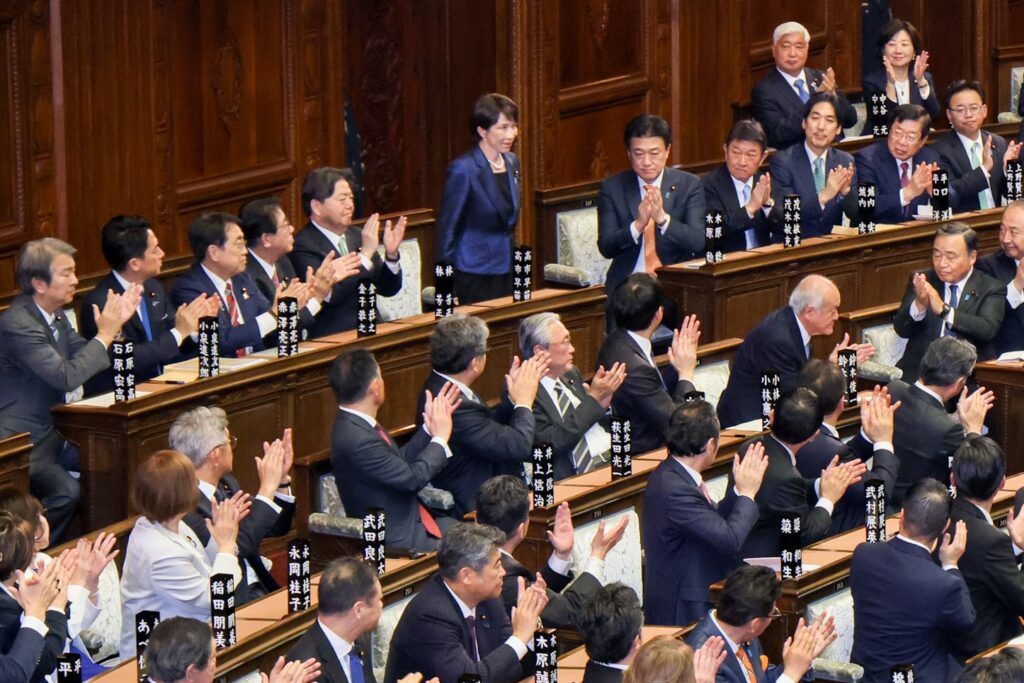
In early February, Japanese Prime Minister Sanae Takaichi led the Liberal Democratic Party (LDP) to a stunning victory in the House of Representatives. But her landslide victory can cut both ways, strengthening her hand on domestic policy while also freeing her to revisit conservative positions that have historically strained ties with South Korea.
The LDP’s historic 316-seat victory in the lower house elections has consolidated Prime Minister Takaichi’s power. As Japan analyst Tobias Harris writes, the large win means “it will be difficult for her intra-party rivals…to question her leadership” in the party. The win is also a public mandate, demonstrating the depth of her popularity with the broader electorate. Voters say they appreciate her public policy approach, focusing on the cost of living, for example, and her pushback against pressure from China. Takaichi “seems like a capable and dependable person. I feel she could be the one to change Japan,” one voter told The Wall Street Journal before the election. “I think she’s popular because she’s different from what it’s been like before.”
This is not to suggest that the Takaichi government is invincible, as the LDP and its coalition partner, the Japan Innovation Party, still hold a minority in the upper house of the National Diet. While the lower chamber can enact laws over the upper house’s opposition, the upper house can force deliberation that takes up time and bandwidth. This means that even if Prime Minister Takaichi has the votes in the lower chamber, “it does not mean that anything can simply be repassed,” law professor Junsuke Matsuura told the Japanese press. While it is unclear whether she will be able to live up to the tenure of her mentor, former Prime Minister Shinzo Abe, it seems Prime Minister Takaichi is firmly in control of Japan.
Meanwhile, South Korea’s official response to Takaichi’s victory has been deliberately measured, even if the Korean press has been less sanguine. The liberal Hankyoreh newspaper published an editorial fretting about “right-wing populism” rising in Japan. But President Lee Jae Myung indicated that he is not as worried about his counterpart in Tokyo. The president congratulated the prime minister on her party’s victory. “I hope the two countries will broaden and deepen relations based on trust and friendship,” President Lee stated. In turn, Prime Minister Takaichi thanked him and said, “Let us advance Japan-Korea relations in a future-oriented and stable manner,” adding that she was excited about her next chance to visit Korea as part of their “shuttle diplomacy.”
Issues That Could Test Korea-Japan Cooperation
If Korea-Japan relations do deteriorate under Lee and Takaichi, there are two likely catalysts. The first is the resurfacing of history. At the end of January, the Korean Supreme Court ordered Japanese construction firm Kumagai Gumi to pay KRW 100 million (some USD 70,000) to the family of a Korean man conscripted to work for the company in October 1944. The decision overturned a lower court decision in the suit, filed in April 2019, that found the statute of limitations had already passed. A National Assembly committee also passed a bill that would allow the South Korean government to hand out prison sentences to individuals that it deems to have engaged in misinformation about sexual slavery under Imperial Japan. President Lee had recently publicly criticized a far-right Korean group that questioned the experiences of comfort women.
President Lee was also critical of the Yoon Suk Yeol administration’s solution to forced labor compensation, but said that he would respect the deal made by the previous administration after taking office. How will he manage domestic public opinion if Japanese companies refuse to pay compensation to the families of forced laborers?
In 2014, Prime Minister Takaichi wrote in a letter to then Cabinet Secretary Yoshihide Suga that it was wrong for Japanese history textbooks to use words like “military comfort women” and “forced abduction.” While she has not commented on the issue as prime minister, it’s not clear that she has changed her opinions. After all, after the February election, she said, “I will secure understanding from our ally and neighboring countries” ahead of a potential visit to the Yasukuni Shrine. These domestic issues have significant implications for foreign affairs and will require finesse in both Seoul and Tokyo to manage.
The second issue concerns the growing difficulties Korea faces in balancing between the United States and China. Takaichi has been successful in maintaining a relationship with U.S. President Donald Trump, even getting an endorsement on social media ahead of the election. She is strongly pro-American, and Japan is moving closer to the United States at a time when other traditional allies have had difficulties with the Trump administration. Within the trilateral U.S.-Korea-Japan framework, the Korea-Japan leg has always been the shakiest. If the U.S.-Japan leg gets closer, Korea could find itself in a tight spot by being outmaneuvered or facing unified opposition by the larger sides of the triangle. Until now, domestic political weakness may have encouraged Japanese leaders to be more cautious in their policymaking when it came to Korea. “Seoul must decide how much bilateral alignment it is prepared to offer, where it needs to articulate its own priorities and how to communicate its expectations in ways that protect both security interests and domestic legitimacy,” wrote former CIA analyst Soo Kim in a Korean media commentary published after the election. This is not to suggest that Korea-Japan relations are headed for a downward spiral; indeed, it is worth noting that the progressive President Lee and conservative Prime Minister Takaichi were quick to play nice together (quite literally, actually). Rather, these potential obstacles serve as a reminder that we should not take the current environment for granted.
Managing Continuity and Risk
Korea is no stranger to a complicated international environment that requires a deft hand. And to be sure, President Lee has said he will take a pragmatic approach toward Japan. Relations between Seoul and Tokyo have improved significantly since the lows of a decade ago, and recent leaders have indicated that they value a productive and positive relationship.
Prime Minister Takaichi’s consolidation of power at home means that it will be easier for her to push unpopular policies while keeping her party in line. But to maintain control, she may have to say some things that her domestic audience wants to hear but could upset foreign audiences. While Prime Minister Takaichi’s victory may be talked about for years, it will take steady hands in both Korea and Japan to keep the bilateral relationship chugging along.
Terrence Matsuo is a Non-Resident Fellow at the Korea Economic Institute of America (KEI). The views expressed are the authors’ alone.
Feature image from Prime Minister Sanae Takaichi’s X account.
KEI is registered under the FARA as an agent of the Korea Institute for International Economic Policy, a public corporation established by the government of the Republic of Korea. Additional information is available at the Department of Justice, Washington, D.C.