
Search All Site Content
Total Index: 6918 publications.
Subscribe to our Mailing List!
Sign up for our mailing list to keep up to date on all the latest developments.
The Peninsula
South Korea’s Strategy for Securing Critical Minerals as FORGE Chair
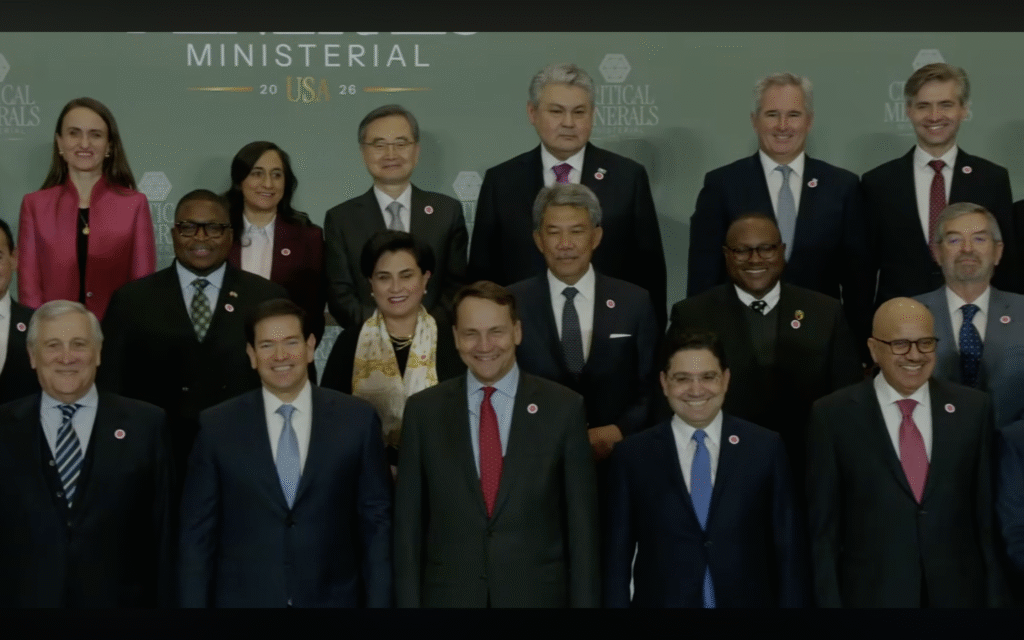
The inaugural Critical Minerals Ministerial was held in Washington, DC, on February 4, drawing significant attention to multilateral cooperation on securing mineral resources. The Donald Trump administration, which restructured the Mineral Security Partnership (MSP) into the Forum on Resource Geostrategic Engagement (FORGE), proposed to the fifty-four participating countries and the European Commission the creation of a “preferred critical minerals trade zone protected from external shocks through enforceable price floors.” In doing so, the administration signaled its commitment to stabilizing and diversifying critical mineral supply chains.
What is noteworthy about the launch of FORGE is that it marks a shift for the Trump administration—previously known for favoring bilateral deals—toward promoting a multilateral framework for international cooperation. The presence of more than five U.S. cabinet officials, including Vice President JD Vance and Secretary of State Marco Rubio, underscores that strengthening critical mineral supply chains is an urgent policy priority for the administration. It will be important to watch how U.S. multilateral cooperation evolves from this starting point.
Critical minerals have unquestionably emerged as a central issue in U.S.-China strategic competition. China began responding to U.S. semiconductor export controls by imposing its own critical mineral export restrictions in July 2023, during the Joe Biden administration. Since then, Beijing has expanded export controls to other minerals and materials such as rare-earth magnets—essential components in electric vehicle motors, consumer electronics, and weapons systems—turning them into a major source of leverage during the Trump administration as well.
Why, then, is China’s weaponization of critical minerals so powerful? First, China holds significant market influence across the entire supply chain—from upstream mining to midstream refining and processing, downstream manufacturing, and recycling. In particular, refining and processing facilities and technologies are heavily concentrated in China, giving it a dominant position at the midstream stage, where it can restrict or control supplies. These “chokepoints” are difficult to overcome in the short term, given environmental concerns, high upfront investment costs, and other constraints associated with building refining capacity.
Second, Chinese firms have secured stable access to overseas critical minerals through direct investment and equity acquisitions in mining companies and facilities in resource-rich regions such as Latin America and Africa.
Third, China has recognized vulnerabilities in its own supply chains and has subsequently pursued diversification of its mineral import sources. According to recent research, China relied on Australia for more than 85 percent of its spodumene imports—a key source of lithium—but has reduced this dependence over the past four years by diversifying its imports from countries such as Brazil, Nigeria, and Zimbabwe.
The weaponization of critical minerals is a grave issue that could destabilize global industrial supply chains and pose existential challenges to industrialized economies. Ahead of President Trump’s planned visit to China in late March, the administration is seeking to conclude tariff negotiations while simultaneously restructuring mineral supply chains and developing countermeasures to reduce China’s leverage.
Over the past several years, South Korea has pursued import diversification, strengthened strategic dialogue and cooperation with resource-rich countries, expanded strategic stockpiles, and promoted recycling to reduce dependence on China. These efforts remain insufficient, however. As chair of FORGE through June, South Korea must move beyond domestic measures and develop a more refined multilateral strategy to enhance global supply chain stability.
This article was originally published in Korean in Hankook Ilbo on February 20.
Ellen Kim is Director of Academic Affairs at the Korea Economic Institute of America (KEI). The views expressed are the authors’ alone.
Feature image from the U.S. Department of State’s YouTube channel.
KEI is registered under the FARA as an agent of the Korea Institute for International Economic Policy, a public corporation established by the government of the Republic of Korea. Additional information is available at the Department of Justice, Washington, D.C.