
By Tom Ramage
South Korea’s Policy Progress from APEC 2025
APEC 2025 delivered the most consequential economic and diplomatic activity Korea has seen in years.
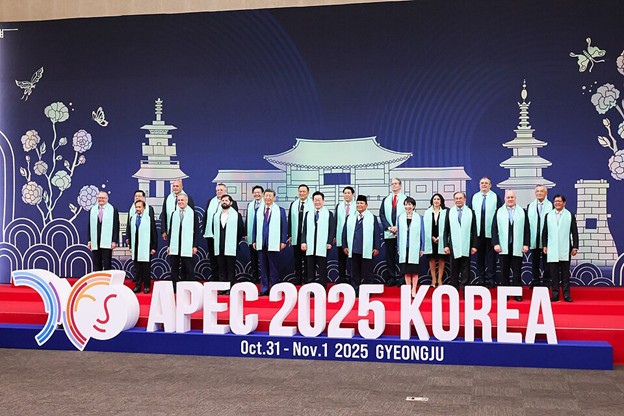
APEC 2025 delivered the most consequential economic and diplomatic activity Korea has seen in years. The Gyeongju summit produced a mix of bilateral breakthroughs, technology partnerships, and regional commitments, and, perhaps most importantly for the U.S.-Korea relationship, gave Korea space to reposition its relationship in the Indo-Pacific. The result is a meeting that advanced meaningful cooperation while underscoring the emerging vacuum created by U.S. retreat from economic multilateralism.
Lee-Trump
The most directly influential advancements were the country-to-country deals and agreements that came from world leaders visiting with President Lee Jae Myung, either officially through APEC or on the periphery. Of course, the United States and Korea came to what appears to be a final agreement on the U.S.-Korea tariff deal with President Donald Trump’s visit to Korea in the lead-up to the meeting, locking in a 15 percent rate on Korean auto and auto part imports in exchange for a USD 350 billion investment commitment in the United States. On the heels of this came an official MOU on a “U.S.-ROK Technology Prosperity Deal” aiming for the United States and Korea to collaborate on AI adoption and innovation and critical technology development as well asMoon and Mars exploration, among other things. Separately, U.S. companies made major investment commitments in Korea as part of the APEC CEO Summit. Of note, Amazon Web Services (AWS) unveiled plans for USD 5 billion in Korean investment by 2031 while NVIDIA CEO Jensen Huang made commitments with Korean technology companies as part of the APEC CEO Summit, agreeing to deploy over 250,000 NVIDIA Graphics Processing Units (GPUs) for AI to Korea. President Trump also spoke at the APEC CEO luncheon on economic security and remarked on the strength of the U.S.-Korea relationship, calling it “wedded,” and noted cooperation in shipbuilding and defense equipment sales, and Korean company investment in the United States. Korea also joined onto First Lady Melania Trump’s “Fostering the Future Together” initiative launched at the September United Nations General Assembly seeking to promote children’s empowerment through “technology, innovation, and education.” The president left the country before taking part in any subsequent part of the of the official APEC Leaders’ meeting. The White House has since released a joint fact sheet on the trade agreement alongside a subsequent “Korea-US Strategic Investment MOU.”
Lee-Xi
On the other side of this was an official bilateral meeting between Korea and China. It was the first official meeting between President Lee Jae Myung and President Xi Jinping and President Xi’s first visit to Korea in 11 years. It came at a particularly important time for Korea-China relations—both for navigating between trade and political tensions between the United States and China and as Korea begins a new presidential administration.
Korea’s Ministry of Foreign Affairs indicated that the summit resulted in a roughly USD 49 billion currency swap agreement between the two countries as well as cooperation in the silver industry, start-up companies, agricultural trade, combating transnational crime, and media exchange. The leaders also signed a Korea-China Joint Economic Cooperation Plan (2026~30) MOU aimed at improving “service trade exchanges” as well as cooperation toward a free trade agreement (FTA). This was reiterated in a press release from the Chinese Ministry of Foreign Affairs including through work on advancing the potential Free Trade Area of the Asia Pacific (FTAAP) process through APEC. President Xi also used the conclusion of the APEC leaders meeting to advocate for a “World Artificial Intelligence Cooperation Organization,” likely seeking to solidify China as a more prominent player in global affairs amidst the United States’ vacuum of leader-level participation in the meeting.
Lee-Takaichi
President Lee Jae Myung also held his first official bilateral with newly inaugurated Prime Minister Sanae Takaichi of Japan. Recent cooperation between the United States, Korea, and Japan on enhancing trilateral relations made it a particularly important meeting to watch, given the new leadership in both Tokyo and Seoul. Attention was paid to how personal dynamics might shape out, with Lee and Takaichi coming from opposite ends of the political spectrum in their respective countries; Lee from the left-aligned Democracy Party, and Takaichi from the conservative Liberal Democratic Party (LDP). The official Korean press statement put out about the meeting assured the continuation of good relations between Korea and Japan, affirming continued cooperation between the countries, calling them “neighbors who share a garden,” and indicating that a meeting between the leaders would occur next at a “regional city in Japan.”
APEC Ministerial Joint Statement
One of two main textual deliverables from the APEC was the joint statement from the ministerial meeting. This is one of the main consensus documents among the 21 member economies, which sets the stage for work between the attendees from now until the next meeting and beyond. This year’s ministerial statement delved into a host of technical topics ranging across the three main 2025 priority areas: “Connect, Innovate, Prosper,” all signaling broader cooperation between the economies.
The APEC member economies made some specific pronouncements on acknowledging the role of the WTO in international trade and sought to add some additional agreements into the framework, including one on “Investment Facilitation for Development” and one on Electronic Commerce. The statement also included language on “the full and effective implementation of the WTO Trade Facilitation Agreement” and the development of a work program for an APEC Investment Facilitation Action Plan. The countries also committed to greater knowledge exchange surrounding AI policy and AI transformation, driven by the inaugural APEC Digital and AI Ministerial Meeting from the 2025 Summit. The ministers also made shared acknowledgment of addressing changing demographic compositions from declining birthrates, population aging, and accelerated urbanization, committing to more initiatives to mitigate the impact of demographic changes on younger generations. Perhaps most significantly, the APEC ministers committed to advancing the FTAAP mentioned in the Korea-China discussions, likely aiming to provide some tangible resilience amidst increasing global trade volatility following a disappearance of the former U.S.-led global trade order.
Gyeongju Leaders’ Declaration
Mirroring the technical issues spelled out in the ministerial statement came the Gyeongju Declaration, which underlined leader-level consensus on trade, technology, and demographics. Like the discussions between Presidents Lee and Xi in the Korea-China bilateral, as well as the Ministerial Statement as a whole, its “Connect” issue segment affirmed cooperation toward the creation of the FTAAP and, moreover, committed to trade facilitation measures. This includes increasing the competitiveness of digital services, strengthening regional supply chain connectivity, enhancing business mobility, and countering transnational crime.
Its other commitments also followed onto the ones outlined in the Ministerial Statement. On “Innovate,” the leaders formally endorsed an “APEC AI Initiative” along with continued efforts to enhance the “security, accessibility, trustworthiness and reliability in realizing the benefits of AI” to be balanced with a human-centered approach, likely pointing toward greater cooperation between the economies on AI and digital governance into the future.
Likewise, its “Prosper” commitments, among other things, fostered support for small and medium enterprises and also acknowledged the role that demographic aging and declining birth rates play in the broader Asia-Pacific economy, endorsing an “APEC Collaborative Framework for Demographic Changes.” Within the Prosper segment, the leaders also acknowledged the expanded role of liquified natural gas (LNG) in the economies’ collective energy systems, as well as the potential of AI, both for the energy sector and as a means to promote domestic health care systems.
The Takeaway
Expectations were high about what the 2025 APEC meeting might spell for Asia-Pacific trade and political relations amidst massive changes to the global trade order following U.S. tariffs on imports, rapid advances in critical and emerging technologies such as artificial intelligence, and new administrations in Washington, Tokyo, and Seoul. The chance for the leaders to meet and find shared consensus on statements relating to AI policy, the impacts of demographic change, as well as advancements toward a Free Trade Area for the region and individual country-level agreements on trade affirmed that multilateralism is still useful at building dialogue between leaders and will likely remain that way even as trends toward economic nationalism begin to drive currents in the international order. Still, the absence of a U.S. leader at the APEC meeting garners its own set of implications. With the president having skipped both this year’s G20 and APEC meeting as well as making a half-attendance at the G7 conference in Canada (which would have otherwise been Trump’s first official meeting with President Lee), the future of these meetings may point more toward one in which there is a vacuum of U.S. engagement, leaving the rest of the world to develop consensus amongst themselves alone. Indeed, this has already proved to be a fruitful opportunity for strategic competitors like China to take leadership and advance their own initiatives and continued U.S. absence may only give more such opportunities to do so. As Korea makes the hand-off to China for the 2026 APEC in Shenzhen, the meeting may show just how China-focused the APEC forum could become.
Tom Ramage is Economic Policy Analyst at the Korea Economic Institute of America (KEI). The views expressed are the author’s alone.
Photo from Wikimedia Commons.
.jpg)
KEI is registered under the FARA as an agent of the Korea Institute for International Economic Policy, a public corporation established by the government of the Republic of Korea. Additional information is available at the Department of Justice, Washington, D.C.