
South Korea’s Economic Rebound is Projected to Continue
While Korea’s export growth in 2025 slowed due to protectionist trade policies, real GDP growth was expected to pick up in 2026.
The South Korean economy has recovered from negative growth in the first quarter of 2025 that was triggered by a political crisis. Improved consumer confidence and rising real wages are supporting private consumption. Fiscal expansion, led by two supplementary budgets in 2025 and monetary policy easing, have underpinned the rebound. While Korea’s export growth in 2025 slowed due to protectionist trade policies, real GDP growth was expected to pick up from 1.0 percent in 2025 and to around 2.0 percent in 2026.
Korea’s Economic Weakness in Early 2025…
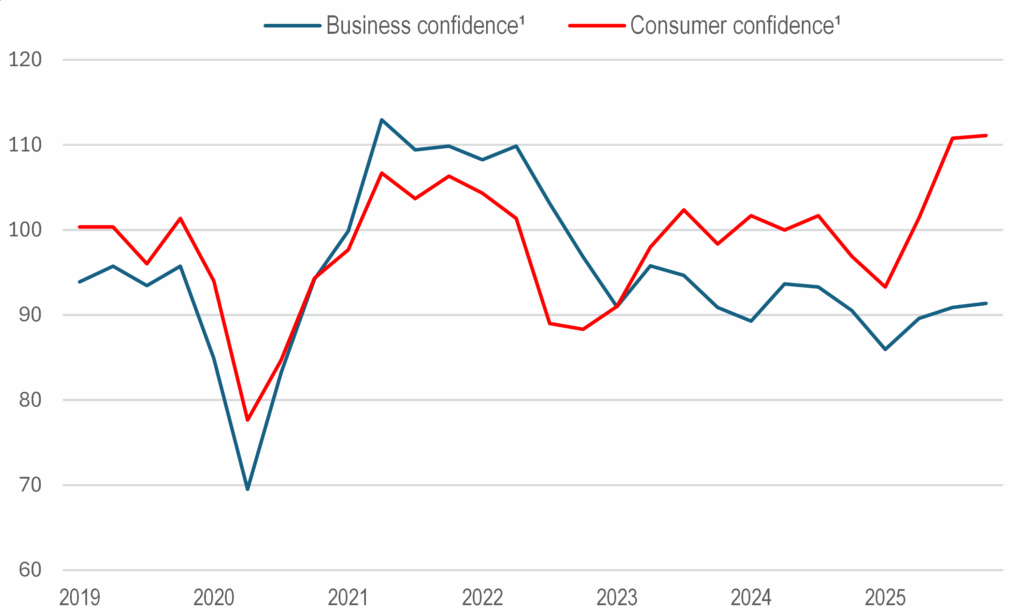
Korea’s political crisis in the first half of 2025 was sparked by then President Yoon Suk Yeol’s declaration of martial law in December 2024, which led to his impeachment in April 2025. It had a negative impact on consumer confidence (Figure 1), contributing to a decline in private consumption, which accounts for one-half of GDP.
Figure 1. While consumer confidence has rebounded, business confidence remains weak
Source: OECD (2025), OECD Economic Outlook, Volume 2025 Issue 1 | OECD and Bank of Korea.
Note: Quarterly averages. The fourth quarter includes October and November.
Political uncertainty also adversely affected business confidence. In addition, protectionist trade policies by the United States, which accounts for nearly one-fifth of Korea’s exports, also weakened business sentiment. The United States’ effective tariff (the average tariff paid across all imports) on Korean exports had been 1 percent, thanks to the U.S.-South Korea Free Trade Agreement. However, the effective rate jumped to 16 percent in the first half of 2025, driven by a baseline 10 percent tariff on all countries and products, as well as product-specific tariffs, such as those imposed on steel, aluminum, and cars. Korea’s exports of goods and services fell 0.6 percent in the first quarter of 2025—contrary to expectations of an increase driven by the front-loading of imports by the United States in anticipation of higher tariffs. President Donald Trump’s proposed 25 percent “reciprocal tariff” on Korea in April 2025 also increased uncertainty. Fixed investment declined in the first half of 2025.
…Was Reversed in the Latter Part of 2025
Real GDP growth accelerated following the downturn in early 2025, reaching 5.5 percent (annualized rate) in the July–September quarter. Private consumption was boosted by two supplementary budgets, totaling around 1 percent of GDP. Consumption coupons, which directly boosted consumer spending, accounted for about half of the fiscal stimulus. In the first phase, which began in July, every individual—regardless of income or assets—could receive coupons worth at least KRW 150,000 (USD 102). Low-income individuals could receive up to KRW 400,000. In the second round of coupons in the autumn, individuals (excluding those in the top 10 percent of incomes) could receive an additional KRW 100,000.
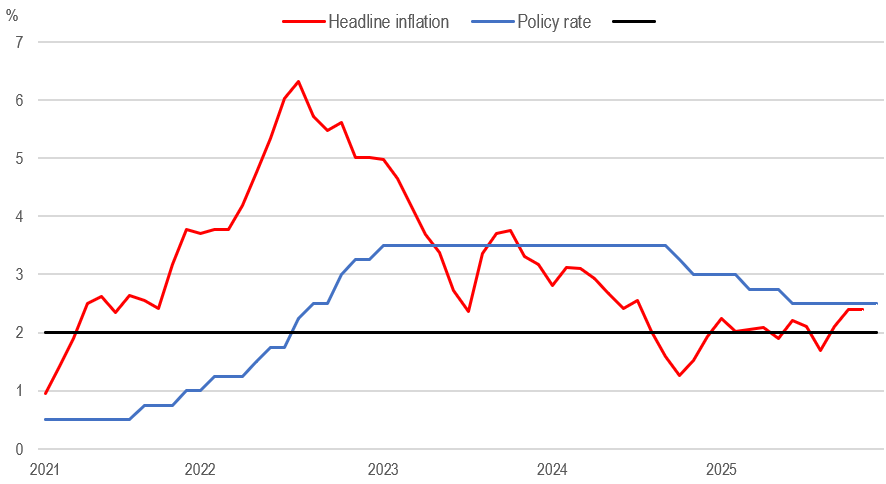
In addition to fiscal stimulus, the Bank of Korea cut its policy interest rate by 50 basis points during 2025 to 2.5 percent (Figure 2). Although inflation is slightly above the 2 percent inflation target, additional monetary easing would be appropriate if the current upturn falters.
Figure 2. The Bank of Korea has lowered its policy rate, with inflation near the 2 percent target
Source: Bank of Korea’s Economic Statistics System.
Expansionary policies contributed to the growth of employment, which was up 1.0 percent in November 2025 (year-on-year), reducing the unemployment rate to a historically low level close to 2.5 percent. It was accompanied by increasing real wages.
In contrast to consumers, business sector confidence remains weak by historical standards (Figure 1). However, it has edged up, as exports recorded rapid growth in the April–June quarter of 2025, and fixed investment turned positive in the July–September quarter. In addition, the Korea Strategic Trade and Investment Deal, signed in October 2025, set most U.S. tariffs on Korean goods at 15 percent, reducing uncertainty in the bilateral trade relationship. The tariff rate is conditional on Korea investing USD 350 billion in the United States. The total includes USD 150 billion for shipbuilding cooperation. The remaining investment will be allocated to projects, capped at USD 20 billion per year, across key sectors.
Minister of Economy and Finance Koo Yun-cheol stated that the government will establish a strategic investment corporation and special fund to select “commercially rational” investment projects. Minister Koo said that the government will also create a sovereign wealth fund and a special fund for strategic export support in 2026 as part of efforts to boost the economy.
The OECD Economic Outlook report from December 2025 projects real GDP growth of 1.0 percent in 2025 (Table 1). Other institutions’ forecasts for Korea are similar, including the Bank of Korea and the Korea Development Institute (0.8 percent) and the Asian Development Bank and the International Monetary Fund (0.9 percent).
Table 1. OECD projections for Korea
| 2023 | 2024 | 2025 | 2026 | 2027 | |
| Percentage changes, volume | |||||
| GDP at market prices | 1.6 | 2.0 | 1.0 | 2.1 | 2.1 |
| Private consumption | 2.0 | 1.1 | 1.2 | 2.0 | 2.2 |
| Government consumption | 1.9 | 2.1 | 2.8 | 3.4 | 2.8 |
| Gross fixed capital formation | -0.2 | -0.8 | -2.7 | 1.5 | 2.1 |
| Final domestic demand | 1.3 | 0.7 | 0.3 | 2.1 | 2.3 |
| Stockbuilding¹ | 0.1 | -0.5 | 0.4 | 0.0 | 0.0 |
| Total domestic demand | 1.4 | 0.2 | 0.7 | 2.1 | 2.3 |
| Exports of goods and services | 3.4 | 6.8 | 4.5 | 3.6 | 2.1 |
| Imports of goods and services | 3.0 | 2.5 | 4.1 | 3.8 | 2.4 |
| Net exports¹ | 0.2 | 1.8 | 0.3 | 0.1 | 0.0 |
| Memorandum items | |||||
| GDP deflator | 2.0 | 4.1 | 2.6 | 1.9 | 1.9 |
| Consumer price index | 3.6 | 2.3 | 2.0 | 1.8 | 2.0 |
| Core inflation index² | 3.4 | 2.2 | 1.9 | 1.8 | 2.0 |
| Unemployment rate (% of labor force) | 2.7 | 2.8 | 2.6 | 2.5 | 2.5 |
| Household saving ratio, net (% of disposable income) | 7.3 | 9.6 | 10.8 | 11.1 | 11.0 |
| General government financial balance (% of GDP) | -0.9 | -1.5 | -2.9 | -2.8 | -2.9 |
| General government gross debt (% of GDP) | 48.6 | 46.0 | 49.2 | 52.0 | 55.0 |
| Current account balance (% of GDP) | 1.8 | 5.3 | 6.4 | 6.4 | 6.2 |
- Contributions to changes in real GDP.
- Consumer price index excluding food and energy.
Source: OECD (2025), Full Report: OECD Economic Outlook, Volume 2025 Issue 2 | OECD.
Korea’s Growth Is Expected to Accelerate in 2026 Despite Global Uncertainty
Most forecasters project Korea to achieve growth in 2026 in line with its potential growth rate, estimated at around 2 percent. Indeed, the OECD projects growth of 2.1 percent in 2026 (Table 1). Forecasts by other institutions are also close to that level, including the Korea Development Institute and the International Monetary Fund (1.8 percent) and the Asian Development Bank (2.0 percent).
The OECD expects that rising real wages and further fiscal easing will be the key drivers of growth. On December 11, President Lee Jae Myung said, “For the time being, we have no choice but to pursue an expansionary fiscal policy. [The economy] needs the state’s efforts to hit the bottom and draw an upward curve.” The OECD projects that the government’s fiscal deficit (including the surplus in social security) will remain close to 3 percent of GDP each year between 2025 and 2027 (Table 1). Consequently, government gross debt is expected to rise from 46 percent of GDP in 2024 to 55 percent in 2027.
While Korea’s government gross debt relative to GDP remains low at about half of the OECD average, budget deficits since 2020 have led to a significant rise. A sound fiscal framework would help cope with rising spending resulting from population aging. With the world’s lowest fertility rate, Korea will experience the most rapid population aging. Consequently, public social spending is projected to rise by 11 percentage points of GDP between 2021 and 2060, boosting the total to around 26 percent of GDP. Pensions and healthcare will account for about three-quarters of the increase.
International trade poses a headwind to growth and a downside risk to the outlook, as the uncertainty over tariff measures and structural shifts in global supply chains could slow exports and business investment in Korea. The World Trade Organization projects that global trade growth will slow from 2.5 percent in 2025 to only 0.5 percent in 2026, as the negative impact of higher tariffs is felt for an entire year.
In addition, weaker global output growth will slow trade. Korea is vulnerable as output growth in three of its largest trading partners—China, the United States, and Japan—is projected to slow in 2026 (Figure 3). The OECD projects that Korean exports will decrease from 6.8 percent (on a national accounts basis) in 2024 to 3.6 percent in 2026 and 2.1 percent in 2027 (Table 1). The Korea Development Institute predicted in August 2025 that export growth would slow to only 0.6 percent in 2026.
Figure 3. GDP growth projections for G20 countries

Randall S. Jones is a Distinguished Fellow at the Korea Economic Institute of America. The views expressed here are the author’s alone.
Feature image from the South Korean Ministry of Trade, Industry and Energy.
KEI is registered under the FARA as an agent of the Korea Institute for International Economic Policy, a public corporation established by the government of the Republic of Korea. Additional information is available at the Department of Justice, Washington, D.C.