
How South Korea Is Helping Shape the New U.S. Critical Minerals Strategy
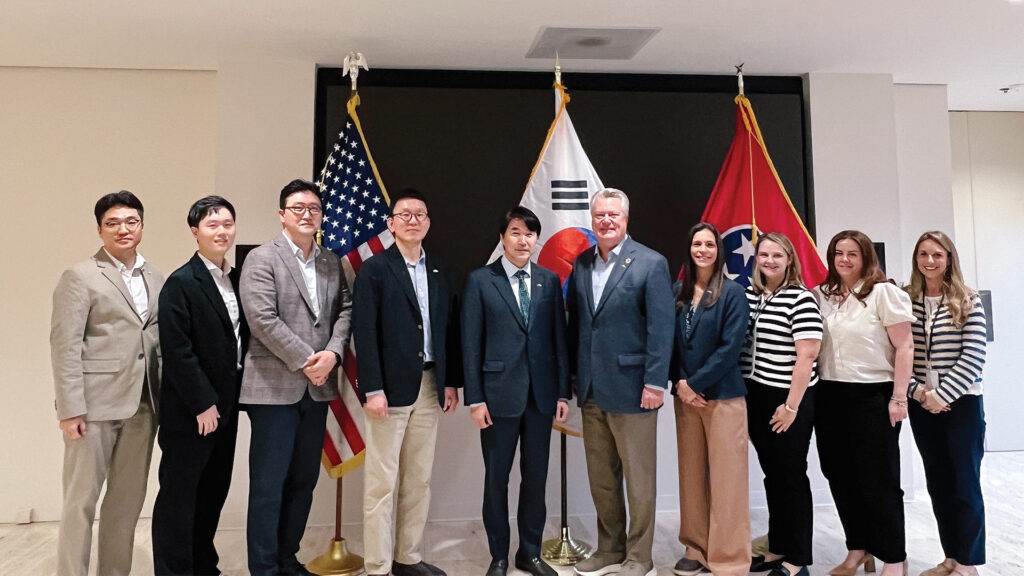
Korea Zinc’s planned smelting and processing facility in Tennessee brings critical minerals processing under U.S. regulatory oversight and supports the U.S. industrial base.
By Soobeen Park
The United States wants to physically locate critical minerals processing inside its own borders, and is seeking help from South Korean firms to make that happen. Korea Zinc’s planned smelting and processing complex in Tennessee will operate through a joint venture, Crucible Metals, and is modeled after Korea Zinc’s Onsan Smelter in Ulsan. Backed by a USD 210 million award under the CHIPS and Science Act and a 40 percent stake held by the U.S. Department of Defense (DOD), the plant could serve as a model for future public-private partnerships.
The planned facility in Clarksville, about an hour outside Nashville, would produce thirteen nonferrous metals—eleven of which carry U.S. critical mineral designations—feeding sectors such as semiconductors, defense, advanced manufacturing, and energy systems. Capital expenditures are estimated at roughly USD 6.6 billion, with total planned investment reaching USD 7.4 billion. By placing these operations on U.S. soil, the project would bring critical minerals processing under domestic regulatory oversight and tie it directly into the U.S. industrial base.
Why This Matters Now
U.S. economic policy considers critical minerals, particularly processed critical minerals and their derivative products (PCMDPs), as a matter of national security. The 2025 U.S. National Security Strategy notes the importance of “countering predatory economic practices” with respect to critical minerals, likely referring to Chinese dominance in the industry, and parallel threats to strictly control its exports. Findings from a Section 232 investigation targeting critical minerals emphasize that excessive reliance on foreign processing, limited domestic refining and processing capacity, and high import dependence have created structural barriers to the United States’ critical mineral capacity. This leaves the United States unable to rapidly restore refining capacity or shield critical supply chains during geopolitical or trade disruptions.
A critical vulnerability lies at the processing and refining stages, rather than the mining stage. While mineral deposits are distributed across many countries, the capacity to convert raw materials into usable industrial inputs is concentrated in a small number of countries, with China as the leading refiner for nineteen of the twenty “important strategic minerals” and holding roughly 90 percent of the world’s rare earth element (REE) processing capacity. The U.S. critical minerals investigation also noted that domestic mining may be possible for certain minerals, yet insufficient domestic refining and processing capacity forces the country to export raw materials for processing and then reimport for use. This midstream stage requires large capital investments and lengthy permitting and regulatory processes, making it difficult to scale quickly or for new entrants to substitute existing capacity.
China’s dominance in refining and smelting provides a clear example of how concentration has become entrenched. Chinese firms have prioritized the long-term expansion of processing capacity over short-term price signals and profitability, thereby constraining competitors’ entry. Under its Fourteenth Five-Year Plan for the Raw Materials Industry, Chinese authorities have promoted the consolidation of rare earth enterprises into large state-aligned groups, coordinated production quotas for mining and separation, and encouraged vertical integration across the processing chain. These measures have strengthened industry concentration and reinforced sustained capacity expansion beyond immediate market cycles. As a result, dependence on a single country for processing and refining has persisted, emerging as a national security issue in both the United States and allied countries, given the risk that supply disruptions pose to important technologies and defense materials.
U.S. Government Setting the Tone
Korean companies are well-positioned to help break that dependence, given their established smelting and refining capabilities and experience operating large-scale facilities. But their willingness to invest is only part of the equation. Tariffs, subsidies, and price incentives alone are insufficient to combat the industrial competition posed by China. Trade measures may shift sourcing at the margin, but they do not determine whether building a refining facility in the United States makes economic sense over the long term. But when investment support is large and credible enough to improve expected returns, firms are more likely to view domestic refining and processing as financially viable and choose to locate capacity in the United States.
Government policy, exercised primarily through the Department of Commerce (DOC) and DOD, can shape where that capacity lands and how it integrates into the domestic industrial base. For both departments, the core objective is to reduce dependence on China and strengthen supply chain resilience in sectors tied to national security. When refining and processing capacity is concentrated overseas, supply risks cannot be easily mitigated once a crisis emerges, which complicates planning and operational stability.
For DOC, expanding domestic refining and processing capacity reinforces the industrial base supporting semiconductors, energy systems, and advanced manufacturing. For DOD, securing reliable access to critical minerals is essential for defense production and long-term military readiness. Thus, engaging a trusted allied firm to establish domestic production contributes to supply continuity and operational control in support of national security objectives.
Conclusion
Korea Zinc’s investment in the United States reflects the Donald Trump administration’s desire to locate critical minerals processing capacity stateside to support semiconductor supply chains. Rather than relying on trade measures or diversified sourcing, U.S. policy is increasingly focused on ensuring key processing stages for these materials are physically established within U.S. borders. The application of CHIPS incentives to a critical minerals refining project further illustrates this development. By extending support to a midstream processing facility, U.S. authorities signal that access to processed materials is considered a part of the semiconductor supply chain.
What remains to be seen is whether the Korea Zinc project represents a singular strategic case or the beginning of a broader pattern in how the United States structures access to its market.
KEI is registered under the FARA as an agent of the Korea Institute for International Economic Policy, a public corporation established by the government of the Republic of Korea. Additional information is available at the Department of Justice, Washington, D.C.