
Why South Korea Cannot Reach Carbon Neutrality on Renewables Alone
Achieving South Korea’s objective of carbon neutrality requires a comprehensive plan to develop a range of renewable energy sources.
South Korea’s 2035 Nationally Determined Contribution (NDC), submitted to the United Nations Framework Convention on Climate Change in December 2025, sets a target of reducing greenhouse gas (GHG) emissions by 53–61 percent relative to their 2018 level (Table 1). The lower bound lies along the linear pathway from 2018 to the target year for carbon neutrality (2050), while the upper bound would require enhanced government efforts, technological innovation, and industrial transformation.
Meeting either end of the target range implies more than doubling the pace of reduction achieved since emissions peaked in 2018—in an economy whose emissions intensity remains among the highest in the OECD. Facing criticism from business groups, President Lee Jae Myung stated that transitioning to a carbon-neutral society is an inevitable path for sustainable growth and for Korea to become a global economic power.
Narrowing the gap between the target and the tools currently in place to achieve it is challenging. Korea’s overall carbon price averaged USD 30 per ton of CO2 equivalent in 2023—less than half the OECD average—and most of the pricing comes from fuel excise taxes rather than the Korea Emissions Trading System (K-ETS), which continues to allocate emission allowances free of charge to the sectors responsible for the large majority of industrial emissions.
On the supply side, renewables accounted for around 9 percent of power generation in 2024, against a 2035 target of at least 30 percent, in a country whose natural conditions make that expansion unusually difficult and costly. Whether Korea meets its 2035 NDC therefore depends less on the ambition of the target than on whether carbon pricing and the power mix are adjusted to match it.
Successful Reductions in Greenhouse Gas Emissions
Korea’s GHG emissions per unit of GDP have fallen significantly since 1990 but remain above other high-income countries (Figure 1). Korea’s high level reflects its focus on manufacturing, which accounted for 26 percent of Korea’s GDP in 2022, double the OECD average. Manufacturing is the main source of Korea’s GHG emissions, along with electricity generation. Energy intensity (energy supply per unit of GDP) has also fallen but remains high compared to other OECD countries (Figure 2).
In per-capita terms, GHG emissions have nearly doubled since 1990, primarily reflecting income growth (Figure 3). Korea appears behind schedule to achieve its 2030 Nationally Determined Contribution (NDC) of reducing its GHG emissions by 40 percent from their 2018 peak (Table 1).
The government is now preparing its Second National Basic Plan for Carbon Neutrality and Green Growth to achieve its 2035 targets. In the NDC submitted last December, Korea set a goal of increasing the share of renewables in power generation, which was around 9 percent in 2024, to at least 30 percent by 2035, still well below the European Union, where its share was half in 2025. In addition, Korea’s coal-fired power generation is to be phased out by 2040. The International Energy Agency has stated that advanced countries should close all unabated coal-fired power generation by 2030 to reach zero carbon emissions by 2050. Nearly three-quarters of OECD countries are on track to phase out coal by 2030.
The Essential Role of Carbon Pricing
Korea applies carbon pricing through excise taxes on fuel, which covered 55.3 percent of its GHG emissions in 2023, and the K-ETS, which covered 80 percent. Overall, 98.5 percent of GHG emissions in Korea are subject to a positive net effective carbon rate. However, the overall price level averaged USD 30 per ton of CO2 equivalent, less than half of the OECD average (Figure 4).
Korea launched K-ETS in 2015, making it the first nationwide, mandatory cap-and-trade program in East Asia. However, the GHG emissions limit set by the K-ETS was not aligned with the GHG emission reduction targets in Korea’s NDC. In addition, K-ETS gave emission allowances for free during the first phase (2015–2017).
During the second phase (2017–2020), only 3 percent of emission allowances were auctioned, and the share was increased to 10 percent in the third phase (2021–2025). The free allocation of emission allowances creates several problems. First, it shields firms from the real cost of GHG emissions. Requiring firms to purchase emission allowances through auctions raises the marginal cost of carbon-intensive industries, such as coal power. Second, it deprives the government of substantial revenue that could be used to finance the green transition. Third, it favors established firms at the expense of new market entrants. Fourth, it disrupts the functioning of the K-ETS market.
The Fourth National Emissions Allowance Allocation Plan, which covers the period from 2026 to 2030, introduced several improvements. First, the annual emissions cap in the K-ETS was aligned with the 2030 emissions reduction target. The emissions covered by the K-ETS will decline each year in line with the commitment to reduce domestic emissions by 40 percent (from the 2018 level) in 2030 (Table 1). Second, the share of emission allowances that are auctioned will vary between sectors, replacing the 10 percent share for all sectors during 2021 to 2025. By 2030, half of the allowances in the power generation sector will be auctioned.
However, energy-intensive trade-exposed (EITE) sectors, such as steel, petrochemicals, and semiconductors, will continue to receive 100 percent of their allowances to protect their global competitiveness. Industrial sectors that are not included in EITE will face a fixed 15 percent auction rate.
Boosting Renewable Energy
For years, Seoul has prioritized renewable energy to achieve climate policy goals. Indeed, the 2050 Carbon Neutrality Scenarios published in 2021 envisaged renewables accounting for 60.9–70.8 percent of electricity generation in 2050. As noted above, the 2035 NDC set a target of at least 30 percent by 2035.
The low share of renewables in Korea partly reflects its challenging natural conditions, which make it difficult to reach the government’s 2021 targets. For example, Korea’s high population density may constrain the use of solar panels. According to one estimate published in 2022, generating half of the renewable energy power projected in the 2050 Carbon Neutrality Scenarios from solar panels would require an area five times the area of the city of Seoul. The poor quality of available renewable energy resources is another constraint. Wind and sunshine conditions are weak, intermittent and variable, and their energy content is low. Wind power generation is possible for only six hours a day on average and solar power generation for only two hours a day. Steady sunshine is particularly scarce during the monsoon season of June and July.
Maintaining a stable electricity supply based primarily on renewable energy would require major innovations to secure sufficient supply flexibility, improved energy storage systems, and smart operating technologies.
Conclusion
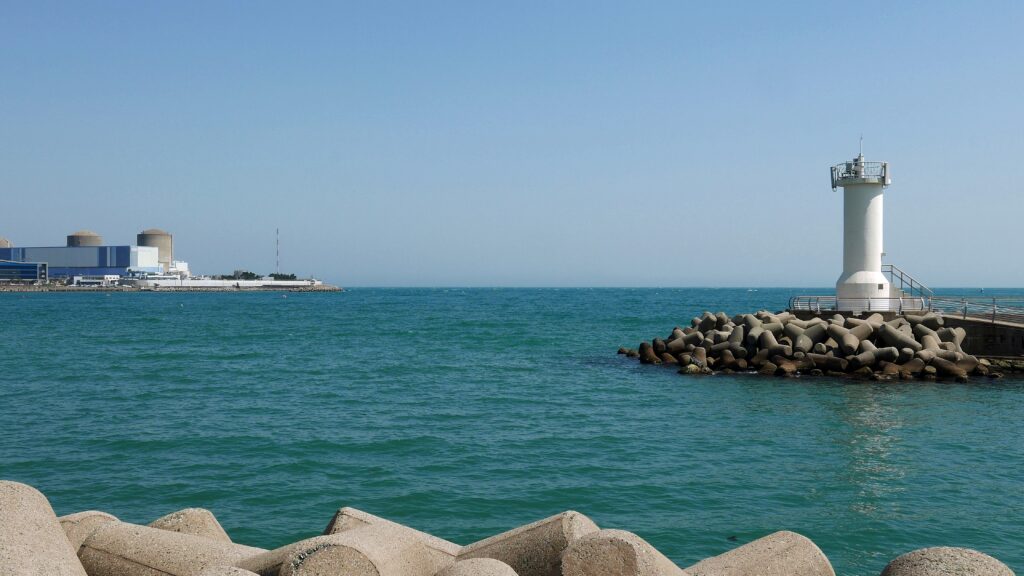
Achieving Korea’s objective of carbon neutrality within twenty-five years is a major challenge. The gap between Korea’s peak in GHG emissions in 2018 and 2050 is short compared to the sixty years it would take the European Union to achieve its emissions goal. It requires a comprehensive plan to develop a range of renewable energy sources, but renewables alone may not be adequate to replace fossil fuels. Consequently, increased reliance on nuclear power, which accounted for 32 percent of electricity generation in 2024, is likely to be necessary to achieve carbon neutrality.
The 2050 Carbon Neutrality Scenarios envisaged phasing out nuclear power, reducing its share to only 6–7 percent. The Lee administration has taken a pragmatic approach to nuclear power that includes ongoing utilization and life extensions of existing operational nuclear plants and moving forward with the construction of two new nuclear reactors. Nuclear power could also help meet the rising electricity demand related to AI.
Randall Jones is a Nonresident Distinguished Fellow at the Korea Economic Institute of America (KEI). The views expressed here are the author’s alone.
This material is distributed by KEI on behalf of the Korea Institute for International Economic Policy. Additional information is available at the Department of Justice, Washington, DC.