
Why Kim Jong Un’s Recent Visit to China Deserves Greater Scrutiny
China’s Dandong city has long been a key hub for North Korea’s cybercriminal enterprise, and Kim’s visit may have had more to do with securing that operational environment than with strengthening bilateral ties with China.
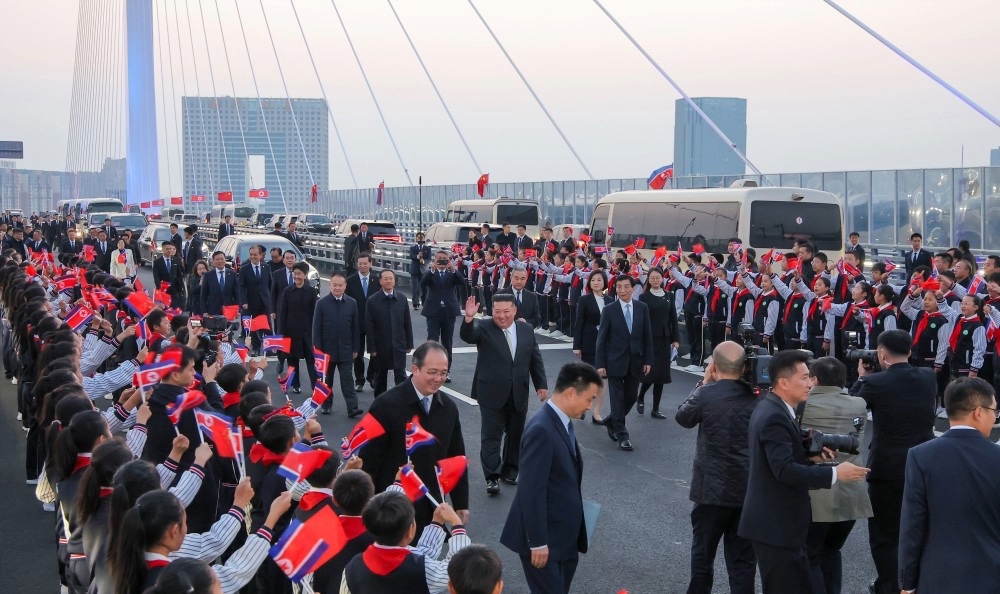
Five days after North Korean leader Kim Jong Un’s one-day visit to the Chinese border city of Dandong on October 24, North Korean hackers stole more than USD 6 billion from Binance, the largest crypto heist on record. Kim’s trip was intended to commemorate the opening of the New Yalu River Bridge. But Dandong has long been a key hub for North Korea’s cybercriminal enterprise, and the visit may have had more to do with securing that operational environment than with strengthening bilateral ties with China. For Washington and Seoul, which are weighing how to respond to the theft while keeping the door open to talks with Pyongyang, that possibility warrants greater scrutiny.
As South Korean Minister of Unification Chung Dong-young said, “The fact that both sides fielded their diplomatic and security teams deserves a close look.” Chung has also suggested the trip could relate to preparations for a possible U.S.-North Korea summit, but several features of the visit suggest a broader agenda. First, Kim visited China for only one day and did not meet with Chinese President Xi Jinping. This was the first time that Kim had visited a foreign country without meeting his counterpart. Instead, the fourth-highest-ranking leader in the Chinese Communist Party, Wang Huning, met Kim in Dandong. This could suggest that Xi either disapproved of Kim’s brief visit or did not think it was important enough to meet. Second, the visit to China came five days before the world’s largest-ever crypto heist, in which North Korean hackers stole more than USD 6 billion from Binance. Third, and most critically, Dandong plays a pivotal role in North Korea’s illicit finance ecosystem.
Given its proximity to North Korea, Dandong has long been associated with facilitating North Korea’s illicit activities. In 2017, the U.S. Department of the Treasury cut the Bank of Dandong off from the U.S. financial system. Despite this sanction, North Korea continues to use Dandong as a key hub for its cybercriminal enterprise. In July 2024, a U.S. federal indictment against North Korean military intelligence operative Rim Jong Hyok revealed that he used an ATM in Dandong near the Sino-Korean Friendship Bridge to withdraw Bitcoin-converted Chinese yuan after a ransomware attack on a Kansas hospital. The U.S. government now offers a reward of up to USD 10 million for information on Rim.
More recently, a 2025 Multilateral Sanctions Monitoring Team report found that a North Korean company linked to the Ministry of Atomic Energy Industry was based in Dandong and facilitated remote IT worker schemes there. A fifteen-person North Korean IT team was also found to have been stationed in Dandong and living in a clothing factory dormitory. More importantly, two North Korean operatives, Kim Chol Min and Kim Ryu Song, were cited as representatives of the Munitions Industry Department’s 313 General Bureau in Dandong and Yanji, respectively, and used Chinese accomplices to launder and cash out cryptocurrency.
During his one-day visit to Dandong, Kim Jong Un visited a memorial that paid homage to the Chinese troops who died in the Korean War. He also visited a vehicle factory, Dandong Huanghai Automobile, which was founded during the Korean War. While Kim presumably did not meet any of these North Korean cyber operatives, the opening of the bridge and Kim’s visit may signal Dandong’s continued importance to North Korea’s cybercrime. After the recent Binance hack, North Korean operatives likely need to launder and convert these stolen crypto assets into liquid currency. North Korean hackers depend on Chinese accomplices, including money-laundering organizations and over-the-counter traders, to convert crypto into cash. North Koreans have previously laundered stolen funds into legitimate cross-border economic ventures, including businesses based in Dandong, to conceal their origins.
Given the opacity of the Chinese and North Korean systems, there is likely to be no smoking gun linking North Korean cybercrime activities to Kim’s recent visit to Dandong. However, North Korea’s cyber operations are increasingly an important source of revenue for the regime, and Dandong has long served as a critical node for the Kim family regime’s illicit commerce. It is plausible that the North Korean delegation raised the cyber issue with the Chinese side and pushed for assistance, or at least asked the authorities there to turn a blind eye. Given Xi’s animosity toward cryptocurrency, this may explain why he did not meet with Kim.
Regardless of Kim’s discussions in Dandong, the Binance theft has put the issue in front of Washington and Seoul. The United States has called for coordinated international action, and South Korea’s Ministry of Foreign Affairs is reviewing additional measures, including unilateral cyber sanctions. At the same time, both allies are leaving room for diplomacy, and Pyongyang has warned that the FBI’s attribution leaves it “matters to reconsider.”
The Multilateral Sanctions Monitoring Team, which the United States and South Korea helped create after Russia killed off the UN Panel of Experts, has documented how North Korea’s illicit revenue moves through Dandong. How the allies weigh that record against the pull of renewed diplomacy will go a long way toward deciding whether Dandong stays open for North Korea’s business.
Benjamin R. Young is Nonresident Fellow at the Korea Economic Institute of America (KEI) and Assistant Professor of Intelligence Studies at Fayetteville State University. The views expressed here are the author’s alone.
This material is distributed by KEI on behalf of the Korea Institute for International Economic Policy. Additional information is available at the Department of Justice, Washington, DC.