
Congress Supports Action for Human Rights in North Korea But Still Does Not Act
There is little chance that Congress will reauthorize the North Korean Human Rights Act, which expired in September 2022, before the midterm elections, leaving the position of special envoy for North Korean human rights empty.
By Robert King
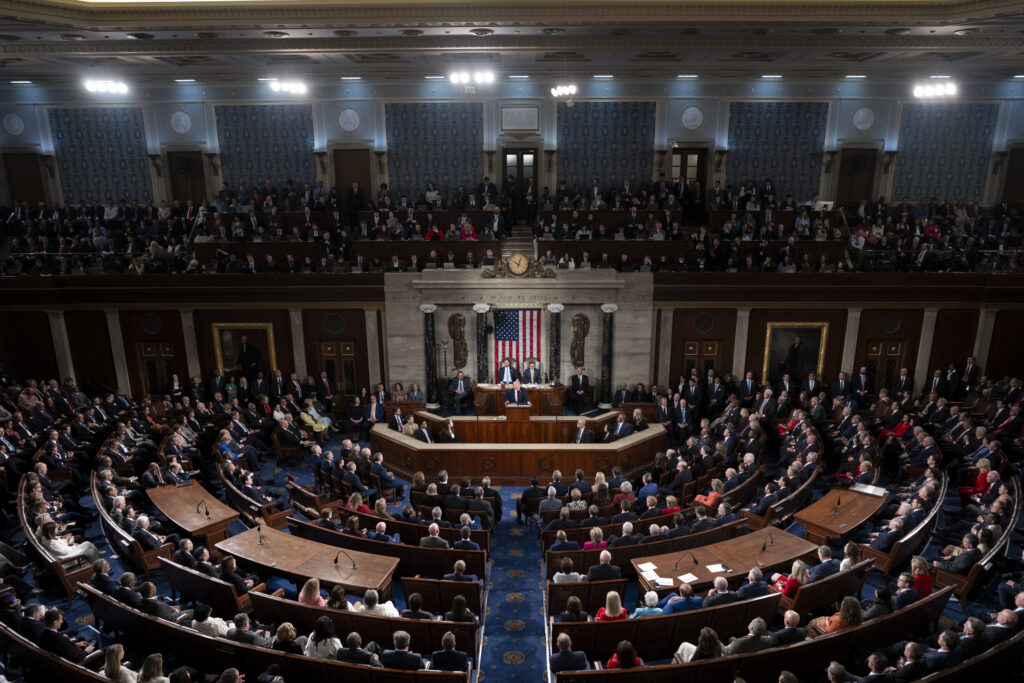
Congress will be in session for roughly four weeks from Labor Day to the end of September, with an overcrowded agenda to complete approval of appropriations bills funding the U.S. government for the coming fiscal year. There is little chance that reauthorizing the North Korean Human Rights Act, which expired in September 2022, will be considered. The legislation is not controversial—when the bill was last approved in 2017–2018, the House of Representatives passed it with 415 in favor and no one opposed, and the Senate approved it a few months later by unanimous consent. The result is that the U.S. Department of State has no special envoy for North Korean human rights, U.S. representatives at the United Nations ignore the issue, and diplomats feel no pressure to report to Congress on North Korean human rights.
The chances that Congress will extend the North Korean Human Rights Act before the 2026 election are slim to none. All 435 seats in the House are up for election this November. Recent forecasts suggest a razor-thin margin, with only nineteen House seats a toss-up. In the one-hundred-member Senate, thirty-five seats are up for election this year, reflecting the rolling six-year term for senators. As with House races, control of the Senate will likely be extremely narrow for whichever party ultimately comes out on top. Of course, there are always last-minute twists that could change results.
Over the past two years, the political margins in both the House and the Senate have been so narrow that Congress has been largely dysfunctional. Controversial actions by President Donald Trump and the very narrow margins in both chambers of Congress have made governing particularly difficult. One consequence is that even routine, non-controversial legislation, including measures that enjoy broad bipartisan support, such as the North Korean Human Rights Act, has not been adopted by Congress.
Past Attempts Have Failed
Both Democrats and Republicans have traditionally shown strong support for the North Korean Human Rights Act, which was first adopted by Congress in 2004, and subsequently extended in 2008, 2012, and 2018.
Since 2008, the legislation has called for the appointment of a special envoy with ambassadorial rank to focus on human rights. Trump signed the legislation in 2018, but he failed to appoint an envoy during his first term. President Joe Biden appointed career diplomat Julie Turner as special envoy for North Korean human rights on October 13, 2023, although the North Korean Human Rights Act had expired and had not been renewed by Congress at the time of her nomination and confirmation.
The president does have the authority to nominate an individual for ambassadorial rank, but the nomination must be confirmed by the Senate. Turner served in that position until shortly after Trump’s Secretary of State Marco Rubio moved Ambassador Turner to another position in the Department of State, and the special envoy position technically no longer exists.
When the North Korean human rights legislation expired in 2022, efforts were made in both the House and the Senate to reauthorize the law. Ironically, the U.S. senator who introduced the reauthorization legislation and guided it through a Senate vote was Rubio, then a Florida senator. The Senate approved the legislation, but Congress adjourned before reconciling the minor differences between the Senate and House versions of the legislation. Ironically, as secretary of state, Rubio eliminated the position of special envoy for North Korean human rights.
Toward the end of 2024, Representative Young Kim (R-CA) again secured a strong affirmative vote for her North Korean human rights extension bill in the House. Senators Rubio and Tim Kaine (D-VA) had also introduced Senate legislation earlier to extend the North Korean Human Rights Act, but the Senate did not vote on it. The House approved the legislation after the November 2024 presidential election, but there has been no further movement since Rubio was nominated as secretary of state and the Senate did not act.
The “Do-Nothing Congress”
Bipartisan legislation was introduced in both the House and Senate in 2025–2026, following the start of Trump’s second term, to extend the provisions of the North Korean Human Rights Act. Representative Kim, with fellow California Representative Ami Bera (D-CA), did so in November 2025, while Senators Kaine and Dan Sullivan (R-AR) introduced a Senate version in June 2026.
This far, no action has been taken on either House or Senate versions of the reauthorization legislation. Only four weeks are scheduled for legislative business from Labor Day to early October of this year, with Congress in recess for the month before the November 3 election. With other “must-pass” bills to deal with, including some critical funding bills, it appears unlikely that Congress will have time to take up the North Korean Human Rights Act before this Congress ends.
Despite overwhelming bipartisan support for measures to press North Korea on improving human rights, the current Congress seems unable to move forward even on bipartisan legislation that has had significant support from all sides. That support has been there for well over the last two decades. Trump has shown little if any interest in North Korean human rights, nor has Rubio shown interest in using his elevated position to pursue the issue. With Trump talking about another summit with North Korea’s Kim Jong Un, it is even less likely that we will see human rights legislation
Increasingly, the current stalemate in Congress brings back memories from an earlier era. The 119th Congress (2025–2026) has been a “do-nothing Congress,” as President Harry Truman said of Congress during the 1948 U.S. presidential election campaign. North Korean human rights is an issue that both chambers of Congress have strongly supported in the past, and it is unfortunate that legislation even on such a non-controversial issue languishes with inaction.
All bills introduced in the House and the Senate die when this Congress adjourns and the new Congress is sworn in, and the process starts over. By the time the 120th Congress could plausibly act, the law will have expired for close to half a decade, and the special envoy position will remain vacant. Congress has never voted against this legislation. Not once, in over two decades. It has simply stopped acting—even on things the Congress agrees on.
Robert King is a Nonresident Distinguished Fellow at the Korea Economic Institute of America (KEI). The views expressed here are the author’s alone.
This material is distributed by KEI on behalf of the Korea Institute for International Economic Policy. Additional information is available at the Department of Justice, Washington, DC.