
Arms Sales to Russia and Trade With China Drive North Korea’s Economic Recovery
Continued benefits from deeper ties with Russia and China may help sustain North Korea’s economic growth, but a lack of energy, the continuing drag from sanctions, the sharp depreciation of the North Korean won, and rising prices for basic foods are likely to pose serious challenges.
North Korea’s economy grew 3.5 percent in 2025, the third straight year above 3 percent, according to the Bank of Korea (Figure 1). Output has now passed its 2017 level (Figure 2), the year the United Nations imposed its toughest sanctions on the regime. Most of the growth came from weapons production for Russia and trade with China. However, the impact on living standards was likely to have been limited, given that the North Korean won has lost roughly three-quarters of its value against the U.S. dollar since May 2024, and rice costs more than five times what it did then.
Sustained growth has been attributed to a “new Cold War strategy” centered on Russia and China to counter sanctions. In exchange for providing weapons and troops to Russia in its war against Ukraine, Russia has supplied North Korea with weapons technology, food, oil, and tourism, contributing to what The Wall Street Journal dubbed the “world’s most surprising economic success story.” A mutual defense and cooperation treaty between the two countries lifted North Korea’s international status and eased its economic isolation. Meanwhile, Chinese President Xi Jinping traveled to North Korea in June 2026—his first visit in seven years—to promote increased trade and aid.
Heavy and Chemical Industries Drive Output Growth
Estimates by the Bank of Korea (BOK) show robust manufacturing growth (Table 1), driven in part by North Korea’s production of artillery shells and ballistic missiles for Russia. Construction growth was led by non-residential building and civil engineering, including the “20×10 policy” (see below). However, mining output growth slowed due to reduced coal production, while electricity, gas, and water production fell because thermal power generation declined.
The BOK estimates North Korean GDP at current prices using South Korean prices and value-added ratios. Its estimates should be viewed with a grain of salt, as the North has not published regular national account statistics since the 1960s, nor has it published any budget information in level terms since the early 1980s. Further compounding the difficulty of assessing the North Korean economy is the lack of a functioning financial system and a credible central bank, as well as wide regional variation in prices and the availability of goods. However, few alternatives to the BOK estimates exist as long as the Kim Jong Un regime maintains such severe secrecy.
The Enormous Gulf Between North and South Korea
Rapid development has brought South Korea’s economic structure in line with those of the most advanced countries. Agriculture, forestry, and fishery and mining account for less than 2 percent of the South Korean economy, compared with nearly one-third in the North (Figure 3). In addition, services’ share is 61 percent in the South, double that in the North.
Despite sustained growth in North Korea, its gross national income (GNI) is less than 2 percent of South Korea’s level (Table 2). South Korea’s per capita GNI is twenty-eight times larger, and its life expectancy at birth is ten years longer. Fertilizer use per hectare of arable land and electricity consumption per capita are both less than 7 percent of South Korea’s levels. North Korea compares favorably on demographics, with an old-age dependency ratio ten percentage points lower than South Korea’s.
The gap in international trade is even more significant, reflecting North Korea’s isolation from global markets. At USD 4.7 billion in 2025, North Korean exports were less than 0.1 percent of South Korea’s (Table 2). In addition to its minimal level, North Korean trade is concentrated with China, which accounted for 98 percent of its official trade in 2024. Inter-Korean trade has dropped to practically zero, reflecting the impact of international sanctions on the North, its COVID-19 lockdown, and policy changes in North Korea.
North Korean exports are concentrated in niche products, such as tungsten ores and concentrates and wigs and related hair products, where North Korea accounts for a non-negligible share of global exports (Figure 4). Beyond these products, North Korea’s export market shares are confined to low-value-added or semi-processed materials. The absence of higher value-added manufactured goods and technologically complex products reflects both weak industrial capacity and the impact of international sanctions.
Challenges Facing North Korea
In contrast to the Eighth Party Congress in 2021, which acknowledged that the 2016–2020 economic plan had “failed,” the February 2026 Ninth Party Congress declared the “fulfillment” of the 2021–2025 plan.
In a follow-up speech in March 2026 to the Supreme People’s Assembly, Kim set a target of increasing industrial output by around 1.5 times during the new 2026–2030 economic plan. He identified electricity and coal as key bottlenecks constraining economic growth, along with corruption. Moreover, international sanctions continue to restrict finance, investment, and formal trade. Although North’s trade with China is rising, it remains only about half of its 2014 peak.
Another concern is the sharp depreciation of the North Korean won. In the two years since May 2024, the won has lost about three-quarters of its value relative to the dollar (Figure 5). Large but uneven increases in official wages across the state sector since late 2023 contributed to exchange depreciation and boosted demand for foreign currency, while stricter controls on foreign-exchange transactions and market activity limited its supply. The plunging value of the won pushes citizens away from the local currency and toward the U.S. dollar, triggering inflation and sharp increases in basic food and import prices. Indeed, the price of rice rose by 5.2 times between May 2024 and May 2026 (Figure 4).
The weaker roles of markets and the private sector also have negative implications for economic growth. Although market mechanisms exist only informally and at the regime’s discretion, private markets became the backbone of the civilian economy before the COVID-19 pandemic. But Kim used the pandemic to suppress market forces, roll back already-limited enterprise autonomy, and reestablish price setting and foreign-exchange allocation. In addition, the revitalization of the state grain distribution system monopolized food sales, thereby weakening private traders.
North Korea’s five-year plan for 2026–2030 suggests that Kim will strengthen centralized economic control and governance further while retaining selected market-oriented mechanisms. In other words, North Korea does not intend to abandon market-oriented mechanisms completely, but instead to maintain them in a more tightly centralized economic system.
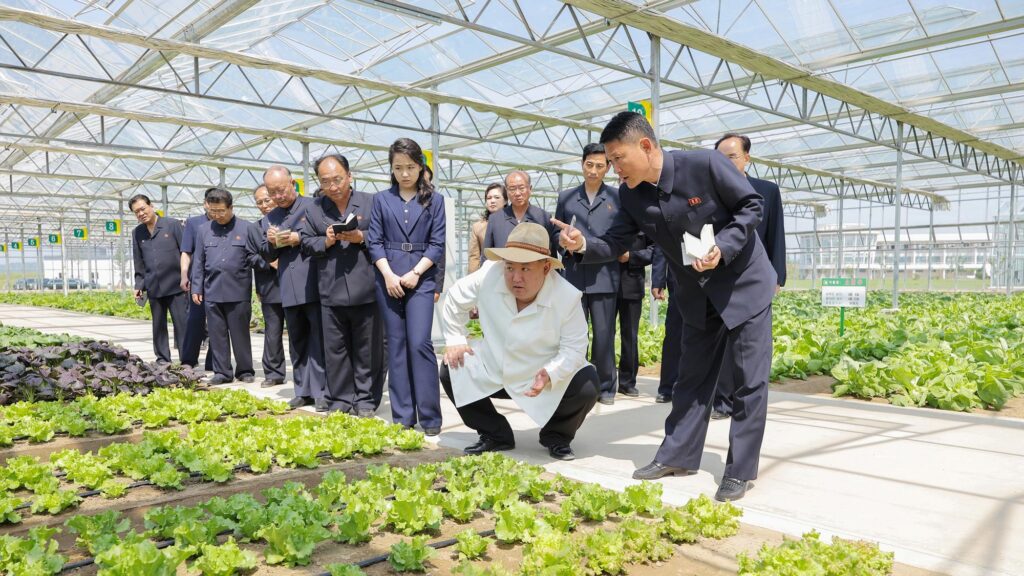
The Kim regime has increased its emphasis on economic growth. In particular, the ongoing 20×10 program, launched in 2024, has been incorporated into the 2026–2030 economic plan. The program aims to promote regional development and narrow the urban-rural economic divide by building modern industrial factories in twenty cities and counties per year over ten years. In addition, the Ninth Party Congress in 2026 focused more on regional development, housing, health care, public services, and rural living conditions.
However, North Korea’s continued emphasis on defense spending suggests limited bandwidth for other priorities, notably economic growth. In September 2025, Kim announced a new policy of simultaneous development of nuclear and conventional forces. Kim appeared to favor continued emphasis on military spending in a March 2026 speech to the Supreme People’s Assembly: “Our style of development strategy was very correct as we directed great efforts to the development of the State and the economy while giving priority to getting a security guarantee of our own and consistently carrying on the line of bolstering up our nuclear forces.”
Conclusion
North Korea appears to have achieved sustained economic growth following declines in the wake of the implementation of tighter international sanctions in 2017 and the COVID-19 pandemic. Continued benefits from deeper ties with Russia and China may help sustain growth during the 2026–2030 economic plan. However, a lack of energy, the continuing drag from sanctions, the sharp depreciation of the North Korean won, and rising prices for basic foods are likely to pose serious headwinds. In addition, the diminished role for market forces and the continued emphasis on military development will limit the North’s growth potential.
Randall Jones is a Nonresident Distinguished Fellow at the Korea Economic Institute of America (KEI). The views expressed here are the author’s alone.
This material is distributed by KEI on behalf of the Korea Institute for International Economic Policy. Additional information is available at the Department of Justice, Washington, DC.