
By Ellen Kim
The Impact of the Iran War on the Korean Peninsula
South Korea now faces not only the fear of entrapment in the Middle East conflict, but also the fear of abandonment due to the U.S. deployment request.
Listen to this article
0:00 / 0:00
The war in Iran is shaking the world. As the conflict involving the United States, Israel, and Iran shows signs of spilling over into neighboring Middle Eastern countries, concerns are growing that a surge in oil prices resulting from the closure of the Strait of Hormuz will provoke a prolonged global energy security crisis. At the same time, U.S. President Donald Trump’s request for allied troop deployments to the Strait of Hormuz is placing both the transatlantic and Indo-Pacific alliance systems under severe strain at a critical juncture.
South Korea now faces not only the fear of entrapment in the Middle East conflict, but also the fear of abandonment due to the U.S. deployment request. Under the framework of “modernizing the alliance,” the strategic flexibility of U.S. Forces Korea (USFK) and the priorities set in the Trump administration’s National Defense Strategy—which emphasized a leading role for South Korea in deterring North Korea—are gradually becoming a reality; for instance, some U.S. military assets stationed on the Korean Peninsula are being redeployed to the Middle East following the outbreak of hostilities.
While the South Korean government is taking a cautious approach to President Trump’s request for troop deployments, it must also prepare for the possibility of a prolonged conflict if the situation escalates further, particularly through strikes on key energy infrastructure in the Middle East. Approximately 70 percent of South Korea’s crude oil imports pass through the Strait of Hormuz, and if the blockade is prolonged, analysis by the Korea Institute for Industrial Economics & Trade (KIET) suggests that manufacturing production costs in South Korea could rise by up to 11.8 percent. Conversely, even if Trump declares a swift end to the war and withdraws from the region, it cannot be ruled out that he may expect countries relying on the Strait of Hormuz to assume responsibility for securing it.
Beyond the bilateral U.S.-South Korea relationship, it is also important to consider, from a strategic perspective, how this war could influence North Korea’s strategic calculations. Iran does not hold the same level of strategic importance for North Korea as Russia does, and the likelihood of North Korea deploying troops to a war as it did in Ukraine is low, given the direct involvement of U.S. forces in the conflict. However, since the 1980s, North Korea has maintained missile and related technology cooperation with Iran and has also directly and indirectly supplied military equipment not only to Syria and Libya but also to armed groups such as Hamas and Hezbollah.
Given the fact that North Korea has already gained economic and strategic benefits through troop deployments and arms support in the Ukraine war, it seems possible that North Korea may seek further gains by providing missile technology, drones, and other weapons systems to Iran and other actors in the future. According to the 2026 Annual Threat Assessment released this week by the U.S. Office of the Director of National Intelligence (ODNI), North Korea, Russia, China, and Iran “are likely to continue selective cooperation with each other.” At a Senate Select Committee on Intelligence hearing, National Intelligence Director Tulsi Gabbard stated that “if a hostile regime survives, it will seek to begin a yearslong effort to rebuild its missiles and UAV force,” an effort that North Korea could play a central role in as an arms proliferator.
North Korea’s overseas arms exports not only undermine the international security environment but have also enabled Russia to neutralize international sanctions against North Korea during its war against Ukraine. Furthermore, the economic gains derived from such activities have ultimately lessened North Korea’s perceived need to engage in dialogue with the United States—an aspect that should not be overlooked.
In sum, the South Korean government should engage in swift consultations and close coordination with Japan and European countries, which are also facing U.S. deployment requests, to help prevent further escalation in the Middle East and work toward a peaceful resolution.
This article was originally published in Korean in the Hankook Ilbo on March 21.
Ellen Kim is Director of Academic Affairs at the Korea Economic Institute of America (KEI). The views expressed are the authors’ alone.
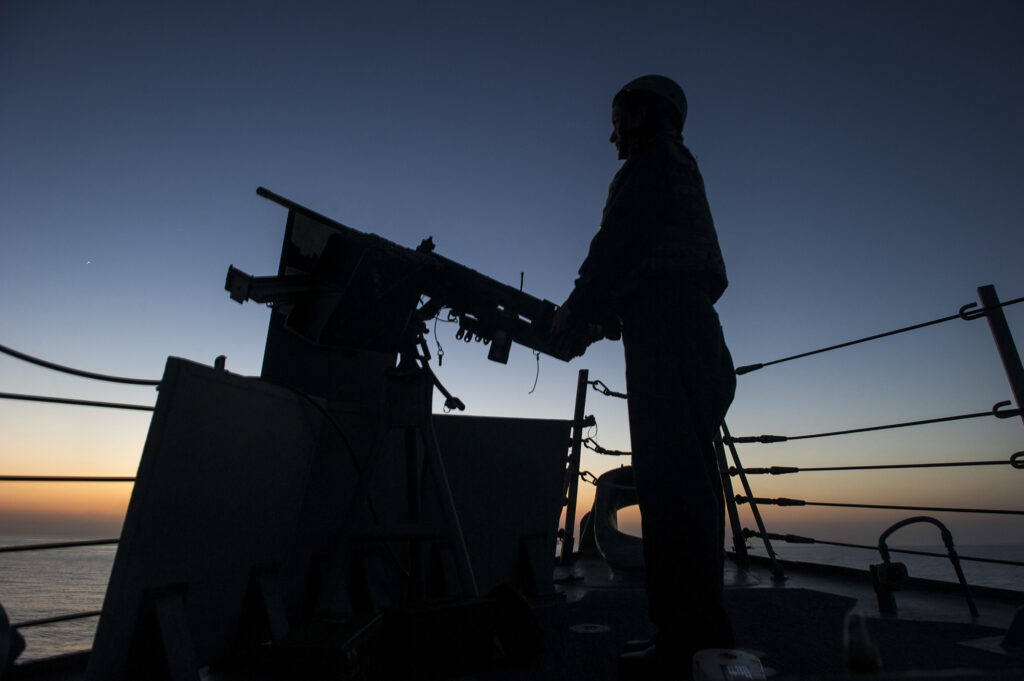
Feature image from The Pentagon.
KEI is registered under the FARA as an agent of the Korea Institute for International Economic Policy, a public corporation established by the government of the Republic of Korea. Additional information is available at the Department of Justice, Washington, D.C.