
North Korea’s Human Rights Record Worsens as UN Pushes for Concrete Benchmarks
The UN Human Rights Council pushes for greater accountability for North Korea to make progress on human rights issues, while South Korea cosponsors a resolution on North Korean human rights.
By Robert King
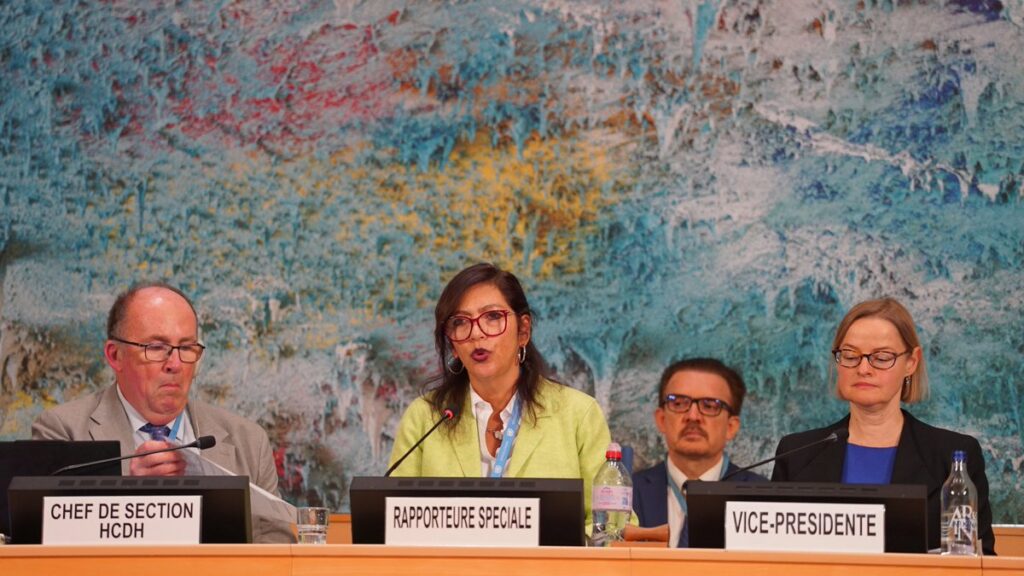
The UN Human Rights Council continued its scrutiny of North Korea this month, with UN Special Rapporteur Elizabeth Salmón presenting a sobering assessment. She noted that over the past decade, the human rights situation in North Korea showed no improvement and, in many instances, “had degraded.” Salmón detailed the expansion of border fences, stricter restrictions on movement, and a shoot-on-sight policy against would-be escapees—measures that have accelerated as Pyongyang’s military partnership with Moscow has deepened.
In a notable push for accountability, the special rapporteur proposed using “measurable indicators” across five areas, including freedom of movement and the right to food, to track whether North Korea follows through on recommendations it has deflected for more than twenty years. The shift from broad condemnation to concrete benchmarks could give future Human Rights Council sessions something specific to hold North Korea to, including commitments the country accepted during its 2024 Universal Periodic Review (UPR).
The UPR is a review of the human rights conditions in every UN member country conducted every five or six years. All UN member states undergo this process on a rotating basis, and North Korea had its fourth review in fall 2024. Building off this most recent review, Salmón proposed focusing on five areas: the right to life, freedom of movement, the right to food, the right to work, and the rights of persons with disabilities. It is not clear how this monitoring system will function or how information will be gathered, but focusing on changes over time in these five important human rights areas could help put pressure on Pyongyang to make progress.
Special Rapporteur Salmón also voiced concern about labor rights. The North Korean government rejected all recommendations made on labor rights during its last UPR. Salmón noted that North Korea’s 2025 Labor Management Act enables the government to assign citizens to workplaces, which reinforces a state-directed labor policy that is equivalent to forced labor. Human rights advocates have reported that labor for North Korean nuclear and missile programs is insured by arbitrary detention, torture, enforced disappearances, forced labor, and restrictions on movement and access to information.
“Even More Suffering”
Salmón’s assessment that North Korean human rights have not improved echoes a special report on the status of human rights in North Korea published by UN High Commissioner for Human Rights Volker Türk ten years after the publication of the UN Commission of Inquiry on human rights in North Korea. “The overall human rights situation in the Democratic People’s Republic of Korea (DPRK) has not improved over the past decade and, in many instances, has degraded, bringing even more suffering to the population,” Turk concluded.
In her report to the Human Rights Council in Geneva two weeks ago, Special Rapporteur Salmón cited High Commissioner Türk’s report and argued for continuing engagement with North Korea on the human rights abuses identified in that report.
The message was clear in the report and during the discussion on North Korea at the Human Rights Council in March 2026. Special Rapporteur Salmón told the Human Rights Council, “As the UN High Commissioner for Human Rights concluded in his 10-year assessment report last September [2025], there has been no overall improvement in the human rights situation in the last decade.” The report quoted a North Korean escapee who spoke with UN officials after reaching South Korea: “To block the people’s eyes and ears, they strengthened the crackdowns. It was a form of control aimed at eliminating even the smallest signs of dissatisfaction or complaint.” No other population lives under such vicious restrictions in today’s world.
In February, just one month before the UN Human Rights Council took up the issue of North Korean human rights abuses, Special Rapporteur Salmón met South Korean government officials and non-government human rights organizations in Seoul. She also met with North Korean refugees who had recently arrived. In addition, Salmón was questioned by the media on legal issues related to North Korean prisoners held by Ukraine—two North Korean soldiers captured by Ukrainian troops have reportedly asked to defect, fearing that returning to Russia following their capture would be treated by North Korean officials as a serious crime, and both could be executed or imprisoned under abusive conditions.
In response to a question during the media briefing, Salmón said, “There are reasonable grounds to believe that in the DPRK, cases of torture and ill-treatment have been very well documented over the years. So, I think that Ukraine has some legal obligations concerning the principle of non-refoulement. It means that one state should not repatriate people to a place where there are reasonable grounds to believe they would face torture or ill-treatment.” At the same time, she carefully noted that “it is up to Ukraine to respect international law and to make the best decision.”
Putting aside the complicated political aspects of the decision, the United Nations and international law are clear, as expressed by Special Rapporteur Salmón. Prisoners of war should not be repatriated if there is a clear risk of harm under the principle of non-refoulement. The final decision on the fate of the captured North Korean soldiers is in the hands of Ukraine, and no decision has been made thus far.
The UN Human Rights Council will hold a vote on adopting the resolution critical of North Korea in the next couple of weeks. It can be a recorded vote, in which member countries are tallied and recorded in official records, or a voice vote, in which the report is approved without naming those in favor or opposed. Over the past two decades, North Korea and its allies, China and Russia, have not demanded that countries’ votes be recorded and published because very few countries oppose the resolution and very few would vote in favor. It is better to adopt the resolution without a vote than to force one in which only a handful of countries would vote against it.
Individual countries, however, can cosponsor the resolution, which is noted and recorded. There has always been a significant number of countries that make a point of putting their name on the record by cosponsoring. Notably, the South Korean government decided on March 28 to cosponsor the resolution “under the stance of cooperating with the international community for the practical improvement of the human rights of North Korean residents.” The Lee Jae Myung administration cosponsored a similar UN General Assembly resolution critical of North Korean human rights in December 2025. The resolution will be approved by an unrecorded vote, but countries have until two weeks after that vote to add their name to the list of cosponsors.
Conclusion
North Korea’s crackdown since the COVID-19 pandemic has dramatically reduced the number of escapees reaching South Korea. Only a few dozen arrive each year this decade, down from over a thousand before the pandemic. Many of those now reaching the South left North Korea years ago and spent time in China or elsewhere—either by force or by choice—before completing the journey. Emboldened by warming relationships with Russia and increasingly China, the Kim regime shows no signs of relenting on movement restrictions and border controls. Defector numbers may remain a trickle for years to come, which is precisely why Salmón’s push for measurable benchmarks matters. Without a concrete framework to track conditions inside North Korea, the UN Human Rights Council risks another decade of condemnation with little to show for it.
Robert King is a Non-Resident Distinguished Fellow at the Korea Economic Institute of America (KEI). The views expressed are the author’s alone.
Feature image is a UN photo by Anastasiia Lavrenteva.
KEI is registered under the FARA as an agent of the Korea Institute for International Economic Policy, a public corporation established by the government of the Republic of Korea. Additional information is available at the Department of Justice, Washington, D.C.