
By Robert King
Two New Bridges Show China and Russia Competing for North Korea
That competition is likely to leave Trump the loser in his effort to meet the North Korean leader later this year.
Listen to this article
0:00 / 0:00
China and Russia opened new bridges to North Korea a month apart, a sign that the two countries are competing for the favor of North Korean leader Kim Jong Un. The Yalu River bridge to China sat unused for more than a decade after its completion in 2014, until Russia began rewarding North Korea for its help in the war against Ukraine. Russia needs North Korean troops and North Korean-made weapons for that war, and China does not want to cede influence over its neighbor. Kim is playing the two against each other, and with both courting him, he has little reason to meet again with U.S. President Donald Trump.
Of the two, Russia depends more on North Korea. Its effort to seize territory from Ukraine has so far been largely unsuccessful, and North Korean troops are essential to keeping up the fight without adding to the pressure on a war-weary Russian public. That pressure has grown over the past year as Ukraine has increasingly made Russians feel the consequences of the war far from the front lines. Pyongyang has provided both troops and material assistance, and Moscow has rewarded it handsomely.
China’s stake is different. The two countries share a border of more than 800 miles, and conditions in Northeast China matter to Beijing politically and economically. An erratic move by Pyongyang could create serious problems for the Chinese government, and Beijing likely worries that it will lose influence if it does not keep up with Moscow in courting Kim. As North Korea’s relations with Russia have flourished, China has made a concerted effort to strengthen its own ties with Pyongyang. The Yalu River bridge was finished in 2014, but North Korea did not complete the access roads needed to reach it for more than a decade.
The competition puts Kim in the enviable position of playing Moscow against Beijing, and it is likely to leave Trump the loser in his effort to meet the North Korean leader later this year. Despite Trump’s indication that a meeting is in the works, Kim has shown no sign of interest.
New Connections
The Yakov Novichenko Bridge crosses the Tumen River, which forms the eleven-mile border between North Korea and Russia. A railroad bridge across the Tumen has linked the two countries since 1959, and an earlier wooden railroad bridge was in the same place.
Construction moved quickly. North Korea and Russia agreed to build the bridge when Russian President Vladimir Putin visited Kim in Pyongyang in June 2024, and work began less than a year later on April 30, 2025. “We are creating a reliable basis for closer cooperation between our two countries,” Russian Prime Minister Mikhail Mishustin gushed. “A road for an open and fruitful dialogue, for bringing our peoples closer, boosting the number of trips and meetings and discovering each other’s history and traditions.”
Although the bridge itself was finished in April, work crews needed an additional five months to complete the road approaches on both sides and build customs and border control facilities. The vehicle bridge was formally opened on September 7, 2026, at a major event featuring top officials from both countries. The bridge was named after Yakov Novichenko, a Soviet military officer who was seriously injured and lost an arm shielding North Korean founder Kim Il Sung from a grenade attack in the 1940s.
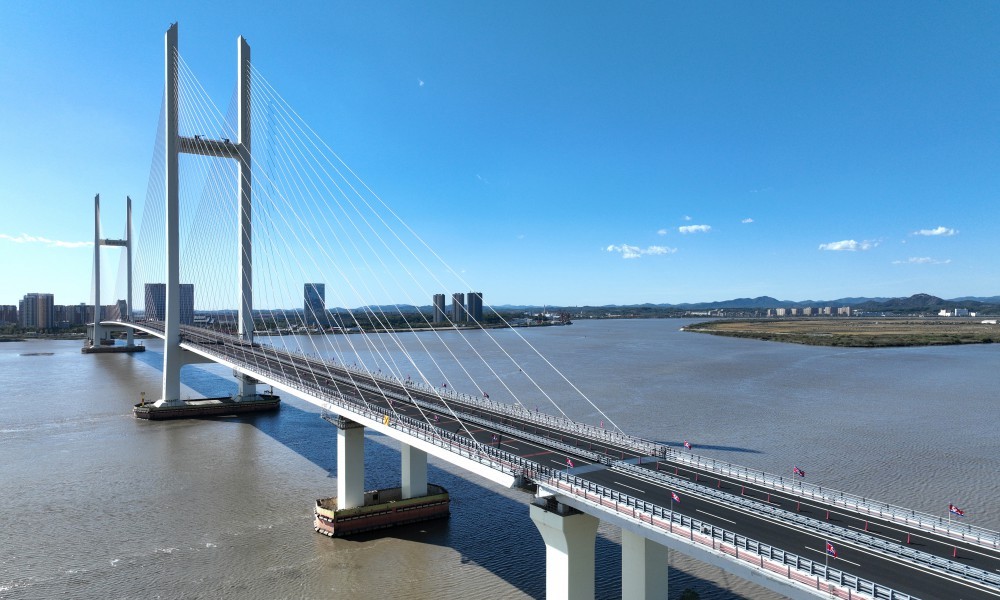
China is keeping pace. A month after the Yakov Novichenko Bridge opened, China and North Korea opened a new bridge across the Yalu River, which forms the border between the two countries. It is the second bridge linking the Chinese city of Dandong with Sinuiju, a North Korean provincial capital. On the older bridge, a single rail track and a one-lane road for trucks and cars carry an estimated 70 percent of trade-related traffic between the two countries. Closures for repairs and maintenance have become an increasing problem. Beijing and Pyongyang agreed to build a second bridge, and construction ran from 2011 to 2014. The new bridge then sat unused until October 2026, twelve years later.
As U.S. Special Envoy for North Korean Human Rights Issues, this author visited Dandong, China, on three occasions, most recently ten years ago. The bridge appeared complete, with access routes in place on the Chinese side but missing on the North Korean side. This was no secret; many others, including journalists, saw the bridge as it was. In 2025, there were signs that work was being done to prepare bridge access on the North Korean side of the structure.
There have been reports since, but no official confirmation, that the delay came from Pyongyang’s failure to build its share of the project, possibly to press China into paying for the North Korean access roads. When the bridge was finished, China may not have wanted to pay.
However, since 2023, the relationship between China and North Korea has shifted as North Korea came to Russia’s aid in the war against Ukraine. North Korea has sent both troops and material assistance, and Russia has rewarded it handsomely. As relations between North Korea and Russia have flourished, China has made a concerted effort to strengthen its own ties with Pyongyang. In October 2023, a month after Kim met Putin in the Russian Far East, China reportedly agreed to fund the customs facilities on the North Korean side of the bridge. Construction there accelerated in 2025, according to satellite imagery analysis, just as Russia was publicly rewarding North Korea for its aid in Ukraine.
The grand opening of the bridge on October 15 was a gala affair – massed trucks flying red flags paraded from China into North Korea. The importance of the opening was highlighted by the fact that the trucks were lined up days in advance. The festive celebration only highlighted the Chinese interest to use the bridge and the gala opening event to emphasize to Pyongyang the importance to Beijing of the relationship with Pyongyang.
What the Bridges Mean for Another Trump-Kim Jong Un Meeting
The two bridges are the latest evidence that Kim knows how to manage Beijing and Moscow to his own advantage. Putin needs North Korean troops, and Chinese President Xi Jinping cannot afford to lose influence over a neighbor that shares a long border with Northeast China. Each has reason to keep courting Kim, and Kim has every reason to let them compete.
That competition is likely to leave Trump the loser in his effort to meet the North Korean leader later this year. Asked in August whether he would be meeting with Kim again, Trump said, “Yeah, I will be.” He also unexpectedly, and at the last minute, ordered joint military exercises with South Korea significantly scaled back, apparently to improve the chances of a meeting. Kim has shown no interest. With China and Russia competing for his favor, he has little to gain at present from a meeting with the U.S. president.
Robert King is Nonresident Distinguished Fellow at the Korea Economic Institute of America (KEI). The views expressed here are the author’s alone.
This material is distributed by KEI on behalf of the Korea Institute for International Economic Policy. Additional information is available at the Department of Justice, Washington, DC.