
By Tom Ramage
What the San Francisco AI Summit Means for U.S.-Korea Tech Cooperation
South Korean President Lee Jae Myung’s AI summit will determine the direction of technology investment and private-sector partnership between the United States and Korea.
Listen to this article
0:00 / 0:00
The AI summit that South Korean President Lee Jae Myung convenes in San Francisco tomorrow is organized around two major growth drivers of the global AI revolution: high-bandwidth memory (HBM) and a national commitment to build data centers at scale. The discussions are expected to focus on both, alongside broader questions on AI rules and regulations. The outcome will shape the direction of technology investment and private-sector partnership between the United States and Korea.
U.S. and Korean industry leaders, including NVIDIA’s Jensen Huang, OpenAI’s Sam Altman, Broadcom’s Hock Tan, Anthropic’s Dario Amodei, Samsung Electronics’ Lee Jae-yong, SK Group’s Chey Tae-won, Hyundai Motor Group’s Chung Eui-sun, and Naver Corporation’s Lee Hae-jin, will also attend Friday’s summit. The concentration of the largest voices in AI for the Korean president’s visit reflects the growing importance of Korea in the global AI ecosystem and will likely inject new momentum in the U.S.-Korea AI partnership.
The main thrust of the conversations will likely be Korea’s support for AI infrastructure in the United States and its provision of cutting-edge HBM chips used in graphics processing units (GPUs) that supply AI data centers for large language models (LLMs). Samsung and SK Hynix collectively account for some 80 percent of the global market share for HBM chips, serving as the basis for a growing retinue of partnerships with U.S. firms to maintain and develop supply chains for compute power in AI. Korean HBM chip exports are particularly salient as they likely helped shield the country’s economy from some of the hardest impacts of the war in Iran.
The U.S. CEOs meeting with President Lee in San Francisco may use the summit as an opportunity to gain greater access to advanced Korean memory chips and strengthen investment ties between the two countries.
Likewise, Korea’s growing investments in its own domestic data centers require substantial deployment of U.S. GPUs, necessitating new and major private-sector partnerships. In June 2026, President Lee announced a “megaprojects” blueprint for semiconductors, physical AI, and AI data centers, including a KRW 550 trillion investment in data centers by 2029. Earlier this year, Shinsegae, a large Korean conglomerate, announced a 250 MW data center with U.S.-based Reflection AI—the largest data center built by a Korean company and the first partnership agreement under the U.S. Department of Commerce’s American AI Exports Program. And notably, on the sidelines of the 2025 Asia-Pacific Economic Cooperation (APEC) summit in Korea, NVIDIA pledged to deploy a quarter million GPUs across Korea to support cloud infrastructure. A major feature of Friday’s discussions may center on U.S. tech companies’ involvement and support in such projects, particularly in the form of strategic investment cooperation. Korea’s robust startup culture around AI shops may also provide a substantial area for partnerships and investment cooperation between domestic Korean startup ventures and Silicon Valley’s tech ecosystem.
An additional area ripe for cooperation could center on Korea’s role in shaping AI governance and its place in the global AI ecosystem. At the AI Seoul Summit in May 2024, the United States announced the International Network of AI Safety Institutes, with Korea as one of the inaugural members, and San Francisco served as the first meeting location later that year. This year’s Group of Seven (G7) summit in France, attended by Lee, also discussed the participating countries’ collective efforts toward AI safety, leading to a declaration by G7 members to work with AI companies for the “safe and beneficial deployment” of AI. Likewise, Anthropic’s recent office expansion in Korea materialized alongside a memorandum of understanding (MOU) with Korea’s Ministry of Science and ICT to advance AI safety, marking greater integration between Silicon Valley’s private sector and the Korean government to work together on building resiliency against digital threats.
The potential for adversarial entities and rogue actors to misuse advanced AI models for nuclear proliferation, malicious cyber operations, and large-scale disinformation campaigns hastens the pace at which tech leaders in both the United States and Korea should establish agreements on the use of AI globally, including which guardrails should be in place and how digital governance is coordinated. President Lee’s apparently forthcoming “San Francisco AI Declaration” will outline the administration’s priorities here, such as determining the tools to safely and equitably share AI technologies with partner countries.
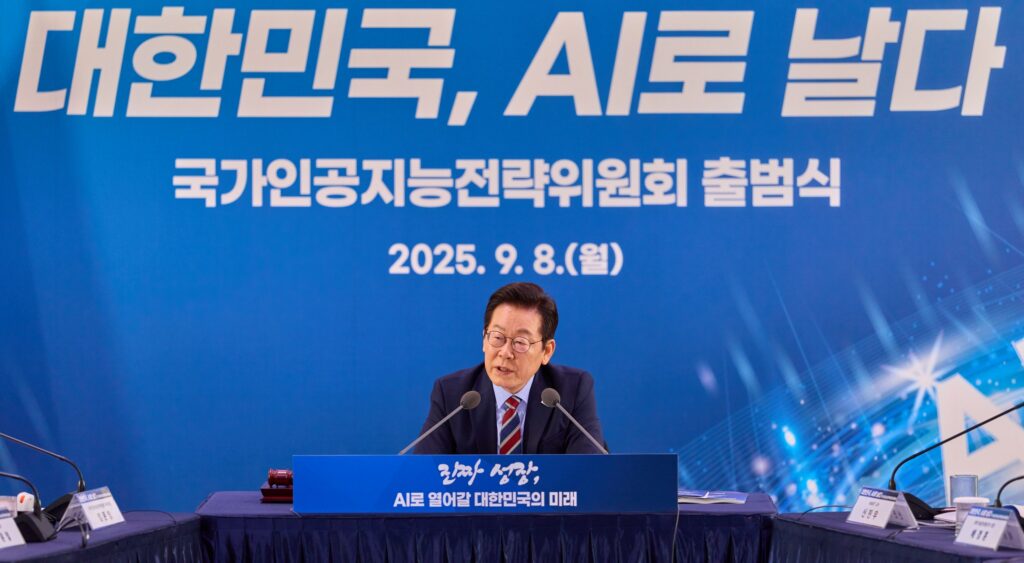
Overall, the outcome of Lee’s visit to San Francisco will help set the future direction of technology investments and private-sector partnerships between the two countries. Korea first iterated plans to become a “top three AI global power” in 2024, and the Lee administration instituted a National AI Strategy Committee to help facilitate that goal in 2025, calling it a “survival strategy” for Korea’s future.
With the AI summit facilitating the government’s vision to become an “AI powerhouse,” its outcome could decide how Korea’s AI strategy and the U.S.-Korea AI relationship unfold in the coming years.
Tom Ramage is a Fellow and Economic Policy Analyst at the Korea Economic Institute of America (KEI). The views expressed here are the author’s alone.
This material is distributed by KEI on behalf of the Korea Institute for International Economic Policy. Additional information is available at the Department of Justice, Washington, DC.