
Trilateralism Through Transition: Reflections on U.S.-South Korea-Japan Cooperation From Experts and Emerging Leaders
The United States, South Korea, and Japan face new challenges to trilateral cooperatfterion a leadership transitions in all three capitals.
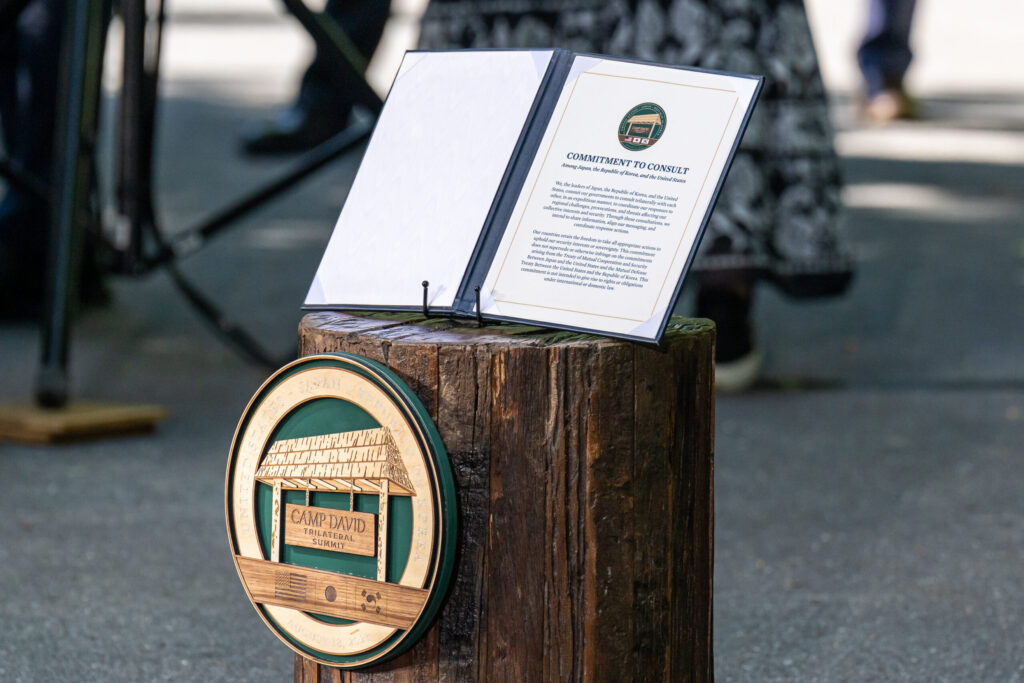
Two years after the Camp David summit among the United States, South Korea, and Japan institutionalized trilateral cooperation, the partnership faces new challenges amid leadership transitions in all three capitals. To assess the stakes, the Korea Economic Institute of America (KEI) and The Maureen and Mike Mansfield Foundation convened a public panel with Zack Cooper (CSIS), Shihoko Goto (Mansfield Foundation), and Eun A Jo (William & Mary). Drawing on insights from these experts, 15 competitively selected emerging leaders joined a private roundtable to develop blue-sky ideas for the future of trilateral cooperation. This report offers timely perspectives for the policy community on how the three partners can sustain momentum amidst uncertainty.
Since the Camp David summit, trilateral cooperation has advanced across security, economic, and diplomatic fronts, even as new challenges test its resilience. Joint defense coordination and regular exercises have strengthened deterrence vis‑à‑vis North Korea’s missile and nuclear threats, in addition to reinforcing alignment in response to other regional security challenges. Economic cooperation has also deepened. Japan and South Korea are diversifying their access to critical minerals through different but complementary strategies, while both are expanding investments in the United States. At the same time, the United States’ tariff-focused and bilateral approach to trade has complicated longer-term trilateral alignment. Meanwhile, the institutional mechanisms launched at Camp David, supported by highly engaged ambassadors in Seoul and Tokyo, have helped sustain momentum. Public sentiment is shifting on both sides. In Japan, favorable views of South Korea have nearly doubled over the past decade, with a majority of respondents indicating “friendly feelings” toward their neighbor, especially among the younger generation. In South Korea, for the first time in three decades, a majority views relations with Japan positively. However, political uncertainty in all three capitals continues to threaten the durability of these gains.
The Donald Trump, Lee Jae Myung, and Takaichi Sanae administrations face strikingly similar pressures that shape the trajectory of trilateral cooperation. All three leaders are navigating challenging domestic politics, limiting maneuverability for bold foreign policy moves. Much of the follow-through on the Camp David commitments occurred under past leaders who negotiated the accord. Thus, the true test of trilateral institutionalization lies ahead and hinges on whether these mechanisms can continue to function with equal regularity and purpose under shifting political leadership. The three governments also share a common focus on how to engage with China, seeking to balance risk management and economic competition with the reality of interdependence. Finally, the United States, South Korea, and Japan are advancing an agenda of economic security, from critical minerals and supply chains to technology and investment, though Trump’s preference for bilateral deals risks undercutting trilateral alignment.
These dynamics raise a central question: What does trilateralism look like moving forward? If it is to remain more than a symbol, what are the opportunities for impact, and where are the risks of backsliding most acute?
To address these questions, participants engaged in three in-depth sessions that explored areas of opportunity, structural and cultural challenges, and concrete strategies for institutional and grassroots collaboration. This off-the-record workshop built upon the public panel held in August and focused on how the trilateral partnership could remain resilient and relevant amid shifting political dynamics, evolving public sentiment, and regional uncertainties.
Feature image from the Joe Biden White House Flickr Account
KEI is registered under the FARA as an agent of the Korea Institute for International Economic Policy, a public corporation established by the government of the Republic of Korea. Additional information is available at the Department of Justice, Washington, D.C.