Search All Site Content
Total Index: 6902 publications.
Subscribe to our Mailing List!
Sign up for our mailing list to keep up to date on all the latest developments.
The Peninsula
2025 Year in Review: The Trump Tariff Strategy From IEEPA to Section 338
The following is part of a new miniseries from KEI surveying the most important developments and trends in the U.S.-South Korea relationship in 2025. You can read all year-in-review pieces by clicking here.
In 2025, tariffs emerged as one of U.S. President Donald Trump’s most visible and legally contested economic policy tools. While the administration framed its tariff strategy as advancing three objectives—incentivizing U.S. production, creating negotiating leverage, and raising government revenue—the year ultimately revealed how difficult it is to pursue all three simultaneously once tariffs are tested in court.
The Trump administration’s most ambitious tariff policy effort came on “Liberation Day,” April 2, 2025, when the president announced a universal 10 percent tariff on nearly all imports and higher country-specific “reciprocal” rates to follow under the International Emergency Economic Powers Act (IEEPA). According to an official U.S. Customs and Border Protection (CBP) statement, the baseline tariff took effect on April 5, with reciprocal rates scheduled for April 9.
The legal challenge arrived quickly. On May 28, 2025, the U.S. Court of International Trade (CIT) issued a permanent injunction blocking the administration’s sweeping IEEPA-based tariffs, holding that the Commerce Clause vests tariff-setting authority in Congress and that IEEPA “does not confer such unbounded authority” to the president. The ruling covered both the universal tariffs and fentanyl-related import duties. Although the U.S. Court of Appeals for the Federal Circuit granted a temporary administrative stay on May 29, it later affirmed the CIT’s core holding en banc on August 29, 2025, leaving only questions of remedy and timing unresolved. The dispute ultimately moved to the U.S. Supreme Court, which heard oral arguments on November 5, 2025.
What proved most consequential in court was not the rhetoric of leverage or reshoring, but revenue. During oral arguments, administration lawyers emphasized that the tariffs were regulatory rather than fiscal, implicitly conceding that a tariff regime defended primarily as a revenue-raising measure risks resembling taxation, a power constitutionally reserved for Congress. That tension sat at the heart of the judiciary’s skepticism.
In practice, the IEEPA tariffs did raise substantial revenue. Reuters reported that the United States collected over USD 100 billion in tariff revenue by July 2025, including a record USD 22.8 billion in May alone. By mid-December, CBP confirmed that tariff collections since January 20 exceeded USD 200 billion, underscoring why refund exposure became a major concern as litigation progressed.
For trading partners like South Korea, this mattered less because of the absolute revenue numbers and more because of policy instability. When tariffs rest on contested legal authority, even negotiated rate reductions cannot fully offset the uncertainty faced by manufacturers, exporters, and investors planning long-term supply chains. South Korea occupies a unique position in this debate. Under the U.S.-Korea Free Trade Agreement (KORUS FTA), nearly all South Korean tariffs on U.S. goods are scheduled to be eliminated by 2026, including the long-standing beef tariff. That makes the U.S. argument for reciprocal tariffs as a response to tariff-based discrimination difficult to sustain using traditional customs duties alone.
As a result, any future tariff pressure would more likely target non-tariff measures, regulations, standards, or administrative practices, rather than headline tariff rates. This shift raises the stakes considerably, because it transforms routine regulatory frictions into potential triggers for sweeping trade retaliation.
The defining tariff story of 2025 was not simply that courts constrained IEEPA. It was that tariffs justified as negotiating leverage or industrial policy become legally fragile once they function as revenue instruments. As the administration looks ahead, the central question is no longer whether tariffs will remain part of Trump’s toolkit, but which statutory foundation can sustain them without collapsing under constitutional scrutiny.
Yohan Moon is a Researcher at the Korea Economic Institute of America. The views expressed here are the author’s alone.
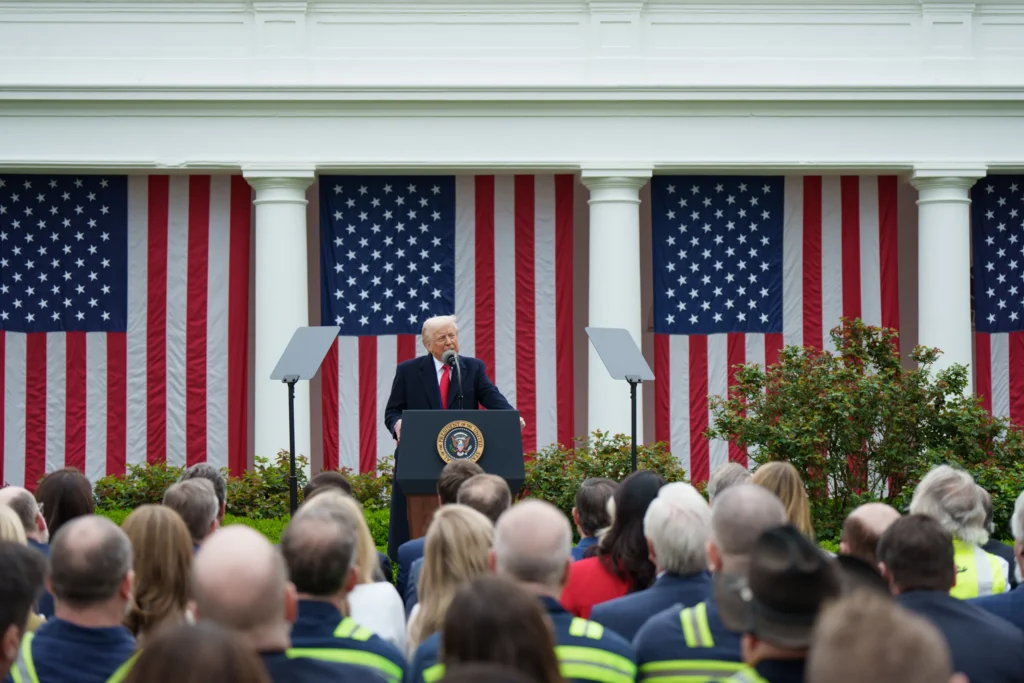
Feature image from The White House.
KEI is registered under the FARA as an agent of the Korea Institute for International Economic Policy, a public corporation established by the government of the Republic of Korea. Additional information is available at the Department of Justice, Washington, D.C.