
Search All Site Content
Total Index: 6895 publications.
Subscribe to our Mailing List!
Sign up for our mailing list to keep up to date on all the latest developments.
The Peninsula
Lee Jae Myung Tests South Korea’s Pragmatic Diplomacy Between China and Japan
Published January 27, 2026
Author: Tom Ramage, Ellen Kim
Category: China, Indo-Pacific, Japan, South Korea
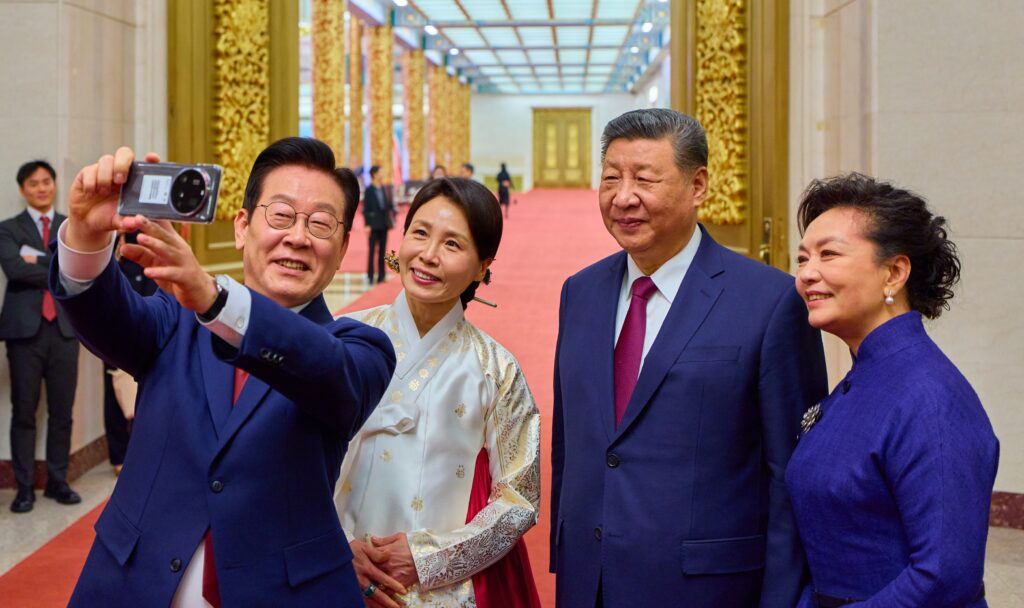
South Korean President Lee Jae Myung began 2026 with active regional diplomacy, visiting China and Japan in the first two weeks of the year. Lee’s trips were critical for assessing whether South Korea can sustain pragmatic diplomacy at a moment when tensions between China and Japan are intensifying over Taiwan, and both countries seek to draw South Korea closer to their respective orbits.
Lee’s travel to Beijing and Shanghai, China, from January 4–7, followed by a visit to Nara, Japan, from January 13–14, reflected his administration’s goal of stabilizing South Korea’s regional relations. South Korea’s relations with China have been strained for almost nine years since South Korea decided to deploy THAAD, a U.S. missile defense system meant to protect against North Korean ballistic missiles, to which China responded by banning or restricting travel, tourism, entertainment exports, and other economic activities between the two countries. Lee’s official state visit to China—the first by a South Korean president in six years—offered an opportunity for what Lee called the “full-scale restoration of South Korea-China relations.” Securing China’s support for the denuclearization of North Korea and peace and stability on the Korean Peninsula was another priority for the Lee administration as it seeks dialogue with North Korea this year, despite North Korea’s continued rebuffs.
While Lee and Xi shared the need to improve and normalize bilateral ties, the outcome of their summit was mixed. On the one hand, it was meaningful that the two leaders discussed thorny issues, such as South Korea’s plan to acquire a nuclear-powered submarine and China’s installation of three steel structures in the Provisional Maritime Zone (PMZ) in the Yellow Sea (China agreed to remove one of the structures during the summit). The two countries also agreed to conclude negotiations on their free trade agreement (FTA)—which has long been held up by its services and cross-border investment portions—and to enhance economic cooperation by concluding fifteen cooperation agreements across technology, transportation, trade, and the economy. An accompanying business delegation signed another thirty-two agreements, including USD 44 million in new export deals.
On the other hand, Xi’s lack of explicit support for the denuclearization of North Korea highlighted a clear gap between the two countries in their approach toward the North. Furthermore, Lee and Xi failed to resume Korean cultural exports to China, which the Chinese government has informally banned since the THAAD incident. The South Korea-China meeting also fell short of creating opportunities to expand market access for Chinese electric vehicles (EVs) and establishing a joint commitment to national-level projects on AI and semiconductor build-out, both of which may signal some hesitation from the Korean side in its relations with China. This can be due to the specter of U.S.-China competition, domestic company protections in South Korea—especially given Canada’s EV deal with China announced days later—or simply a lack of consensus on trade issues.
Meanwhile, Lee’s trip to Japan, at the invitation of Prime Minister Sanae Takaichi, provided an opportunity to sustain the positive momentum in South Korea-Japan relations and bolster U.S.-South Korea-Japan trilateral cooperation as the United States shifts its strategic focus to the Western Hemisphere. Lee’s summit meeting with Takaichi in Nara, the latter’s hometown, allowed the two leaders to reaffirm their strategic alignment on denuclearizing North Korea as a shared goal. The two leaders stated their commitment to a future-oriented working relationship and made an important first step in addressing history issues by agreeing to test the DNA of the remains of Korean laborers who died in a 1942 undersea mining incident.
The South Korea-Japan summit also played a broader role in bringing South Korea closer into the regional economy, where the leaders agreed to “further develop their current economic partnership to navigate the rapidly changing international situation and trade order.” National Security Adviser Wi Sung-lac stated that the two sides discussed South Korea’s accession to the Comprehensive and Progressive Agreement for Trans-Pacific Partnership (CPTPP), the U.S.-absent, Asia-Pacific-oriented trade bloc. More than signaling the renewed relevance of regional trade and economic security for Asian nations amidst growing threats to the global trade order from tariffs and economic coercion, this ensures further economic diplomacy between South Korea and Japan as South Korea’s accession bid—which needs Japan’s approval—likely necessitates mutual agreement surrounding its restrictions on Japanese seafood imports following the 2011 Fukushima nuclear disaster. To this end, the Japanese side indicated that “Japan would communicate the safety of its food products based on scientific evidence.”
The highlight of the Lee-Takaichi summit was the “drumstick diplomacy.” After their joint press conference, the two leaders held an impromptu drum performance to K-pop music. Later, Lee wrote on X, “We were a bit off beat, but tried to stay in sync”—a wise metaphor that captured the current state of bilateral relations and the chemistry between the two leaders. As in the South Korea-China summit in Beijing, which, among other things, included shared bonding over eating jajangmyeon (black bean noodles) and taking selfies on a Xiaomi smartphone, these cultural gestures underline the importance that cultural and people-to-people ties play, driving home the fact that the relationships go beyond the policy confines of economics and security.
Ultimately, South Korea’s ability to independently engage with China and Japan amid an ongoing diplomatic row between the two countries was deft. President Lee did well to come away from each summit with forward-looking statements and agreements, each containing commitments to various forms of ongoing exchange, while avoiding disproportionate deference toward either country amid the regional political crisis.
No one summit can truly be compared with the outcome of the other—each contains its own historical and geopolitical nuances. But taken together, they may signal Seoul’s commitment to a regional policy of pragmatic diplomacy, economic security, and broader regional stabilization amid a highly volatile regional and global political order.
Ellen Kim is Director of Academic Affairs at the Korea Economic Institute of America (KEI). Tom Ramage is Economic Policy Analyst at KEI. The views expressed are the authors’ alone.
Feature image from The Blue House.
KEI is registered under the FARA as an agent of the Korea Institute for International Economic Policy, a public corporation established by the government of the Republic of Korea. Additional information is available at the Department of Justice, Washington, D.C.