
Xi’s North Korea Visit Puts a Trump-Kim Summit Back in Play
Kim could seek recognition without giving up his nuclear warheads, and Trump may seek to claim peace on the Korean Peninsula.
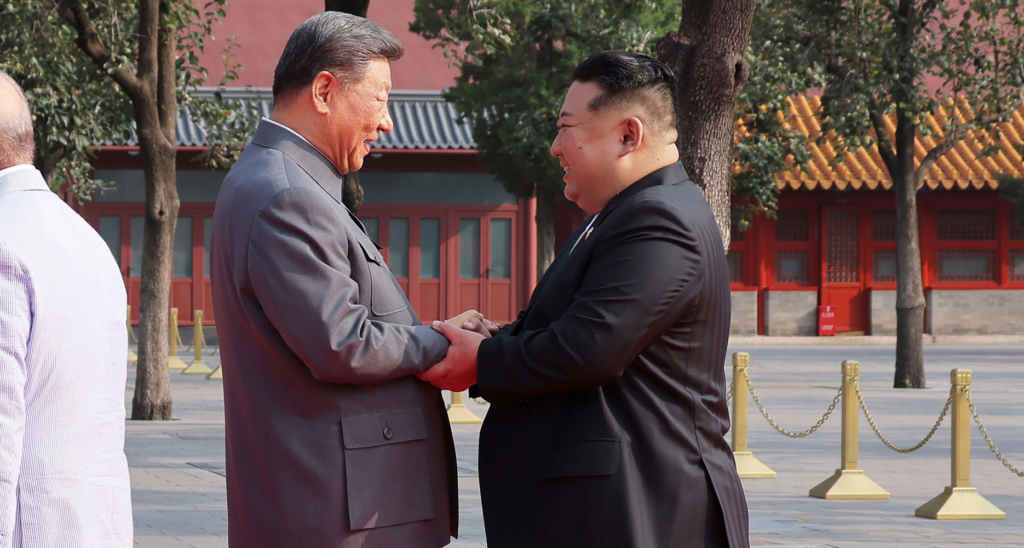
Chinese President Xi Jinping will make a rare visit to North Korea on June 8—his first international trip this year—weeks after hosting U.S. President Donald Trump and Russian President Vladimir Putin in Beijing. The sequencing has revived a scenario that seemingly grew less likely as Trump’s second term wore on: a third Trump-Kim summit. This writer shared that skepticism, but recent conversations in Seoul with senior officials and North Korea analysts have produced a case for the summit that is proving harder to dismiss than six months ago.
Before reports of Xi’s Pyongyang visit surfaced, this writer had extensive discussions in Seoul with senior officials and well-informed North Korea analysts, during which the possibility of a Trump-Kim summit seemed to gain credence. The idea that such a meeting could even take place before the U.S. midterm elections in November came up in these conversations.
There are, of course, differing views on this and on relations with North Korea. The Lee Jae Myung administration’s senior advisors are seemingly grouped into two broad camps. The “jaju,” or autonomy, camp emphasizes inter-Korean relations and autonomy. The “dongmaeng,” or alliance, camp prioritizes alliance relations with the United States. While both camps may back another meeting between Trump and Kim to advance their respective goals, they interpret North Korea’s eagerness for talks differently.
The dongmaeng camp is more skeptical on this front. They argue Kim is now in a stronger position thanks to Russian aid and support for its nuclear weapons program, and point to tensions with China and sanctions for further strengthening the North Korea-Russia partnership. For example, when Chinese Minister of Foreign Affairs Wang Yi flew to North Korea in April, interlocutors in Seoul told this writer that the Kim regime was unsatisfied with China’s reluctance to recognize it as a nuclear-weapon state.
In this view, economic problems in North Korea are not severe enough to threaten the country’s elite class or incentivize the regime to seek sanctions relief. The regime is focused on an intense military buildup, encouraged by its alliance with Moscow. As a result, the dongmaeng camp believes Kim is uninterested in dialogue but will want recognition of North Korea’s nuclear weapons in any future meeting.
Why Trump and Kim May Want to Meet
Not everyone is convinced. The jaju camp believes that Kim sees great utility in another summit with Trump because he is the only U.S. president that will give him the kind of reception and respect he seeks. Accordingly, if Trump does not set denuclearization as a precondition for talks and makes the initial move to seek a meeting, Kim will be open to the idea, those in the jaju circle argue. But, if denuclearization is explicitly on the table, one well-informed source told me, “he won’t go.”
From this perspective, a summit can happen even if Trump does not recognize or acknowledge North Korea as a nuclear state. The United States may not officially acknowledge this status, the argument goes, but if Trump refrains from bringing up the issue, Kim will think he has gone more than halfway. Russia has already acknowledged North Korea as a nuclear state. And China may be ready to follow Trump’s lead.
Whether this is a viable outcome for the U.S. president largely depends on how the war in Iran concludes. If it ends with an ambiguous solution to Iran’s nuclear program, that could open the door to the U.S.-North Korea summit outcome above. The claim would be that Trump and Kim have achieved “peace” on the Korean Peninsula, brought to an end the state of war that has existed for more than seventy years, and stabilized the entire region.
Some in Seoul suggested a version of the deal discussed in Hanoi in early 2019 could now be agreed upon, with formal denuclearization put aside for later. Kim would commit to no additional production of nuclear warheads—his current stockpile of more than fifty warheads is more than sufficient—and pledge not to proliferate nuclear technology to others, including Iran. Of particular appeal to Trump, Kim could offer to suspend the development and deployment of intercontinental ballistic missiles capable of reaching North America.
“Trump can sell to the U.S. public that he prevented war on the Korean peninsula,” a well-informed source suggested.
The Economic Driver
One important driver of a summit, at least for Kim but maybe for Trump as well, is the prospect of expanded economic cooperation. Conditions within North Korea are extremely stressed, says Kim Byung-Yeon, a North Korean economy expert at Seoul National University.
It is unclear whether living conditions have improved for most North Koreans since Kim took over in late 2011. The country is dealing with extremely high inflation, absurdly low exchange rates, runaway wages, and high rice prices despite Russian assistance. Kim Byung-Yeon says these crisis conditions are due to the regime’s “repression of the market, monopolistic conduct of trade, and suppression of dissent in an attempt to curb South Korean influence.”
From the jaju camp’s view, Kim Jong Un wants to make North Korea a strong and wealthy country. Russian recognition and support alone cannot make this a reality. For that, he needs investment from China and the West, and to that end, the United States and China need to cooperate.
This is not a new argument, and one contested by North Korean experts who see the regime driven mainly by its feverish security buildup, its own survival needs, and even lingering aims of forced unification.
The Third Wheel
The odd man out in this game is South Korea. Kim has abandoned unification, declared the South a hostile state, and severed inter-Korean channels that brokered the 2018 engagement period. South Korean President Lee Jae Myung has far less, if any, leverage compared to President Moon Jae-in at that time.
Opening the doors to engagement with South Korea would be the most effective means of rapid economic development for the North. But a senior official noted with some resignation, “It would lead to regime collapse. That is why they are open to every other country except the South.”
The Lee administration continues to call for broader talks. Minister of Unification Chung Dong Young, a prominent member of the jaju group, recently called for four-party dialogue among the two Koreas, the United States, and China. But there is little reason to expect this proposal to go anywhere.
Ironically, perhaps, the Lee administration is now forced to rely on Trump’s outreach to Kim as the only means of improving inter-Korean relations.
Daniel C. Sneider is a Non-resident Distinguished Fellow at the Korea Economic Institute of America (KEI) and a Lecturer in East Asian Studies at Stanford University. The views expressed here are the author’s alone.
This material is distributed by KEI on behalf of the Korea Institute for International Economic Policy. Additional information is available at the Department of Justice, Washington, DC.