
The Trump Effect on South Korea-Japan Relations
Despite ideological differences at the leader level, South Korea and Japan have deepened their bilateral partnership due to shared challenges against an unpredictable United States and China.
The August 2023 U.S.-South Korea-Japan trilateral summit at Camp David provided powerful impetus for Seoul and Tokyo to restore warm ties, an undertaking initiated by former South Korean President Yoon Suk Yeol.
The momentum in South Korea-Japan relations has continued, surviving changes in leadership in all three countries. Even the potentially disastrous pairing of a conservative nationalist government in Tokyo and a progressive administration in Seoul has not slowed the pace of the bilateral partnership’s deepening.
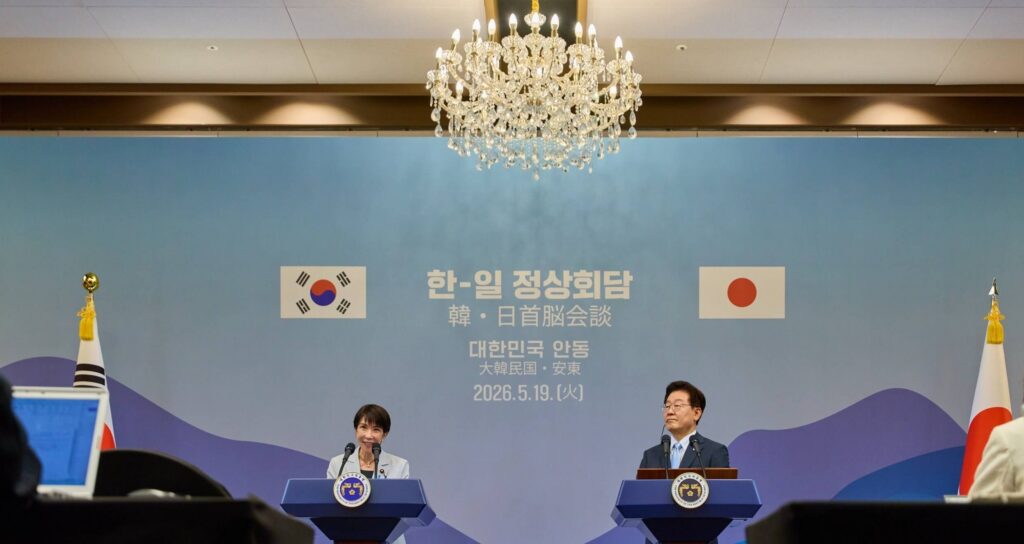
South Korean President Lee Jae Myung and Japanese Prime Minister Sanae Takaichi sit at two ends of the political spectrum, but their May 2026 meeting in Lee’s hometown of Andong on May 18–19 was marked by a spirit of warmth. Even Lee’s critics, who feared that his long-held harsh views on the legacy of Japanese colonial rule would reverse progress, were pleased.
Former South Korean Ambassador to Japan Shin Kak-soo was “quite impressed with how [Lee] handled South Korea–Japan relations after taking office,” noting that the meeting in Andong “went very well”—a view shared by senior South Korean officials in off-the-record discussions.
This success can be credited to South Korea and Japan’s shared challenges of hedging against both China and an unpredictable United States, with U.S. President Donald Trump’s trade wars and military interventions sending shocks across both economies. Lee’s decision to avoid past sources of contention like wartime history issues with Japan can be read as a calculated effort to use closer ties with Tokyo to insulate South Korea from growing chaos in an unpredictable security environment.
The most powerful factor in this is the prospect of U.S. withdrawal from global leadership under Trump 2.0. Another South Korean senior official noted off the record that South Korea and Japan have “shared anxieties about Washington” and that “it is not about China.”
Senior South Korean officials are discussing the need for closer security ties with Japan in response to U.S. retreat, including potentially finessing the territorial disputes by signing a non-aggression pact and moving towards a mutual defense treaty. While this would go beyond what most South Koreans would tolerate—and much less in Japan—its mere consideration is a remarkable sign of the impact of Trump-driven uncertainty.
This tightening is taking place without active U.S. involvement at the highest level. While trilateral meetings are still being held among senior officials and statements are being issued with common views on regional and global security issues like North Korea, this is the product of institutional inertia created by former U.S. President Joe Biden’s administration. There is no evidence of a connection between those official pronouncements and the White House, and Trump has never expressed any interest in trilateral cooperation, nor is he eager to follow in Biden’s footsteps.
Despite the factors impelling closer ties, there are serious concerns in Seoul and Tokyo that the rhetoric of bilateral partnership has not been sufficiently reflected in concrete actions.
The most cited example of this is the potential admission of South Korea to the Comprehensive and Progressive Agreement for Trans-Pacific Partnership (CPTPP), a move which could forge closer trade and investment alliances and counter U.S. mercantilism. While Seoul has expressed its interest in joining, it has yet to formally apply. Domestic politics remain a constraint, reflected in the ongoing restrictions on the purchase of Japanese seafood due to the Fukushima nuclear accident and its aftermath.
A similar dynamic is visible in the arena of defense cooperation. Japanese Minister of Defense Shinjiro Koizumi visited Seoul in June 2026 and reaffirmed tightening defense ties and trilateral cooperation with the United States. But he was unable to get Seoul to sign off on a long-sought military logistics pact, which would institutionalize joint operations. Lee told reporters earlier in June that public sentiment on history issues was the obstacle to signing what would otherwise be a logical agreement.
Beyond immediate issues, two policy areas—China and North Korea—could also drive the neighbors apart.
Lee has been careful to maintain good ties with Beijing, both in the economic realm and in potentially seeking China’s help in dealing with North Korea. The divergence between Lee’s policy toward China and the hostile state of China-Japan relations was noted at the Andong meeting.
Both governments share a commitment to the eventual denuclearization of the Korean Peninsula. But Lee seems ready to back a possible Trump summit with North Korean Supreme Leader Kim Jong Un, which could offer de facto acceptance of North Korea’s nuclear status. Japan has always been fearful that this outcome could lead to a separation of the Korean Peninsula from U.S. extended deterrence commitments and leave Japan exposed to Pyongyang’s nuclear threat.
The relationship also remains marred by the lingering issues of wartime history and justice that have been carefully put aside but not resolved. Compensation cases against Japanese companies for wartime workers in Japanese mines and factories continue to make their way through South Korean courts. Takaichi has carefully avoided doing anything to inflame Seoul, but it would only take a visit to the controversial Yasukuni Shrine—something she did regularly for several decades—to relight the fires of South Korean patriotism.
For now, the path to improved ties looks open, thanks in large part to Trump and to a lesser extent to Chinese President Xi Jinping. But the question of how long it will remain so is far less certain.
This article was originally published in East Asia Forum on July 12.
Daniel C. Sneider is a Non-resident Distinguished Fellow at the Korea Economic Institute of America (KEI) and a Lecturer in East Asian Studies at Stanford University. The views expressed here are the author’s alone.
This material is distributed by KEI on behalf of the Korea Institute for International Economic Policy. Additional information is available at the Department of Justice, Washington, DC.