
The Narrow Path for South Korean Nuclear Power in Vietnam
Russia already won Vietnam's first reactor. Korea Vietnam nuclear ambitions now hinge on the second—and on matching Moscow on financing and fuel.
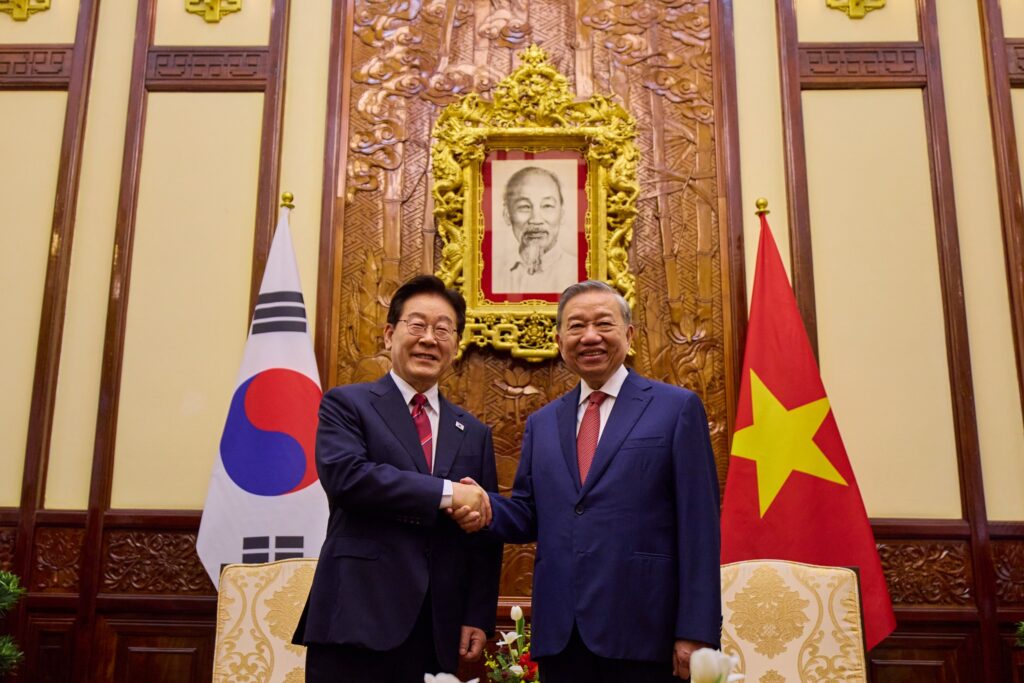
South Korean President Lee Jae Myung used his state visit to Hanoi last month to pitch a Korean-built reactor in southern Vietnam. Standing alongside Vietnamese Prime Minister Le Minh Hung, he framed the partnership as a generational opportunity, in hopes the country would follow Czechia, Poland, and the United Arab Emirates in choosing Korean nuclear technology over the alternatives.
The problem is that one of those alternatives has already won. Russia’s Rosatom State Corporation was chosen in March to build Ninh Thuan 1, the first of two reactors Vietnam plans for Ninh Thuan province. What remains contestable is Ninh Thuan 2, and on the criteria Hanoi cares about most, Moscow starts with a substantial lead. Whether Seoul can close that gap depends less on the quality of its technology than on whether it can match Moscow where it counts—financing, fuel supply, and willingness to move on Hanoi’s timeline.
Powering the Future
Vietnam has emphasized the role of nuclear power in advancing its broader objectives of economic development and security. By 2050, Vietnam aims to generate 6–8 percent of its electricity from nuclear power, with up to four large reactors and fifteen small modular reactors. To support this plan, Vietnam recently revised its Law on Atomic Energy to strengthen regulations on the building and operation of nuclear facilities. This includes monitoring provisions to strengthen government oversight, supporting workforce development, and liaising with international authorities such as the International Atomic Energy Agency.
Although Hanoi has long been interested in developing nuclear power generation, previous attempts, including in Ninh Thuan, have been unsuccessful. The recent regulatory changes and government plans suggest, however, that Vietnam will work harder this time around to complete the project.
Given Hanoi’s interest in expediting nuclear power development, it is likely that Russia will be its preferred partner. Hanoi and Moscow have had a long relationship as authoritarian states, and Russia’s Rosatom State Corporation has already been tapped to build the Ninh Thuan 1 reactor. The first iteration of the project fell through in 2016, but in March 2026, an agreement was reached between then Vietnamese Prime Minister Pham Minh Chinh and Russian Prime Minister Mikhail Mishustin for Rosatom to restart the project as a symbol of their countries’ friendship. Vietnamese media also added that Russia agreed on “strengthening cooperation with Vietnam across traditional sectors while expanding into emerging areas.”
There has been no official announcement of Russian involvement in Ninh Thuan 2. But the report linked above suggests that Hanoi is keen to maintain and build on its existing relationship with Moscow. Rosatom is a major player in nuclear power construction. In 2022, it was estimated to control 70 percent of the global construction market and was a major source of uranium fuel for seventy-eight reactors internationally. This success can be attributed to its state backing, which means that Rosatom’s clients can avoid “having to deal with multiple bodies and agencies with differing interests.” By controlling all aspects of the procurement and construction process, Marco Siddi of the Finnish Institute of International Affairs says Rosatom can operate as a “one-stop shop.” Given the complexities of nuclear power plant construction and operation, Russia is an attractive partner because it can handle most of the work while also allowing Vietnam access to nuclear power.
Against this backdrop, Korea faces a difficult path to becoming Vietnam’s preferred partner for the Ninh Thuan 2 reactor, if not the ultimate developer. To be sure, Seoul has been diligent in positioning itself as a nuclear power technology exporter. Its first project was the Barakah nuclear power plant in the United Arab Emirates, which began construction in 2009 and came online in 2020. Since then, Korea has signed agreements on nuclear power cooperation with a variety of states, including Poland in 2023 and Czechia in 2025.
South Korean Competition
There are three things Korea can do to improve its chances of securing the Ninh Thuan 2 project. The first is to support Vietnam’s workforce development. A major hurdle for Vietnam is its lack of qualified workers for the construction and management of nuclear power plants. Vietnam has a significant pool of engineering and technical talent, but many of them are based in Europe. Seoul should consider programs to bring Vietnamese workers to Korea for training, or invest in such facilities and programs there.
This leads to another measure: highlighting the economic benefits of people-to-people exchanges. As tourism between the two countries increases, Korean and Vietnamese travelers will be exposed to new products such as food, cosmetics, and household goods. This spillover effect could strengthen demand for Vietnamese exports or remittances back to Vietnam. Given the economic dimensions of Vietnam’s nuclear power push, these additional benefits may further incentivize Vietnam to partner with Korea on nuclear cooperation.
Finally, Korea should note that it is a state in good standing with the international community. Many state-owned enterprises and industries in Russia are under sanctions by the United States and others due to the Ukraine war. Rosatom has not faced the same level of sanctions as other Russian organizations, but roughly seventy individuals tied to the organization and subsidiaries have been designated to limit the company’s financing and acquisition of advanced technology. The Vietnamese government wants to handle nuclear material responsibly and maintain cordial relations with the West, so Korea should highlight the fact that its companies and suppliers do not face the same exposure to global sanctions as Rosatom does.
The ongoing conflict in Iran has emphasized the importance of alternative energy sources for states. Nuclear power in Vietnam offers an opportunity to introduce carbon-free energy production and to strengthen Korea’s influence in Southeast Asia by exporting its nuclear technology expertise. If Seoul seeks to bolster nuclear cooperation with Hanoi, it should emphasize the economic benefits of partnering on the Ninh Thuan 2 project.
Terrence Matsuo is a Non-Resident Fellow at the Korea Economic Institute of America (KEI). The views expressed are the authors’ alone.
This material is distributed by KEI on behalf of the Korea Institute for International Economic Policy. Additional information is available at the Department of Justice, Washington, DC.