
South Korea Wants to Be a NATO Partner, Not Just a Vendor
Korean President Lee Jae Myung proposes a defense industry partnership between Korea and NATO that positions Korea as a participant in the alliance’s rearmament that helps fill critical gaps in the broader Western defense industrial complex.
South Korea is now the second-largest arms supplier to NATO’s European members, but the sales remain a series of bilateral transactions rather than incorporated within the alliance’s procurement system.
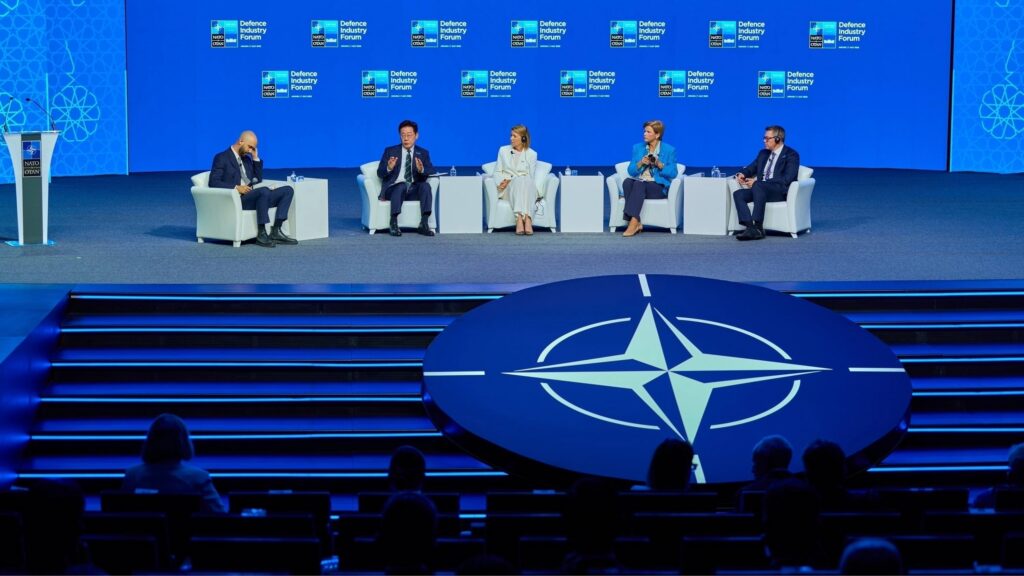
That gap may be closing, however. Speaking at the recent NATO Summit Defense Industry Forum, Korean President Lee Jae Myung described a Korea-NATO “defense industry partnership 2.0” that positions Korea as a participant in NATO’s rearmament rather than a vendor, helping fill critical gaps in the broader Western defense industrial complex. Under the partnership, Korea and NATO would jointly produce, operate, and conduct research and development (R&D) on weapons systems. He also called for joint research on emerging technologies and the alignment of standards. Additionally, Korean firms may soon enter NATO’s USD 10 billion joint procurement market, and the country could become an observer in NATO’s defense raw materials program.
But entering NATO’s procurement system is not the same as competing successfully inside it. Korean firms have captured a meaningful share of demand for European rearmament— the accumulated sustainment relationship that European suppliers have built over decades. Whether Lee’s proposal changes that depends on which of Korea’s obstacles are procedural and which are structural.
NATO and European Rearmament
Russia’s invasion of Ukraine and U.S. President Donald Trump’s reduced support for long-standing U.S. allies in NATO have pushed European nations to begin rearming. NATO members have pledged to spend 5 percent of GDP annually on defense by 2035, with 3.5 percent dedicated to core defense needs and 1.5 percent going toward related defense and security needs such as cybersecurity, infrastructure, and the defense industrial base.
European rearmament is not exclusively a function of NATO. The European Union is also taking steps to support the rearmament of member states. In 2025, the European Union agreed to support arms purchases under the Security Action for Europe (SAFE) fund, which established EUR 150 billion (USD 173 billion) in loans for member states to engage in large-scale defense procurements. SAFE complements the existing European Defense Fund (EDF), which supports collaborative defense research.
Korea is not eligible for the EDF, but it formally applied to participate in the SAFE program last year. While non-EU members are limited to supplying only 35 percent of components for purchasing weapons systems, Korea’s status as a Security and Defense Partner makes it eligible for a separate agreement that could lift those limits. If approved, Korea would be well-positioned to partner with major European defense firms and compete for additional contracts.
IP4 Arms Exports to NATO Members
Although European rearmament efforts emphasize internal procurement to strengthen the continent’s defense industrial base, NATO members also purchase weapons from the Indo‑Pacific Four (IP4): South Korea, Japan, Australia, and New Zealand.
Japan historically prohibited the export of lethal arms but lifted those restrictions earlier this year as part of a U.S. call that allies take a greater role in providing security in the Indo-Pacific. Under the new guidelines, Japan may export lethal weapons to seventeen countries that have signed defense equipment and technology transfer agreements, including several NATO members. Currently, Japan produces and sells Patriot missiles to the United States and is a partner with the United Kingdom and Italy in the development of a sixth-generation fighter jet. While Japan’s current footprint as an exporter to NATO is limited, it is expected to grow with the lifting of export restrictions.
Australia has a longer history of exporting weapons to NATO members. It exports armored vehicles such as the Boxer Heavy Weapon Carrier to Germany and the Bushmaster to the Netherlands and the United Kingdom. It also exports digital Lance turrets to Hungary, high-energy anti-drone systems to the Netherlands, and an Over the Horizon Radar system to Canada. Through NATO’s Prioritized Ukraine Requirements List, Australia also provided Ukraine with tactical air defense radars, combat equipment, and munitions.
As a small arms exporter overall, New Zealand exports a relatively small amount of arms to NATO members. The largest amount goes to the United States, with token exports of less than half a million to NATO members such as the United Kingdom, Turkey, Italy, Bulgaria, and a few others.
Korea’s Existing Arms Exports to NATO
Europe has become the world’s largest arms importer. According to the Stockholm International Peace Research Institute (SIPRI), Europe accounted for 33 percent of all global arms imports between 2021 and 2025.
Despite the absence of a formal NATO procurement agreement, Korea has a robust arms trade relationship with the alliance’s European members. Korean firms were the second-largest exporters of arms to NATO’s European member states, accounting for 8.6 percent of arms imports over the most recent period in SIPRI’s data. This remains far behind the United States, however, which accounted for 58 percent of Europe’s arms imports.
Korean arms exports are highly concentrated in Poland, accounting for almost half of Korea’s arms exports in recent years to European NATO member states. Top export items include K2 Black Panther tanks, the K9A1 Thunder self-propelled howitzers, K239 Chunmoo rocket launchers, “Legwan” combat vehicle, and the FA-50 training and light combat aircraft.
Norway is another significant importer of Korean arms. It imports the Chunmoo rocket launcher, the K10 armored ammunition resupply vehicle, and the K9 howitzer. The same howitzer has also found buyers in Estonia, Finland, and Romania. Romania imports the K10 armored ammunition resupply vehicle, while Estonia purchases the Chunmoo rocket launcher.
Market Risk and Opportunity Across NATO
European rearmament presents opportunities for Korean defense contractors to expand their sales in Europe, something the Lee administration is targeting with its proposal to deepen cooperation with NATO in areas related to the defense industrial base.
Korea’s failure to win Canada’s recent submarine contract, however, highlights some of the challenges Korean defense firms face in the broader NATO market. Chief among them is a lower level of interoperability with NATO standards. Among Korean defense contractors, only Hyundai Rotem’s K2 battle tank, combat engineering vehicle, and armored recovery vehicle meet NATO standards. Securing NATO contracts will also require increased joint partnerships and deeper strategic alignment with NATO.
Deeper defense industrial cooperation through joint production, operation, and R&D on weapons systems offers pathways toward greater interoperability. It would also require Seoul to align more closely with NATO on security priorities. If Korea and NATO are able to deepen defense industrial cooperation, it would not only expand opportunities for Korean defense firms but help to fill some of the gaps among U.S. allies exposed by the wars in Ukraine, Gaza, and Iran.
Taken together, NATO’s rearmament needs, Europe’s expanding procurement mechanisms, and the growing role of Indo‑Pacific suppliers create a strategic opening for Korea. Seoul’s push for deeper defense industrial cooperation with NATO through joint production, R&D, and procurement access would help address interoperability challenges while positioning Korean firms to compete more effectively in Europe’s rapidly evolving defense market.
If these initiatives advance, Korea could become an increasingly important contributor to transatlantic security and a key partner in strengthening the Western defense industrial base.
Troy Stangarone is Visiting Senior Fellow at the Korea Economic Institute of America (KEI). The views expressed here are the author’s alone.
This material is distributed by KEI on behalf of the Korea Institute for International Economic Policy. Additional information is available at the Department of Justice, Washington, DC.