
By Namyeon Kwon
Ship Repair Offers Best Pathway for Modernizing the U.S.-South Korea Alliance
Korea can more effectively showcase its industrial capacity and fulfill the U.S. push for alliance modernization in ship repair, or maintenance, repair, and overhaul (MRO).
Listen to this article
0:00 / 0:00
There is growing momentum in the U.S.-South Korea shipbuilding relationship, driven by declines in U.S. naval power, where delays in new ship construction have converged with a maintenance backlog on aging vessels. In December 2025, President Donald Trump unveiled the “Golden Fleet” initiative and cited Hanwha in connection with a new class of frigates. More recently, the U.S. government reached out to Korean shipbuilders for information regarding their capacity to build destroyers and tankers, and the Korea-U.S. Shipbuilding Partnership Center opened in Washington.
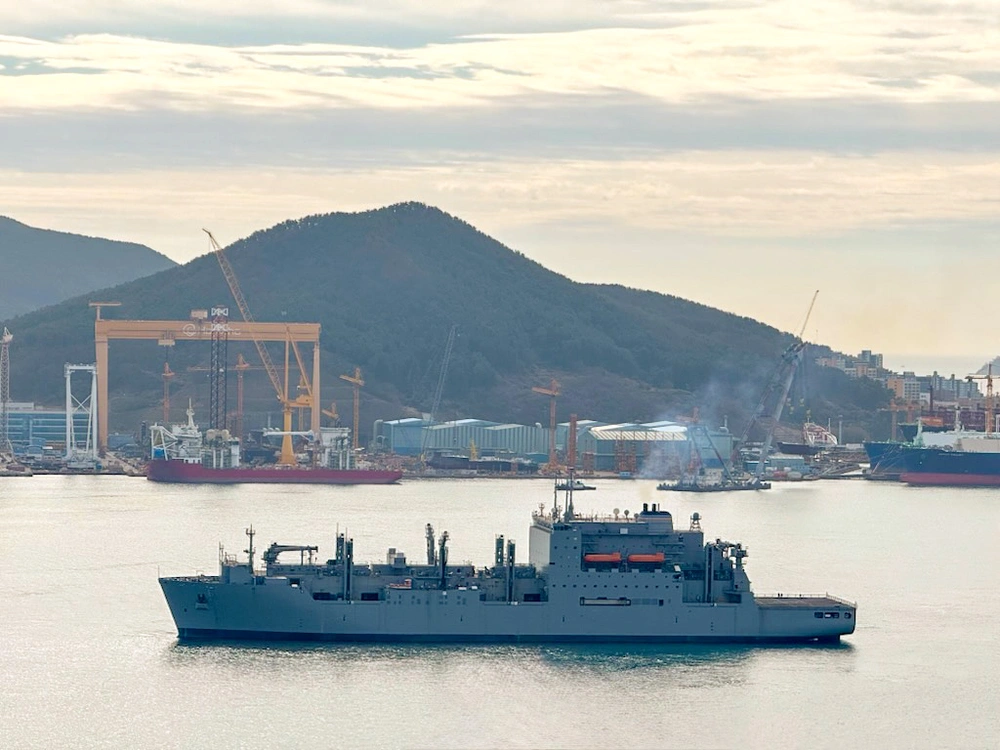
However, greater opportunities for showcasing Korea’s industrial capacity and fulfilling the U.S. push for alliance modernization lie in ship repair, or maintenance, repair, and overhaul (MRO). Korean yards are repairing U.S. Navy vessels, and Korean shipbuilders, including Hanwha Ocean, HD Hyundai, and HJ Shipbuilding & Construction, are winning contracts for MRO projects with U.S. ships. The next task for the two allies is to transform ongoing MRO cooperation into a stable sustainment pipeline for the alliance.
Where U.S.-South Korea Naval MRO Stands
At the fifty-seventh Security Consultative Meeting in November 2025, Secretary of Defense Pete Hegseth announced that a U.S. warship would undergo MRO in Korea for the first time—a move described as “historic progress to enhance U.S. readiness and deterrence.” Efforts previously confined to contracts between the Navy and individual Korean firms are now being elevated to discussions of alliance readiness.
The current contracts primarily involve Military Sealift Command auxiliaries, dry cargo and ammunition ships, and fleet replenishment oilers, which share considerable technical ground with commercial vessels and have lighter technology protection and security burdens than combatants. However, as MRO efforts extend to warships, Korean companies will face challenges related to laws and regulations, access to technical data, and security and certification. Korea’s ability to navigate these obstacles will depend on which vessels the United States sends for overseas repair and how far it draws allied industries into its sustainment network.
Predictability is another challenge. Contracts are awarded intermittently, and even after contracts are signed, the project scope and timeline can shift. For instance, the midterm availability for USNS Amelia Earhart began at roughly USD 3.86 million, but the obligated amount later rose to about USD 15.95 million (figures from the U.S. spending database, queried in April and August 2026), which extended the end date. Industry accounts indicate that the Navy repeatedly requested additional work during the availability, expanding the job beyond its original scope. Such changes and delays are not unusual in themselves, as repair projects often reveal previously unknown defects once an availability is underway.
The difficulty is that such changes affect a yard’s ability to plan. The Government Accountability Office (GAO) has noted that growth work, identified during a maintenance period but not originally planned, is a significant driver of delays and can occupy dry docks longer than planned, disrupting subsequent repair periods. GAO has also observed that the Navy routinely revises its shipbuilding plans and repair projections, which does not provide the industrial base with a stable demand signal on which to base investment decisions.
From Contracts to Alliance Sustainment Capacity
The foundation for treating naval MRO as more than industrial cooperation and as alliance sustainment is already in place. The Pentagon announced the Regional Sustainment Framework (RSF) in 2024, which seeks to provide sustainment closer to the point of need by drawing on allied and partner maintenance capacity. In addition, the Partnership for Indo-Pacific Industrial Resilience (PIPIR), which launched the same year, brings together sixteen member countries, including Korea, to cooperate on defense industrial resilience across production, supply chain resilience, sustainment, and policy and optimization. Within these two mechanisms, Korea is pursuing an MRO pilot project for a U.S. Army watercraft and establishing a CH-47 Chinook T-55 engine repair hub.
How, then, should naval MRO maximize the use of existing mechanisms? The concept of deterrence by capacity provides a helpful framing: deterrence rests not only on capability and resolve but also on the industrial capacity to replace expended materiel and return damaged systems to service. The Pentagon should use RSF and PIPIR to more explicitly position repair work in Korea within theater sustainment planning. Doing so would require metrics for measuring performance, a means of validating it, and the demand to sustain it.
Measurement comes first. Beyond industrial results such as awarded vessels and contract values, both governments should also assess performance from a sustainment perspective, through repair throughput, turnaround time, schedule adherence, and surge capacity. Tracked and reviewed jointly through RSF implementation, the PIPIR sustainment workstream, and the U.S.-Korea Logistics Cooperation Committee, theater planners should incorporate the collective repair record of Korean yards rather than viewing them as a series of separate contracts.
Capacity identified this way gains credibility when validated under realistic conditions. The U.S. Navy has conducted Ship Wartime Repair and Maintenance Exercises (SWARMEX) with the Seventh Fleet to give forward-deployed ship repair teams in the Indo-Pacific region experience in battle damage assessment and repair while building ties with local repair industries. In the first such exerciseheld in Japan, U.S. naval repair organizations, the Japan Maritime Self-Defense Force, and a local Japanese yard cooperated on maintenance of the USS Fitzgerald destroyer. U.S.-Korea combined exercises should incorporate a comparable repair element. Doing so would show how the partnership performs under contingency conditions—which contract records cannot—and would extend cooperation to military-to-military sustainment.
Measurement and validation, however, hold up only under predictable demand. Repair capacity rests on investment in facilities and workforce, and such investments are preferable under a stable understanding of future workload. In its 2026 shipbuilding plan, the Navy stated it would pursue multi-ship sustained partnerships and award contracts for complex maintenance earlier to lengthen planning horizons for private yards. The Navy should extend those methods to allied yards, which would give Korean firms a more solid foundation for investments. From the U.S. side, a stable demand signal is an important condition for securing repair capacity from allies, ensuring it is available when needed.
Conclusion
U.S.-South Korea naval MRO is not simply an industrial matter. By supporting the readiness of U.S. naval forces in theater, it contributes directly to regional deterrence. The trust and record built along the way form a bridge toward broader cooperation in shipbuilding. It is, in that sense, an axis that strengthens the alliance on both the security and industrial fronts.
The two countries should focus on managing ongoing repair cooperation as a stable sustainment capacity for the alliance rather than as a collection of individual contracts. If the current record of contract awards is connected to predictable maintenance planning, measurable performance, and logistics cooperation that links peacetime to contingency, naval MRO in Korea could become a durable sustainment capacity for the alliance.
Namyeon Kwon is an Associate Research Fellow in the Logistics Policy Division of the Center for Defense Resource Management at the Korea Institute for Defense Analyses (KIDA). The views expressed here are the author’s alone.
This material is distributed by KEI on behalf of the Korea Institute for International Economic Policy. Additional information is available at the Department of Justice, Washington, DC.