
Kim Jong Un Has No Interest in Meeting Donald Trump
North Korean leader Kim Jong Un is in a far stronger negotiating position than in 2019 and sees little need for U.S. sanctions relief or a meeting with President Donald Trump.
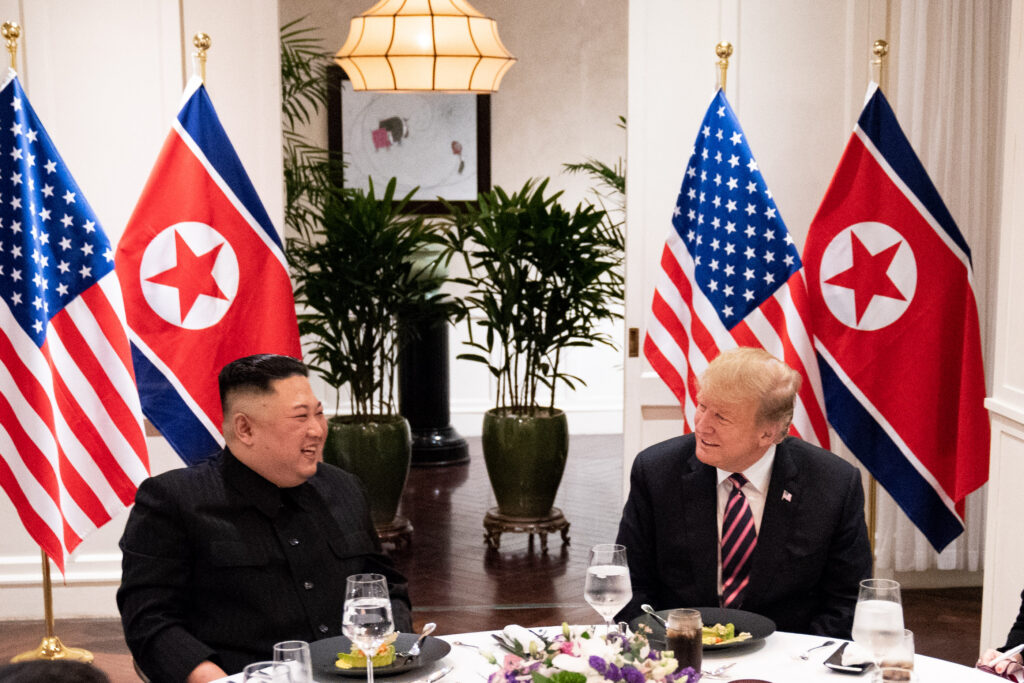
Yesterday, President Donald Trump announced he would meet North Korean leader Kim Jong Un before the end of the year. While the U.S. president seems certain that the North Korean leader wants to meet with him, reception from Pyongyang toward Trump’s outreach has been ice-cold. Kim is in a far more advantageous geopolitical position than in 2019, when the two last met, and does not need rapprochement with the United States to achieve its objectives. However, despite Kim’s economic and military gains from the ongoing war in Ukraine, he should not discount the benefits of meeting with Trump.
Kim has fully inserted himself into the war in Ukraine by supporting Putin’s war machine and has boosted his nuclear weapons program with Russian assistance. Buoyed by cryptocurrency heists and remote IT worker schemes, North Korean cyber criminals continue to generate considerable revenue for the regime. Compared to their previous round of diplomacy, Kim is in a far stronger negotiating position and sees little need for U.S. sanctions relief or a meeting with the unpredictable U.S. president.
Trump’s resurgent interest in North Korea comes on the back of a U.S. military quagmire in the Middle East. Desperately looking for a diplomatic victory after failed negotiations with Iran, Trump has set his sights again on the Korean Peninsula and is looking to revitalize his personal relationship with Kim. Trump seems to think that diplomacy with the North Korean leader will be easier and smoother than the last time because Kim allegedly treated him with “great respect.”
Unfortunately for Trump, Kim is likely to ignore his overture. The war in Ukraine allowed Kim to reduce his economic dependence on China and expand his economy. By providing weapons and soldiers to Russia, Kim has reaped massive economic benefits. Kim has rejuvenated the domestic defense manufacturing base and expanded access to Russian markets. Since 2022, North Korea’s economy has grown by over 3 percent annually. Even North Korea’s rural regions, long seen by the regime as potential hotspots of discontent and thus neglected economically, have recently seen development, with new medical facilities being built across the country.
Despite Kim’s recent successes, he should not discount this once-in-a-lifetime chance to take advantage of the most mercurial U.S. president. Trump seems extremely keen to meet again with Kim and discuss nuclear weapons. If Kim is savvy and opportunistic, he would meet with Trump and ask the United States to remove all its troops from the Korean Peninsula. The presence of U.S. troops in South Korea has long been a sore spot for the North. Trump, who recently requested to “substantially reduce” U.S. joint military exercises with South Korea, may give in and reduce—or altogether eliminate—the U.S. troop presence in South Korea. A glitzy way to officially end the world’s longest-running conflict, the Korean War, would reinvigorate Trump and distract his followers from his obvious foreign policy failures in the Middle East.
Kim Yo Jong, Kim Jong Un’s sister and close confidante, said in North Korea’s state-run media that she was “completely unaware” of any communication between the two leaders and that her brother has no interest in meeting Trump as long as the “hostile” U.S. policy remains in place. While Kim Yo Jong is known for having a prickly and formidable personality, the “Dear Leader” himself has thus far not publicly spoken about Trump’s recent outreach. While it remains to be seen whether Kim Jong Un responds to Trump, the U.S. president should understand that this is not the same North Korean leader he once negotiated with.
Benjamin R. Young is Non-resident Fellow at the Korea Economic Institute of America (KEI) and Assistant Professor of Intelligence Studies at Fayetteville State University. The views expressed here are the author’s alone.
This material is distributed by KEI on behalf of the Korea Institute for International Economic Policy. Additional information is available at the Department of Justice, Washington, DC.