
By Korea View and David Lee
Increasing Korea’s Role in Multilateral Security Cooperation
Seoul’s deployment of a larger naval force to the U.S.-led multilateral naval exercise may signal a shift from its traditional security posture.
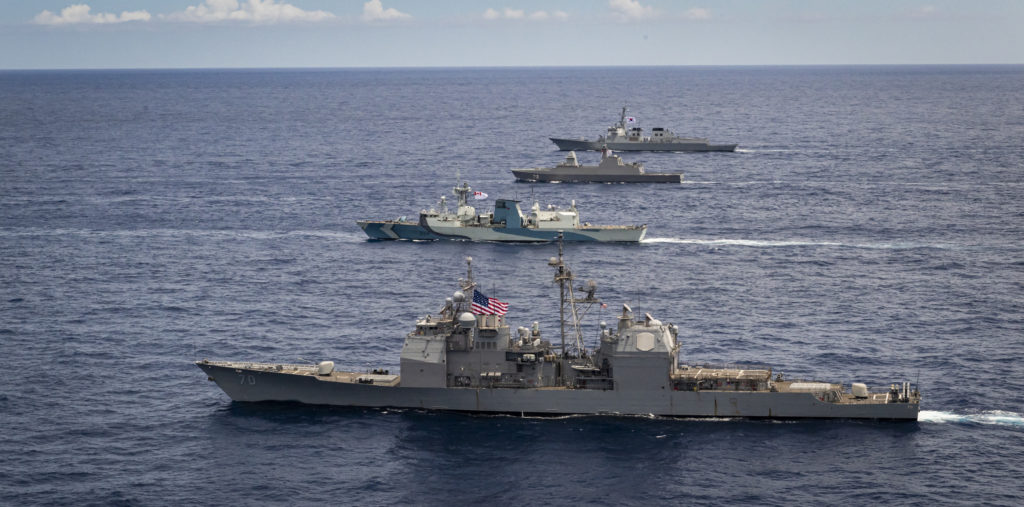
On May 24, officials in Seoul announced that a one-star navy officer would accompany South Korea’s largest-ever fleet to the biannual U.S.-led maritime military exercise, known as the Rim of Pacific Exercise (RIMPAC). The exercise intends to “ensure the safety of major sea lines of communications and improve combined capabilities” of U.S. partners in the Pacific Ocean.
South Korea’s increased role reflects a shift in Seoul’s posture, which traditionally placed greater emphasis on its bilateral security alliance with the United States than multilateral security cooperation. The change in noticeable when comparing the resources the country had committed to RIMPAC in the past. South Korea had dispatched mid-ranking officers to lead small-to-medium-sized destroyers and submarines at the exercise between 2008 and 2020. By contrast, South Korea is sending a more senior officer to lead a larger force in this year’s exercise that includes an amphibious assault ship capable of operating a sizable landing force with 6 tanks and up to 15 helicopters. In addition, it will take a more significant role in commanding the landing force during the exercise.
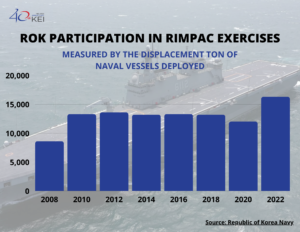
The South Korean navy’s ambition to increase its operational range has driven the acquisition of new ships since the 2000s. But the increased participation of these new assets in the upcoming multilateral military drill suggests a conscious effort by Seoul to establish a stronger alignment with the United States. This is consistent with President Yoon Suk Yeol’s statements in his inauguration speech and the Biden-Yoon Joint Statement, which highlighted South Korea’s goal of expanding its role as a promoter of universal values and rules-based norms.
This briefing comes from Korea View, a weekly newsletter published by the Korea Economic Institute. Korea View aims to cover developments that reveal trends on the Korean Peninsula but receive little attention in the United States. If you would like to sign up, please find the online form here.
Korea View was edited by Yong Kwon with the help of David Lee, Sarah Marshall, and Mai Anna Pressley. Picture from the flickr account of the U.S. Navy.