
Explaining South Korea’s Stock Market Boom
The sharp rise in the South Korean stock market is driven by rising global demand for AI semiconductor chips, domestic corporate reform, and the rapid growth of leveraged ETFs.
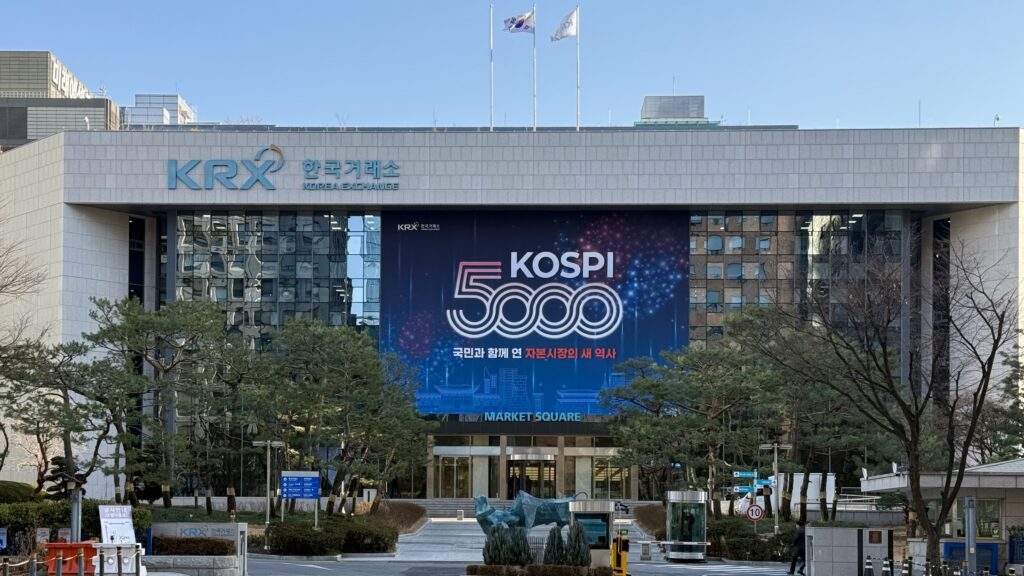
The KOSPI, South Korea’s benchmark stock market index, nearly doubled during the first half of 2026, the largest increase in the world (Figure 1, Panel A). The surge in global demand for AI semiconductor chips has been the main driver of rising equity prices. Samsung Electronics and SK Hynix, the two leading Korean chipmakers, now account for more than half of Korea’s market capitalization. Reforms to corporate governance and the rapid growth of leveraged exchange-traded funds (ETFs) also help explain the sharp rise in the stock market. The semiconductor-led exports boom prompted the government to raise its GDP growth forecast to 3.0 percent in 2026, up from 2.0 percent in January.
However, the KOSPI Volatility Index exceeded its 2008 global financial crisis peak and the Korea Exchange triggered market-wide circuit breakers seven times, more than in the entire history of the mechanism before 2026. The market’s concentration in two companies and one sector, combined with the growing role of ETFs, has contributed to the increased volatility. The index has since declined roughly 27 percent from its June 19 high. Korea’s outsized dependence on the semiconductor industry as a driver of economic growth poses risks by exposing it to external shocks and cyclical volatility.
The “Korea Discount”
President Lee Jae Myung made boosting the stock market a core economic objective, aiming to shift the Korea discount to a Korea premium. Despite being an advanced economy with globally competitive industries, Korean equities have persistently traded at a significant discount relative to global peers. In addition, Korea’s stock market capitalization averaged 93 percent of GDP between 2014 and 2024, well below the OECD average (Figure 2), reflecting its bank-centered financial system. The average price-to-book ratio of firms in the KOSPI index over this period averaged 0.99, compared to 1.8 in Japan and 3.7 in the United States, indicating that a significant share of Korean-listed companies traded below book value. In other words, the market values them less than their net assets.
The Korea discount has been attributed in part to weak corporate governance. The complex ownership structures of large family-controlled business groups have favored the founding families at the expense of minority shareholders. In 2023, the Asian Corporate Governance Association (ACGA) ranked Korea’s corporate governance eighth among twelve Asia-Pacific economies, coming in ahead of China and some ASEAN countries but behind India and Malaysia. The report noted that Korea faced significant weaknesses in the disclosure of basic governance practices such as board evaluations, director remuneration, and director training. Moreover, it lacked a clear roadmap to improve corporate governance.
Several other factors have contributed to the Korea discount. Many conglomerates have kept dividend payout ratios low, prioritizing growth and cross-subsidizing weak affiliates over maximizing shareholder returns. The concentration of Korean companies in cyclical, capital-intensive industries appears to heighten volatility and vulnerability to global supply-chain shifts. Geopolitical risk related to North Korea may have also contributed to the Korea discount.
Factors Driving Korea’s Equity Prices
The semiconductor boom has been the most important factor. Record-breaking demand for memory chips to build AI infrastructure has led to sharp upward revisions in the earnings of Korea’s two leading semiconductor producers. Projections of earnings per share for listed companies, excluding Samsung Electronics and SK Hynix, were revised upward by 48 percent in May 2026 (Figure 3). In contrast, the projection for the total market, including the two semiconductor producers, was 261 percent. Consequently, SK Hynix’s share price has risen 10.1 times since June 2025, while the share price of the larger and more diversified Samsung Electronics has risen 5.6 times. Both companies recently joined the list of fourteen companies worldwide that are valued at more than USD 1 trillion. Samsung Electronics’ operating profit in the second quarter of 2026 was more than nineteen times higher than a year earlier. SK Hynix and Samsung Electronics now account for 55.5 percent of KOSPI’s market capitalization, compared to 22 percent at the end of 2023 (Figure 4). On July 10, SK Hynix raised USD 26.5 billion in the biggest U.S. initial public offering ever by a foreign company.
In addition, Korea has pursued corporate governance reform as a top priority. The Financial Services Commission launched the Corporate Value-Up Program in February 2024 to encourage listed companies to improve capital efficiency, upgrade governance, and increase shareholder returns to help overcome the Korea discount. The program included the Korea Value-Up Index (KVI), which comprises firms that meet a range of governance criteria. Since its launch in October 2024, the shareholder return in the one hundred companies included in the KVI has outperformed the KOSPI 200 (the two hundred largest and most liquid publicly traded companies) by 17 percent.
President Lee took office in June 2025, promising to promote the development of the stock market through corporate governance reforms. In July 2025, the Commercial Act was revised to include shareholders in the scope of directors’ duty of loyalty. Outside directors were renamed “independent directors” to promote their independence from management and controlling shareholders. In addition, their mandatory share was increased from a quarter of the total number of directors to one-third in July 2026. The Commercial Act was revised again in August 2025 to prohibit firms from opting out of cumulative voting by amending their articles of incorporation and to increase the minimum number of audit committee members who must be elected separately from the other directors from one to two. In January 2026, a major tax reform significantly changed how dividend income is taxed for both firms and investors to promote higher dividend payments. Such reforms may have encouraged investors to invest in the stock market, contributing to a near doubling in the KOSPI index between May 2025 and January 2026 (Figure 5).
The run-up in the KOSPI index in 2026 was led by domestic investors. Foreign investors offloaded a record net KRW 148.3 trillion (USD 96.7 billion) of Korean equities in the first half of 2026, a record high. Sales by foreign investors were primarily driven by profit-taking on the major semiconductor producers, global asset rebalancing, and the depreciation of the won against the dollar. Overall, foreign institutional investors have withdrawn a significant amount of capital from Korea since the beginning of the war in the Middle East at the end of February (Figure 6).
Domestic investment was promoted by the growing popularity of exchange-traded funds (ETFs), which are pooled investment vehicles that hold baskets of assets and trade on stock exchanges. The total net assets of Korean ETFs have risen fourfold during the past three years. Average daily trading turnover in ETFs increased from KRW 6.6 trillion in December 2025 to KRW 34 trillion in June 2026 (USD 23 billion). ETFs, which account for about 30 percent of stock market trading volume and 6 percent of total market capitalization, provide cheaper and easier access to high-profile stocks than buying individual shares.
Leveraged ETFs, which are specialized funds designed to multiply the daily return of an underlying index or asset, typically using complex derivatives, are playing an increasing role. A “2x” leveraged ETF provides twice the daily returns of the underlying stock they track, resulting in amplified gains and losses. Leveraged ETFs account for about one-fifth of the 1,142 ETFs in Korea. In May 2026, the Korea Exchange introduced single-stock leveraged ETFs that track Samsung Electronics or SK Hynix. They are designed exclusively for short-term, intra-day trading.
Conclusion
The sharp rise in the Korean stock market has boosted its market capitalization as a share of GDP close to the OECD average (Figure 2). In absolute terms, the Korean stock market now exceeds all Group of Seven (G7) countries except the United States and Japan.
However, there are concerns about the risk of a bubble, given the speed and size of the increase in the KOSPI index and its concentration in the two semiconductor giants, which account for more than half of Korea’s market capitalization. While some analysts question its sustainability, others note that the stock market surge is underpinned by soaring revenues for Samsung Electronics and SK Hynix, shortages of the high-bandwidth memory semiconductor chips they produce, and robust investment in AI infrastructure. Korean stocks still trade at relatively modest valuations even after the recent surge, and some experts expect further gains. In late June, the government announced a USD 576 billion initiative to solidify Korea’s leading role in semiconductors. The boom in semiconductors may spread to other sectors of the economy.
It is clear that the introduction of single-stock leveraged ETFs tracking the daily performance of Samsung and SK Hynix has increased stock market volatility (Figure 7). Indeed, the Korea Volatility Index has exceeded its peak during the global financial crisis in 2008. Korea Exchange has triggered market-wide circuit breakers six times this year after the KOSPI index fell more than 8 percent from the previous session’s close. Before 2026, circuit breakers had been activated only six times. The KOSPI index fluctuated more than 4 percent on nine trading days in June.
Given the high-risk nature of leveraged ETFs, the Financial Supervisory Service now requires retail investors to sit through mandatory educational courses and pass a quiz before trading these products. In addition, the Bank of Korea plans to strengthen its monitoring of ETFs. On July 7, Deputy Prime Minister and Minister of Economy and Finance Koo Yoon-chul stated, “We are well aware of the concerns that leverage ETFs increase market volatility.” He added that discussions on how to minimize volatility are underway. On July 17, the government tightened regulations on investment in single-stock leveraged products. In addition, the authorities temporarily banned listings of new leveraged ETFs linked to major tech firms until market conditions stabilized. In sum, volatility and the economy’s concentration on two companies and one sector are bigger worries than the level of the KOSPI. Over the medium-term, diminishing Korea’s dependence on key sectors and firms by reducing the polarization of its economy between manufacturing and services and between large firms and small and medium-sized enterprises is a priority.
Randall S. Jones is a Distinguished Fellow at the Korea Economic Institute of America (KEI). The views expressed here are the author’s alone.
This material is distributed by KEI on behalf of the Korea Institute for International Economic Policy. Additional information is available at the Department of Justice, Washington, DC.