
A New Risk Calculus for the Korean Peninsula
North Korea and Russia have radically different approaches to the value of human life and risk than the West—a reality that U.S. and South Korean defense planners must prepare for.
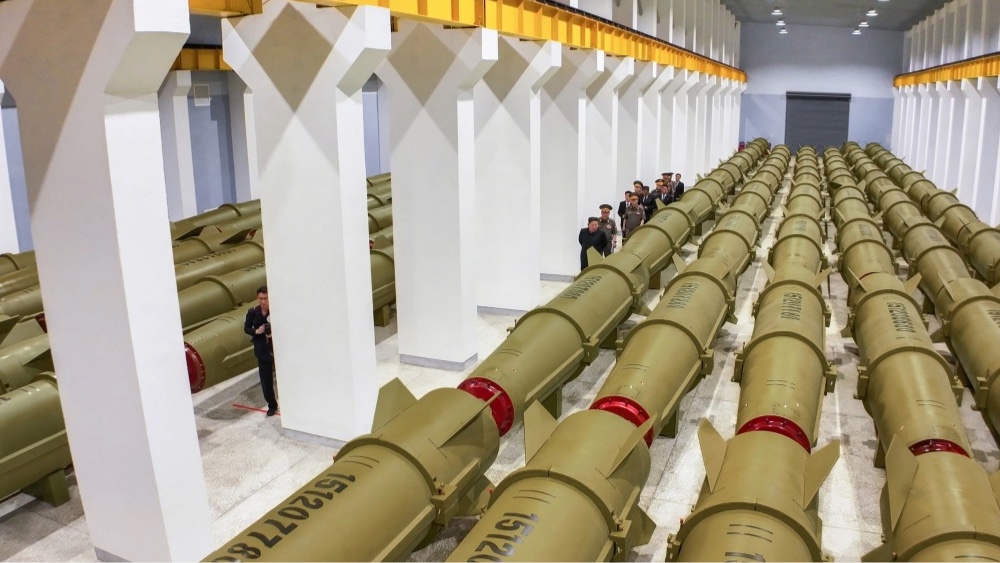
State-sanctioned violence and militarism form the foundation of the rejuvenated North Korea-Russia partnership, and that should shape how U.S. and South Korean alliance planners read the North’s tolerance for risk.
But the relationship lacks the dynamics of twenty-first-century alliances. North Korea and Russia share no ethnic or religious linkage, no common political system, and no joint economic vision. They do not trade goods and services to improve domestic living conditions, and they trade weapons, ammunition, and soldiers to destabilize regions. Both regimes accept far higher human costs than democratic governments do, which is the assumption that the United States and South Korea should carry into any contingency planning.
In his 2003 essay, political theorist Achille Mbembe explained the concept of necropolitics and said that “the ultimate expression of sovereignty resides, to a large degree, in the power and the capacity to dictate who may live and who must die.” Using necropolitics as a conceptual framework to explain the North Korea-Russia relationship allows us to see this partnership in a different light. Unlike the collective West, which traditionally upholds universal human rights and the rule of law, the North Korean and Russian regimes view these liberal values and principles as inherent weaknesses. The inability of Western publics to stomach high body counts in war and sacrifice economic stability for military needs is seen as a strategic opportunity for the dictatorships in Pyongyang and Moscow.
While Mbembe mainly uses necropolitics to explain the Israel-Palestine situation, extending this idea to diplomacy is a useful tool for explaining international partnerships, such as the North Korea-Russia relationship, that fall outside traditional definitions of alliance structures. The North Korea-Russia partnership is centered around facilitating the means and ends of warfare. With both nations on a permanent wartime footing, Kim Jong Un offers artillery shells, soldiers, and landmine sweepers to Vladimir Putin in exchange for military technology. The two nations send each other the tools and instruments of death. What makes this different from arms sales between democracies is the fact that this military-centered trade between Pyongyang and Moscow forms the core of this diplomatic partnership. While the United States may sell weapons systems to South Korea and vice versa, the two governments do not see those arms sales as the primary driver of the alliance.
Beyond the diplomatic realm, necropolitics defines North Korean and Russian domestic politics. Russian dissidents “accidentally” fall out of apartment windows or end up in Siberian gulags. Kim enlarges an already expansive political prison system and ruthlessly kills potential political rivals, including his half brother. Most of the people living in both North Korea and Russia would qualify under Mbembe’s category of the “living dead.” Malnourishment and the inability to escape precarious socioeconomic conditions characterize much of life in the rural regions of both countries. Moreover, the mandatory military conscription of North Korean and Russian men renders them as living in a “death world” where personal agency is taken away and their lives are at the whims of their commanders.
More than 350,000 Russian soldiers have died in Putin’s war against Ukraine. This gruesome statistic parallels Stalin’s disregard for human life during World War II. While many in Washington and Seoul see these body counts as a sign of Russian weakness in the war, it is useful to remember that dictators do not view humanity in a similar fashion. These illiberal necropolitical values, embraced by Pyongyang and Moscow, change the risk calculus on the Korean Peninsula.
While most pundits do not believe Kim would be foolish enough to launch a full-scale invasion of South Korea, it is still worthwhile to understand that the North approaches risk and the value of human life from an entirely different perspective. While South Korea has matured into a robust liberal democracy with strong institutions and rule of law, North Korea has descended into Kim’s personal fiefdom. With absolute control of party-state affairs, he willingly sacrificed thousands of his own soldiers for a conflict in a faraway European theater. It is therefore useful to consider that Kim might be willing to do something equally reckless on the Korean Peninsula to pursue his own goals.
The inability to understand the nature of the North Korean regime has long clouded analyses and assessments of the Kim family regime. Despite the opacity of North Korea’s inner workings, it is clear from defector testimony and human rights organization reports that Pyongyang has a radically different conception of the value of individual human life. Given this fact and Pyongyang’s history of reckless behavior, it is imperative that both Washington and Seoul prepare for wild and dangerous scenarios on the peninsula. While Kim is not an irrational figure, he operates from an entirely different vantage point that only a handful of other dictators in the world understand.
Benjamin R. Young is Non-resident Fellow at the Korea Economic Institute of America (KEI) and Assistant Professor of Intelligence Studies at Fayetteville State University. The views expressed here are the author’s alone.
This material is distributed by KEI on behalf of the Korea Institute for International Economic Policy. Additional information is available at the Department of Justice, Washington, DC.